Monday, October 05, 2015

Hail to the King Pt. 1- Creepshows

As I've written here before, Stephen King is the author I feel the most personally connected to. This basically means that whenever I pick up a new Stephen King book I feel like I am immediately on the book's wavelength. There's no settling in period where I have to get used to the book's rhythms, I'm simply engaged in the story from page one. Whatever Stephen King's authorial faults and missteps(which can be many), I still enjoy reading the work. I may finish a novel and walk away disappointed with the final result, but I'm never anything but completely satisfied while actually reading the thing. This rose-colored fondness for even his lesser output even extends, to a much much lesser extent, to the filmed version of Stephen King's work.

I don't think it's a particularly controversial statement to say that the majority of Stephen King movies range from mediocre to outright awful, with only the rare standout rising about good to great. I think his film's get an unnecessarily bad rap, however, simply from having his name attached. In truth anybody as prolific as he is, with studios as eager to churn out movies with his name attached(even if only tangentially, if anyone remembers the lawsuit over Lawnmower Man, which originally ran with Stephen King's name above the title until he complained that the actual movie only shared a title and nothing else with one of his short stories) is going to see their fair share of flops. So despite this supposed truism, Stephen King's name still graces several films a year, and just about everything he writes is optioned for film or television before it's even been published. I think it's worth noting, though, how few of those works are actually making it to theatres these days, and how many are finding homes on the relatively lower-risk world of television. Stephen King's name doesn't bring quite the financial security to film as it used to, though a quick trip to IMDB will show there are currently 23 projects in development based on his novels or short stories. To be fair, though, many of those appear to be the so-called Dollar Babies, stories that he will sell the movie rights to for $1 to student or beginning filmmakers with some tightly controlled rules about how the film is distributed. Also, many of the projects seem to be in development hell, with cast and crew signing on and dropping off at regular intervals. The golden age of Stephen King at the cinema have passed, and I have a radical belief as to the reason his works have so often failed to connect with audiences and critics; Stephen King himself.

There is a reason one of his most widely respected adaptations, The Shining, is a radical departure from the source material, while one of his most widely derided adaptations, the television version of The Shining, is slavishly devoted to the original words. Stephen King has a very distinct way with dialogue, a filthy patois of regional New England phrasing and speech patterns. Stephen King characters speak, at risk of being circular, like Stephen King characters. Not like anyone else. His characters speak in a way that no one on Earth actually does. It's distinctive and striking, and on the page it's enjoyable to read, but once you hear those words coming out of the mouths of real people, everything grinds to a halt. For this reason, whenever Stephen King gets personally involved in the production of a film(something that used to happen more often than it does these days), he requires a collaborator with a voice strong enough to be heard over King's, and a willingness to say 'no' to some of his more ridiculous tendencies.

Art by Berni Wrightson from the Creepshow graphic novel.

Or, in the case of Creepshow, a collaborator operating on a sympathetic frequency. It also helps that Creepshow's conceit- a collection of short vignettes inspired by and mimicking the old EC Comics- turns King's penchant for overdone dialogue into a strength instead of a weakness. With a script written entirely by King, and directed by George A. Romero, the film is basically a series of one-act Grand Guignol stories utilizing occasional visual flourishes designed to evoke panels from a comic book. The unity of the film, the way everything holds together, is a testament to just how simpatico the two masters were at the time. It was the beginning of the 80s, and Creepshow was the 4th of the eventual 19 full feature films based on Stephen King's books and stories within that decade. George Romero was coming hot off an unparalleled run of interesting, unique work in the 70s(Martin, Dawn of the Dead, and Knightriders were the three films leading up to this). While certain aspects of the film have aged poorly(some of the comic panel transitions feel a bit creaky, and Romero's often un-stylish directing style sometimes fails to complement the film's more chaotic tendencies), it remains a superior example of the horror anthology.

Anthology films are notoriously- one might say inevitably- hit or miss. Even the best anthologies can't quite please all people all the time, and will have one or two segments that are best forgotten. In that regard, Creepshow puts all other anthologies to shame, as there isn't really a bad story in the bunch(though of course I have my favorites). Perhaps it's the strong authorial voice from Stephen King, the consistent visual tone of the movie, or the clear template of one act, blackly comic, inventively gory morality plays. For whatever reason, Creepshow remains consistent throughout, and features a nice mix of types of story. Though the movie was directed entirely by Romero, each segment is edited by someone else, which gives the film a nicely varied pace. One story might go one for a little while, but then it'll be followed up by a quick, 5 minute short story about a man being devoured by alien fungus(The Lonesome Death of Jordy Verril, probably my favorite bit from the film). When the film is over, it does leave one with the feeling of having just read one of the old Tales From The Crypt or Weird Tales comics.


When it came time for the inevitable sequel, both of the creative minds behind the original decided to take one step back from their original roles, and the film greatly suffers for it. Stephen King steps back from screenwriter, serving only as the author of the original short stories(and as a truck driver in a quick cameo during the final story). George Romero steps back from directing to write the screenplay, and nothing else. Stepping up to direct is Michael Gornick, Romero's cinematographer on many of his best films. He had previously directed four episodes of the Romero-produced Tales From The Darkside television show, including one written by Stephen King, so he clearly had the chops to take over. But for whatever reason, the material fails to connect with audiences, and though the sequel has developed a bit of a following, it's clearly a lesser effort from the original. Less fun, less profane, and less idiosyncratic.

To be honest, I have a bit of leftover affection for the movie, which I was introduced to before seeking out the original. As a young teen I quite enjoyed Old Chief Wood'n Head, the opening story in the film. I liked the image of the wooden cigar-store Indian chief creakily and slowly seeking vengeance for the kindly old couple who owned the shop he stood in front of. I remember enjoying the animated segments, featuring Tom Savini voicing the Creep(this films version of the Cryptkeeper or Cousin Eerie). The third segment gave me a little salacious thrill at the opening sex talk as the callous bored housewife who kills a hitchhiker first haggles with the male prostitute who has just given her six- count 'em, six!- orgasms. And then, of course, there is the second segment, The Raft, which holds the distinction of being the only piece of filmed entertainment to give me a nightmare. I can still recall the nightmare, over 20 years on, and the feeling of terror as this inscrutable, smeary blob of oil came to me with unavoidable, inescapable intent. These days The Raft is usually the only part of the movie I'll sit down to watch. It's not so scary these days, but it still carries a strong dose of that original panic I felt when I first saw it. Plus the effects in it are stellar, and the quickly decomposing bodies as the sentient oil slick traps a quartet of unlucky swimmers still look disturbingly realistic.

Pure nightmare fuel.

I think the problem with the film is best explained by viewing the original Creepshow, and studying why it works so well. Creepshow one had 5 short stories of varying length of tone. Creepshow 2 has 3 stories, each about 25 minutes long, of strikingly similar pace and humor. The film also drops the comic book panel conceit, which it consigns to a few minutes of poorly animated interstitials between the actual shorts. These segments entertained me as a kid, but as an adult I can only notice how choppily animated they are, and how the character drawings change shockingly from shot to shot. The film is not the worst horror sequel, or even the worst anthology film, but it is fairly forgettable. It's no surprise that it took 20 years for an (unofficial) sequel(which I haven't yet seen) to slink its way onto the shelves of rapidly disappearing video stores.While I say the original Creepshow is showing it's age, it still remains unique. Creepshow 2 has not aged as poorly, but remains just as flat and boring as it did in 1987, though my 13 year old self would probably argue with me.

Saturday, October 03, 2015

Fabulous Frightening Firsts

People love firsts. They love commemorating them, recounting them, hearing about them, and reliving them. First date, first kiss, first concert, first dance,,, There is a rush that comes the first time you do anything new, and any good junkie will tell you that you never stop trying to match that original high. The same holds true for horror fans; we scour bookshelves for new authors, rifle through discount bins in seedy corners of video stores, scour through the less reputable corners of netflix, forcing ourselves to ignore the suggested rating of one-star or less. We pore over hours of forgettable(if we're lucky) trash in hopes of find something that will give us at least a taste of that original rush of fear. A couple of hours would be great, thank you. Every movie a horror fan watches is, in a way, an attempt to recapture the original childlike mix of terror and wonder that accompanied our first experience with the horrific and nightmarish.

The idea of writing about my first horror film came from a facebook, thread, where this sort of eternal nostalgia seems to comprise 85% of all posts(and I am as guilty as anyone else of perpetuating this). In a way this is a ridiculous idea, because there's no real way for me to verify my actual first horror film. Childhood memories fade, adapt, and shift in such a way that it can be hard to tell what order events happened in, or what you saw with your own eyes versus what other people told you. For the purposes of this post, however, we'll go ahead and say that my first ever horror film was John Carpenter's The Thing, which is at least the first horror movie I have a clear memory of watching. It is entirely possible that this is because the shocking impact on my young impressionable mind was so intense that it superseded all other horror movie memories. It is also possible, judging by the impact this film had on my childhood, that I had to relearn the alphabet after watching it.

If I'm being completely honest with you, my memories of this event are anything but crystal clear. It's more like a series of images and sensations with no real connective tissue. A mnemonic slideshow. I'm not even sure of my exact age at the time, so I'll stick with just the things I remember with pretty strong certainty.

I know I was between the ages of 5 and 8, because I was still going to school at Gladys Wood Elementary, and hadn't yet made the change to Chinook, which I started attending in the 4th grade. I know I watched it at a friend's house, though I do not remember the friend's name(although, strangely, I could give you directions to his house from just about anywhere in Anchorage). I'm fairly certain it was during summer vacation, because in my memory it is a bright sunny day, something I had occasion to view quite a bit as I quickly found the movie too much for my young, inexperienced psyche. I believe he had an older brother, although it could have been a cousin, either way there was an older boy in the house who had unfettered access to HBO while my friend's parents were at work. I don't think I saw the movie from the very beginning, because I remember being shocked years later at the pre-title spaceship scene at the very beginning. I believe I came into the movie just after the opening title, because I remember the ominous, minimalist bass line that accompanied the aerial shots of Antarctica as two Norwegian men hunt an escaping husky from a helicopter. Ennio Morricones' score is probably what haunts me the most from this film. More than the overwhelming dread, or the suffocating paranoia. More than the gore, or the crazy mutations. The score still gives me a brief vestigial urge to hide myself behind the couch whenever I rewatch the film and those opening moments begin.


I do not recall actually watching the film's first standout effects shot, when the rescued dog from the opening- which turns out to not really be a dog at all- kills a kennel full of canines in an explosion of alien appendages, mutated orifices and slimy projectile excretions. I feel like I must have made it at least this far, however, because I know that after this film I treated our family dog, of a similar breed to the one in the film, with a small measure of distrust. I was old enough to realize the film was not reality, but young enough that it still colored my perception of our dog. I knew he wasn't going to suddenly split into a writhing mass of tentacles and teeth, but it was hard to keep the thought out of my mind whenever I had to take him out to go to the bathroom. I believe it was sometime shortly after this, it must have been, that I ran silently from the room, feeling a cold hollow pit in my stomach. I didn't watch all of the movie in this sitting, but I did stay within ear shot. I sat at the top of the stairs, looking down to my friend's front door, in a position where I could hear the events on screen, but was able to control when I actually looked at the screen.


It may be hard to believe, considering how completely I adore all things horror to this day, but for years after The Thing I was almost entirely incapable of watching a horror movie in its entirety. I avoided them whenever possible, and hid behind the couch whenever I couldn't actually leave the room. The Thing had scarred me, badly, and I was in no hurry to recreate the situation. However, it had also sparked something in me at the same time. I had always been a bookish kid, constantly reading and re-reading whatever I could find. Throughout the ensuing years I gravitated to more and more 'spooky' material. I began reading books on witchcraft and cryptozoology(Unsolved Mysteries was a big influence on me, as well), voodoo and supernatural folklore. I checked out plenty of books about science fiction and horror movies(although at this time I was leaning more towards the sci-fi end of the spectrum) and pored over the photos and stills included. In the 6th grade I began reading actual horror novels, starting with Peter Benchley's Jaws(which was confiscated from me by a concerned teacher because it had a nude woman on the cover, though nothing was visible. It was essentially the famous poster of the lady swimming while the shark rises up from beneath), and quickly moving on to Stephen King and, very briefly, Dean Koontz. It wasn't until I was 12 or 13 that I actually began watching horror movies in earnest, as I began spending time with a group of cousins who had been raised on the nightmare worlds of Freddy Krueger and Jason Voorhees. And still I would say I merely dabbled in horror films. I watched them, sometimes through my fingers, while with my cousins, but I rarely if ever sought them out. That is, until 1991, when I first saw Clive Barker's horror/fantasy film Nightbreed, which completely won me over to the side of the monsters, and I've never looked back since.

To be continued....

Thursday, October 01, 2015

Let The Countdown Commence!

Ah, Autumn. The days are getting shorter, the leaves are changing color. Fireplaces are lit, snow begins crawling down the mountains, and the winds carry a nice, comfortable chill. The days are pleasantly bracing, but at night windows are shut against the gathering cold, as people turn their homes and apartments into personal caves in which they will pass the long dark winter in warmth and comfort.

Or, at least, those things would be happening were I still back home in Alaska. But now I'm in Southern California, where the leaves are only changing color to due lack of water, fireplaces are only lit to destroy evidence, and the winds carry the distinct feeling you get when you open an oven to check your meal. In general I do not miss Alaska, but the two month period of September and October are my favorite times of the year, not least because it leads up to the greatest holiday ever invented; Halloween. There are many things I love about Halloween, and many of them are forever linked in my mind with my upbringing in Alaska, where most years we would still be waiting for the first snow, and yet winter gear was often required for any real trick-or-treating. For that reason, trick-or-treating has seen a significant decline in recent years, as more and more parents opt for the comfort of indoor malls or Trick Or Treat Towns set up in high school gymnasiums. But those people are missing out, and it saddened me as year after year I would take my daughter Trick-Or-Treating and spend the entire night without seeing another child in costume. On the plus side; she got more candy from less houses than I ever saw in my childhood.

Feeling the holiday spirit in California can be a bit of a challenge, for many of the climate related reasons listed above. It can be hard to get into the creepy, spooky mindset when there isn't a cloud to be seen and temperatures are climbing up into the 90s. And so I must be a bit more proactive and determined in my celebrations. Fortunately, since I've moved down here, I've found gainful employment at Universal Studios, and this marks my second year working the Terror Tram attraction for Halloween Horror Nights. So that means that I get to spend four nights a week surrounded by men and women in gory costumes running around and scaring thrillseeking guests. And, I get to do this on the Bates Motel set, with Mother looking down from her window on the hill at all the excitement below. I don't get to go Trick-Or-Treating anymore, and a lot of my weekend horror viewing must take place in the middle of the afternoon before work, but I think it's a mighty fine tradeoff.


This year also sees me returning to The Countdown To Halloween blogathon, which I've passed on for the past couple years. This year I plan to make a full go of it, though, with as many posts as I can manage over the 31 October days and nights. To that end I've pulled aside plenty of creepy movies, books, comics, and music to form the background of my month, on top of several special events which I will be getting into later. The biggest part of my celebration will involve movie watching. Lots and lots of movie watching. In years past I've planned out certain films to watch, but this year I'm playing things a little looser. With hulu, netflix, amazon prime, and the local library, I have more access to movies than I have in quite awhile, and I'm pretty much going with what appeals to me at the moment. A couple of patterns have already appeared, though. I started my movie watching in earnest on September 18th, to coincide with the first Horror Night, and this year seems to be the Year of the Vampire, as well as the Year of the Franchise. Through a combination of happenstance and planning, I've seen a handful of vampire movies over the past couple weeks, and I'm planning on continuing that trend with viewings of the Universal Dracula sequels, as well as some of the Hammer sequels(of which I've only seen the first). I'm also going to run through a few series, most notably Creature From The Black Lagoon(only three films, so not incredibly difficult to squeeze in), and the Nightmare on Elm Street series. I plan, this year, to have a healthy mix of classic and obscure, new and old, favorites and new-to-me, and a concerted effort to watch some of the big titles that have thus far eluded me. Although 'big titles' might be a misnomer, as so far that has amounted to Cujo and the two Blacula Films.

On the book front, I'm reading the first of the official Nightmare on Elm Street novels. I was gifted an omnibus of three novels several years ago and am only not getting around to reading them. I also plan on reading through a bunch of Lovecraft's short stories, to complement my reading of Providence, Alan Moore's epic treatise on Lovecraft's interconnected mythos. I'm also leaving myself open to whatever might come up during the month, as I may find some hidden gem during one of my weekly trips to the library. As for music, well, my ipod has already become infested with soundtracks and morbid music of all varieties. The surf-rock spook of Satan's Pilgrims or The Bomboras, the prog-rock tinged nightmares of frequent Argento collaborators Goblin, and everything in between.

So yes, this Halloween proves to be a very busy one, full of work and celebration, both of which seem to be interconnected at times. I would also suggest to many people to click on the little Frankenstein mask up in the upper right corner of my blog. That will take you to the Countdown To Halloween blog(you could just click that link, as well), and I encourage you to search around in the list of participants. I haven't had the chance yet, but I plan on scouring through there, but it would be nice of you to give it a glance. We're all going to do our best to make the season a blast for everyone, and I'm hoping you'll come along with me for it.

Wednesday, September 30, 2015

Summer of Darkness: Cornered(1945)


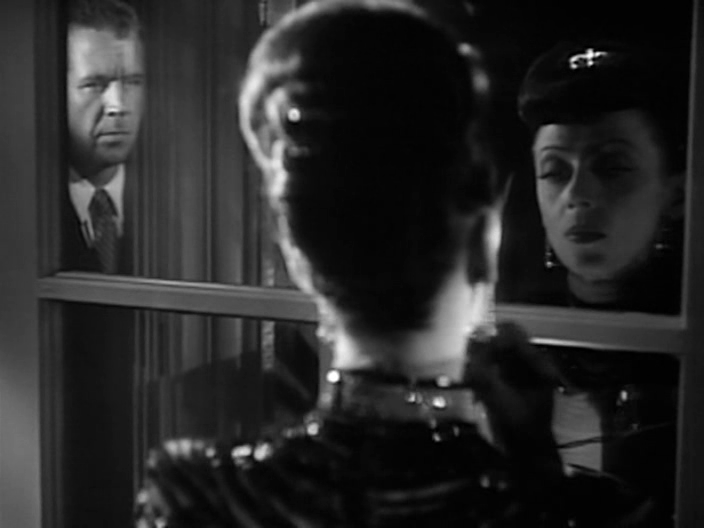
So here we are with another brain addled hero thrust into a plot that would be complex even to someone completely control of their faculties. Dick Powell dipped into this arena for a few sequences in Murder, My Sweet, but here he's left adrift for the entire movie, suffering from a brain injury that's causing frequent headaches, confusion, and, it's implied, increased hostility.

A lot of noir films were inspired by the tumult of WWII, but Cornered addresses this worldwide crisis of conscience more directly than most, dealing specifically with post-war France and the hunt for Nazi war criminals. The opening acts of the film take place in the grimy bombed out ruins of postwar France, while the bulk of the story takes place in the more tropical and civilized-seeming climes of South America, where many Nazis have emigrated to hide out.

Dick Powell, recently discharged from the military for medical reasons(the aforementioned head injury) sneaks back into France with the intention of finding his wife's murderer. She was a French resistance fighter, one of many executed and left in a mass grave. His search puts him on the trail of Jarnac, a mysterious man whom few have seen, and that official documents say is dead. Powell believes otherwise and coerces his resistance contacts into helping him track Jarnac to Brazil.


Dick Powell is presented as a man so damaged by the war, physically & mentally, that he only has room in his mind for one idea; to kill Jarnac. He's a bull in a china shop that's already been devastated. His quest threatens to destroy whatever might still be standing in a world that's already fallen apart. In France his old resistance comrades are wary of helping him, or at the very least do not have the time to spare. Their fight has moved from the literal battlegrounds of the war to the less glamorous bureaucratic arena of nation building. He wants to kill one man as revenge for his wife's murder, his old allies are concerned with infrastructure and squabbles over livestock, the day to day business of returning a sense of normalcy. The latter half of the film follows Powell as he tries to ferret out the mysterious Jarnac in South American high society. His presence in South America is just as much of a disruption as it was in France, as his quest disrupts not only glitzy parties, but the more organized attempts of officials to bring Nazis to justice. The officials desperately need Jarnac alive, to lead them to the countless other Nazis in hiding, while Powell merely wants him dead.

And therein lies the radical message within Cornered; that your instinct for revenge is wrong. Powell's satisfaction comes at the cost of finding justice for thousands of others, many of whom have suffered worse than he has. In fact, the moment of revenge goes unnoticed by Powell, who, in a shockingly brutal scene, slips into a fugue state while pummeling Jarnac's face. As he comes to, he doesn't realize what he's done, is convinced he merely knocked Jarnac unconscious. There is a quickly discovered happy ending to the film, as an alternate route to Jarnac's comrades is found, but this doesn't quite obscure the message; revenge is a hollow pursuit, even when the crime is as great as it was in WWII. Justice is much harder, but an overall healthier choice. It's a lesson Powell learns too late, but one that, the film hopes, the world will take to heart.

Tuesday, September 29, 2015

Summer of Darkness: This Gun For Hire(1942)

All I can say after watching This Gun For Hire is 'wow, that was entirely unexpected.' This film belongs to a genre that, before today, I believed to be a more modern invention; that of the stoic, lonesome, highly professional killer with his own strong code of ethics. Alan Ladd in this film belongs to the same class of criminal as Alain Delon in Le Samourai, Jean Reno in The Professional, or even Ryan Gosling in Drive. Men who do their jobs with a minimum of fuss, speak almost never, and live fastidious, carefully constructed private lives. Made a half decade later, I could see Michael Mann having a field day with this material.

This Gun For Hire takes that archetype and drops him unsuspecting into a plot involving a corrupt millionaire selling poison gas to the Japanese, a nightclub performer hired by a US senator to spy on her boss, and a payroll robbery of thousands in $10 bills. It sounds like a lot to keep track of, but the movie itself flows smoothly from scene to scene. As complex as the plot sounds on paper, it remains easy to understand in execution. Many subplots will disappear from the film for long stretches of time, leading to several thrilling scenes where the various threads meet up suddenly and then drift apart. There are a lot of moving parts, and This Gun For Hire keeps track of them in an admirably clear and concise manner.


The film isn't so much about the various plot machinations, anyway. Most of them turn out to be McGuffins, anyway, existing primarily to put the plot in motion and make sure various characters are in the right place at the right time. Instead, the film is more about the strains both mental and physical that the jobs of subterfuge and murder place on people. The characters in This Gun For Hire are all compromised and damaged, more by the lies they are forced to tell than by the bullets that frequently fly by. Veronica Lake risks her life and, more importantly, her love by what she has to do in the name of national security. Alan Ladd gives a speech late in the film that explains how a man could kill people for a living, but it's an unnecessary scene. The speech exists primarily for Verona Lake's benefit, to give her a reason to sympathize with the man. We the audience could tell by his actions, his closed off, suspicious, hostile-yet-sorrowful demeanor that someone got to him and hurt him at a very young age.

This Gun For Hire is not really a noir film, at least not in the way we normally think of the genre. It's more like a spy film seen through a noir-ish filter. There are plenty of signifiers held in common with noir. It's no coincidence that many scenes, including a long, defining standoff where Ladd tells Lake his story, is set within a train yard. Those tracks pop up again and again in noir films, always offering the illusion of escape while providing nothing but a preordained trip to your final destination. As Ladd determinedly seeks for revenge on his employer, he finds himself barrelling towards a familiar nihilistic end.


Tuesday, July 21, 2015

Summer of Darkness Extra Credit: British Noir

It's very hard to find an image for this phrase not from a vampire movie.
As anyone reading this probably knows, I've been taking part in TCM's Summer of Darkness online course, which is the impetus for all of the movie writing I've been doing lately. The suggested viewing list comprises 121 films which will be shown in rather large marathons every Friday this summer. I've seen many of these films previously, but the majority have been new to me. I'm doing my best to catch up with as many of them as possible, yet eventually it will be impossible to get to them all this summer. More of an impediment than time constraints(which is in short supply as I try to fit moving viewing, reading, and writing between shifts at work) is the fact that I no longer have cable, or access to TCM in order to watch these marathons. Various online sources, and the public library, have been very helpful in this regard, but even they only help out so much. In order to supplement this project, and expand my overall understanding of the subject matter, I've taken to watching films noir not on the list when the opportunity presents itself. Hence, today's extra credit films, The Slasher and Twilight Women, taken from a DVD set of British film noir.

Honestly, calling either of today's films 'noir' is a bit of a stretch, and most likely a marketing ploy on the part of distributors VCI Entertainment, seeking a marketable hook with which to combine two 'social problem' melodramas based on stage plays. In point of fact, neither film is accurately titled on the DVD case; Twilight Women is actually Women of Twilight, according to the opening credits, and The Slasher was originally titled Cosh Boy, information that would certainly help anyone confused as to why no one in the film is slashed. From here on in, I will be referring to both films by their original titles.

Women of Twilight opens like a standard noir film, albeit one with a more pronounced feminine focus. After a credits sequence showcasing closeups of the main female characters, the film centers in on Vivianne(Rene Ray) dozing in a livingroom chair when she's awakened by two mysterious men knocking on the door. We never see the men, but she's clearly expecting trouble, for she shuts off the lights and sneaks out the backdoor. Vivianne meets up with her boyfriend, a nightclub singer whose apartment she was residing in. He admits to having killed someone, and is promptly hauled off by the police.

At this point, I thought I had the film pretty much figured out; Vivianne would begin investigating the murder while her boyfriend inched closer and closer to being executed. She'd discover some outrageous coincidence that proves her boyfriend was somehow innocent, just in time for a happy reunion at the end of the film. I could not have been more wrong. Women of Twilight drops its noir trappings as Vivianne finds a new home in a crowded boarding house, a haven for unwed mothers and other disgraced women(which Vivianne now is, since the press has prominently focused on her as the murderers live-in lover) who can find nowhere else to go. We even get a new main character in Chris Ralston, an unwed recent mother whose fiancee is working abroad. She can afford better lodgings, but in London in the 50s, her options would have been rather limited. A shared room in a crowded flat is pretty much the only thing available to her.

The most positive thing I can say about Women of Twilight is that, following so much misogyny in American noirs, it was refreshing to encounter a film this pro-feminism. It's not so much that the female characters in this film are all strong and capable- in fact most of them are depicted in rather unflattering lights- but that the film seems critical of the patriarchal social rules that have places all of these women in such desperate circumstances. The human villain of Women of Twilight is Nellie Alistair, who hides behind her false compassion as she works to keep these women marginalized and reliant on what she assure them is her selfless charity. In actuality, the real villain of the movie is the puritanical view of women that keeps these characters desperate and miserable.

The worst thing I can say about Women of Twilight is that it wallows in the miserablism of its subject matter. It's bleak almost to the point of caricature, and a quick rundown of the tragedies both minor and major suffered in this film would lead to chuckles rather than gasps. Petty theft, domestic violence, physical assaults on pregnant women, and crib death, just to name a few. The unceasing onslaught of unpleasantness eventually becomes numbing, so that it becomes neither enjoyable to watch, nor emotionally affecting.


That same sense of bleakness, endemic to a lot of British post-war art, is also present in Cosh Boy(a cosh is a British term for a bludgeon, or a blackjack), though not to the same heightened levels. The noir elements, conversely, are more prevalent in this film, though they're still very minor. Cosh Boy is, actually, a juvenile delinquency picture, just this side of being labeled an exploitation flick. The film follows Roy, the leader of a teenage gang who regularly bludgeon old women for their pocket change. Sentenced to probation for one such crime early in the film, Roy and his gang merely work out how to use the youth center they must volunteer at as a cover for further criminal acts.

Cosh Boy shares with Women of Twilight a sense of civic duty. Roy, the human villain of the piece, is meant to be a totem for a perceived societal ill, albeit one almost directly at odds with that of Women of Twilight. In Cosh Boy the societal ill isn't patriarchal, puritanical moral codes, the societal ill is that we aren't following those codes closely enough. In every example the film gives, the cause of teenage delinquency is lack of a father figure. Every member of the gang comes from a broken home, where, in most cases, the father was killed in the war. In Cosh Boy, no matter how well-meaning the mothers are, they can't do the job themselves without the aid of a man. A major subplot of the film concerns Canadian Bob Stevens' desire  to marry Roy's mother, apparently out of a desire to fix Roy. His repeatedly stated goal is to wed Roy's mother so that he will be able to give Roy the physical beatings he should have been receiving daily like any upstanding member of society.

A young Joan Collins makes a very early film appearance as the sister of one of Roy's gang, back from boarding school. She's a very proper girl when we meet her, and Roy takes an instant liking to her. The film features one of those distasteful rape scenes from the 50s where the woman clearly doesn't want to have sex, but then at the last minute changes her mind. I think it's done in an effort to get past the censors(the stage play apparently was more explicit), but it's still a bit offputting. The film also features one of the most subtly vile visual metaphors for sex I've ever seen, as it cuts from a shot of the two embracing to a shot from within an alleyway where a sudden wind is blowing trash and detritus out into the streets. The sickness within Roy is spreading to proper, upstanding London society.

The deductive viewer will probably guess where this subplot is going, and sure enough, Rene becomes pregnant. When she reveals this to Roy, and informs him they must get married, he blows her off. Learning his mother has married Bob Stevens, Roy then plans and carries out a heist of the club that Bob works at, where he accidentally shoots a man in the course of the robbery. This is too much for the rest of his gang, who decide that they'll cut their losses and take whatever punishment is coming to them. Most of them are underage, anyway, and unlikely to face any serious penalty.

The end of the film finds Roy locked in his bedroom while an angry mob of women come for him after Rene attempts suicide, in which the baby is miscarried. Bob Stevens comes in, and removes his belt in order to 'thrash' Roy before the police come for him. This finale is a bit odd, as it attempts to add a humorous punchline to a film that has featured bludgeonings, rapes of underage girls, and subsequent miscarriages. As Bob is about to beat Roy, the police come in to arrest him. Seeing the belt, they announce they'll be back in ten minutes, and leave the apartment to the sound of Roy's screams as the crowd of women outside look on with approving smiles. The film attempts to convince us that regular abuse of children is enough to keep them on the straight and narrow, which doesn't ring true, as Roy's right hand man in the gang lived in a home where he was clearly beaten every day. Perhaps it has to be a man doing the beating, as a woman would simply send the wrong message.

In Women of Twilight the noir elements disappear from the film entirely after the opening scenes, and in Cosh Boy they pop up only occasionally. Both films have a nihilistic streak, and certainly many noir films have their share of bleakness. But in noir the bleakness is more baroque, the shadows heighten the theatricality of the scenes, while here they just pull everything down. In these two films the nihilism is earthier, more mundane and more terrible for it. Although the noir elements are muted, it's possible to see the smudged fingerprints of noir on the films, though I wouldn't make them required viewing for any but the most devoted acolytes of the genre.

Saturday, July 18, 2015

Summer of Darkness: Tension(1949)

Well, it was bound to happen eventually. At least a few of the films in this summer-long project had to be duds. It's not that Tension is a complete failure, or even without merit. The plot holds promise, the direction is competent, and there are some interesting moments throughout, but the film is just so remarkably ill-conceived in it' execution that I was never quite sure whether I should be laughing or rolling my eyes. The tone veers wildly from one extreme to another, and never seems to hit a comfortable note.

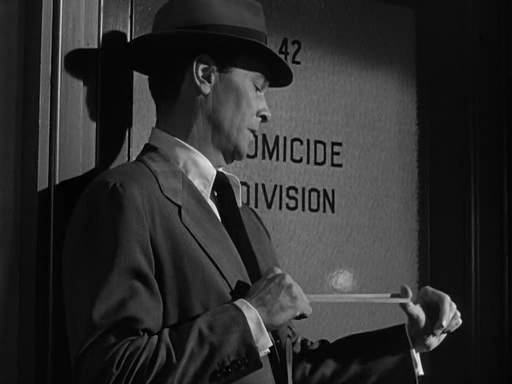
The film opens with Police Lieutenant Collier Bonnabel(Barry Sullivan) talking through his process on the job, how he gets criminals to crack during interrogations by carefully reading their body language and expertly applying various types of pressure. This prologue is all done with Lt. Bonnabel speaking directly to the audience, and to make the metaphor clear, he's pointedly fidgeting with a rubber band the entire time. As he reaches the climactic moment in his speech, Lt. Bonnabel snaps the rubber band, letting us know what always happens to criminals who happen to cross him. This scene is, to put it bluntly, ludicrously overwritten. The speech sounds like someone trying to come across as a two-fisted pulp hero when in actuality he's never been out from behind a desk. There's no authenticity here, and everything is incredibly on-the-nose. Then the prologue is over, and we enter the story proper, still with Lt. Bonnabel narrating. He pops up here and there to provide narration, which does little beyond describe what we see on the screen.


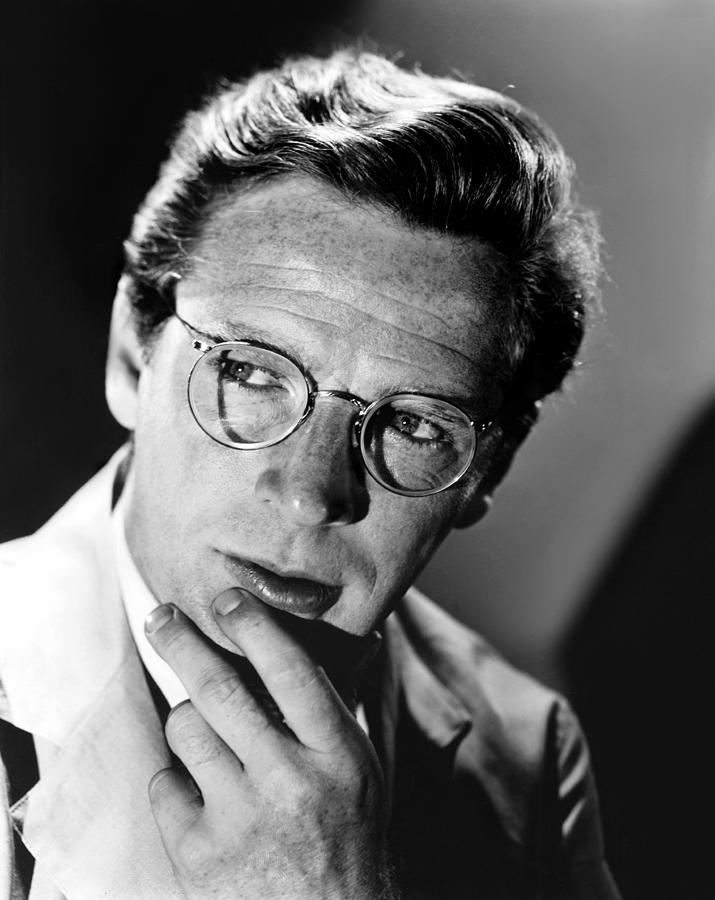
Richard Baseheart plays Warren Quimby, a pharmacist whose entire life is devoted to the idea of pleasing his wife, Claire(Audrey Totter). He works the graveyard shift for 12 hours a night to save up to buy a house, but his wife would rather spend the money on expensive perfumes while they live in the city where she can enjoy the nightlife. That Claire has a tendency to step out on Warren is no secret; Claire blatantly flirts with men she meets in the Pharmacy, and Lt. Bonnabel's narration relates the fear Warren faces every morning, never knowing if he'll return to find his wife in bed, or still out from the night before. Warren is comically milquetoast, in his pharmacist's smock, wearing glasses designed for optimal nerdiness. He can only whine at his wife as she pushes him around and propositions men in front of him.

Eventually Claire leaves him for a wealthier man named Barney Deager(Lloyd Gough), and Warren begins to fall apart. He goes to try and reclaim his wife, only to be beaten on the beach by his wife's lover, in a scene with all of the dramatic weight of a body-building ad from the back pages of a comic book. The jerk even steps on his glasses and kicks sand on him.

A trip to the optometrist, and the discovery of contact lenses, gives 'our hero' Warren the brilliant idea to concoct a new, secondary identity, one with perfect vision. A scapegoat for the police to pin the murder on once he kills his wife's lover. To this end, Warren rents an apartment in this new identity's name, makes himself visible to his neighbors in this new guise, and leaves threatening messages for Barney care of his new identity. All while also working 12 hour shifts at the pharmacy and maintaining his regular life, of course.

I'm discussing the nuts and bolts of the plot in much more detail than I normally do, and in my notes I still have another couple paragraphs to go, so I'm going to just cut right through it with some fastpaced recap. Warren meets a beautiful neighbor, and has second thoughts about murdering Barney, but still sets out to complete what he started. This is probably the best scene in the film. The writing and acting in this scene finally hit the same wavelength, and the lighting and staging capture the scene in striking shadow-filled images. It's a bright spot at odds with the rest of the movie. Warren never goes through with it, and he rushes out to excitedly propose marriage to his new girlfriend. But first: another complication! Barney ends up dead anyway, and now the police are seeking his alternate identity, the one that wants to get married. Enter Lt. Bonnabel, finally appearing on screen after narrating a ton of stuff he was not there for.


The plot doesn't really get any easier to swallow here. It takes the cops an incredibly long time to realize that Warren and their murder suspect are the same person, even though they have a rather large, clear photo of the suspect. The simple fact that he's not wearing glasses in the photo is enough to trip up the homicide detectives for a laughably long time. A lot of my problems with Tension arise from the character of Lt. Bonnabel, whose prologue gives the film an unintentionally cheesy vibe, like an Ed Wood film without the personality. His voiceover pops up randomly throughout the film, which is supposed to make this seem like notes from a casefile, but actually makes him seem like a voyeuristic outsider. It somehow gets worse once he actually enters the film as an actual character. His actions never seem professional or realistic, and he comes across as deeply, deeply creepy. He begins an affair with Warren's wife, and while it's later revealed that this was a ploy to get her to spill the beans, it never feels appropriate. The fact that he's apparently sleeping with Claire never actually plays into how she's caught, and feels like yet another chance for the film to humiliate Warren. This isn't Sam Spade allowing himself to be seduced to crack a case, this is like Joe Friday feeling up some hippy chicks before busting them for possession. It's uncomfortably sleazy.


As I've said, Tension is competently made, with flashes of what could have been a much better movie. If the movie had leaned harder into the cartoonish elements, it could have been a gonzo black comedy. Likewise if it had sustained the noir greatness of the scene where Warren decides not to kill Barney, it could have been an undiscovered classic of the genre. As it is, the film feels like a jumble of styles that never really mesh together.