Showing posts with label Summer of Darkness. Show all posts

Wednesday, September 30, 2015

Summer of Darkness: Cornered(1945)


So here we are with another brain addled hero thrust into a plot that would be complex even to someone completely control of their faculties. Dick Powell dipped into this arena for a few sequences in Murder, My Sweet, but here he's left adrift for the entire movie, suffering from a brain injury that's causing frequent headaches, confusion, and, it's implied, increased hostility.

A lot of noir films were inspired by the tumult of WWII, but Cornered addresses this worldwide crisis of conscience more directly than most, dealing specifically with post-war France and the hunt for Nazi war criminals. The opening acts of the film take place in the grimy bombed out ruins of postwar France, while the bulk of the story takes place in the more tropical and civilized-seeming climes of South America, where many Nazis have emigrated to hide out.

Dick Powell, recently discharged from the military for medical reasons(the aforementioned head injury) sneaks back into France with the intention of finding his wife's murderer. She was a French resistance fighter, one of many executed and left in a mass grave. His search puts him on the trail of Jarnac, a mysterious man whom few have seen, and that official documents say is dead. Powell believes otherwise and coerces his resistance contacts into helping him track Jarnac to Brazil.


Dick Powell is presented as a man so damaged by the war, physically & mentally, that he only has room in his mind for one idea; to kill Jarnac. He's a bull in a china shop that's already been devastated. His quest threatens to destroy whatever might still be standing in a world that's already fallen apart. In France his old resistance comrades are wary of helping him, or at the very least do not have the time to spare. Their fight has moved from the literal battlegrounds of the war to the less glamorous bureaucratic arena of nation building. He wants to kill one man as revenge for his wife's murder, his old allies are concerned with infrastructure and squabbles over livestock, the day to day business of returning a sense of normalcy. The latter half of the film follows Powell as he tries to ferret out the mysterious Jarnac in South American high society. His presence in South America is just as much of a disruption as it was in France, as his quest disrupts not only glitzy parties, but the more organized attempts of officials to bring Nazis to justice. The officials desperately need Jarnac alive, to lead them to the countless other Nazis in hiding, while Powell merely wants him dead.

And therein lies the radical message within Cornered; that your instinct for revenge is wrong. Powell's satisfaction comes at the cost of finding justice for thousands of others, many of whom have suffered worse than he has. In fact, the moment of revenge goes unnoticed by Powell, who, in a shockingly brutal scene, slips into a fugue state while pummeling Jarnac's face. As he comes to, he doesn't realize what he's done, is convinced he merely knocked Jarnac unconscious. There is a quickly discovered happy ending to the film, as an alternate route to Jarnac's comrades is found, but this doesn't quite obscure the message; revenge is a hollow pursuit, even when the crime is as great as it was in WWII. Justice is much harder, but an overall healthier choice. It's a lesson Powell learns too late, but one that, the film hopes, the world will take to heart.

Tuesday, September 29, 2015

Summer of Darkness: This Gun For Hire(1942)

All I can say after watching This Gun For Hire is 'wow, that was entirely unexpected.' This film belongs to a genre that, before today, I believed to be a more modern invention; that of the stoic, lonesome, highly professional killer with his own strong code of ethics. Alan Ladd in this film belongs to the same class of criminal as Alain Delon in Le Samourai, Jean Reno in The Professional, or even Ryan Gosling in Drive. Men who do their jobs with a minimum of fuss, speak almost never, and live fastidious, carefully constructed private lives. Made a half decade later, I could see Michael Mann having a field day with this material.

This Gun For Hire takes that archetype and drops him unsuspecting into a plot involving a corrupt millionaire selling poison gas to the Japanese, a nightclub performer hired by a US senator to spy on her boss, and a payroll robbery of thousands in $10 bills. It sounds like a lot to keep track of, but the movie itself flows smoothly from scene to scene. As complex as the plot sounds on paper, it remains easy to understand in execution. Many subplots will disappear from the film for long stretches of time, leading to several thrilling scenes where the various threads meet up suddenly and then drift apart. There are a lot of moving parts, and This Gun For Hire keeps track of them in an admirably clear and concise manner.


The film isn't so much about the various plot machinations, anyway. Most of them turn out to be McGuffins, anyway, existing primarily to put the plot in motion and make sure various characters are in the right place at the right time. Instead, the film is more about the strains both mental and physical that the jobs of subterfuge and murder place on people. The characters in This Gun For Hire are all compromised and damaged, more by the lies they are forced to tell than by the bullets that frequently fly by. Veronica Lake risks her life and, more importantly, her love by what she has to do in the name of national security. Alan Ladd gives a speech late in the film that explains how a man could kill people for a living, but it's an unnecessary scene. The speech exists primarily for Verona Lake's benefit, to give her a reason to sympathize with the man. We the audience could tell by his actions, his closed off, suspicious, hostile-yet-sorrowful demeanor that someone got to him and hurt him at a very young age.

This Gun For Hire is not really a noir film, at least not in the way we normally think of the genre. It's more like a spy film seen through a noir-ish filter. There are plenty of signifiers held in common with noir. It's no coincidence that many scenes, including a long, defining standoff where Ladd tells Lake his story, is set within a train yard. Those tracks pop up again and again in noir films, always offering the illusion of escape while providing nothing but a preordained trip to your final destination. As Ladd determinedly seeks for revenge on his employer, he finds himself barrelling towards a familiar nihilistic end.


Tuesday, July 21, 2015

Summer of Darkness Extra Credit: British Noir

It's very hard to find an image for this phrase not from a vampire movie.
As anyone reading this probably knows, I've been taking part in TCM's Summer of Darkness online course, which is the impetus for all of the movie writing I've been doing lately. The suggested viewing list comprises 121 films which will be shown in rather large marathons every Friday this summer. I've seen many of these films previously, but the majority have been new to me. I'm doing my best to catch up with as many of them as possible, yet eventually it will be impossible to get to them all this summer. More of an impediment than time constraints(which is in short supply as I try to fit moving viewing, reading, and writing between shifts at work) is the fact that I no longer have cable, or access to TCM in order to watch these marathons. Various online sources, and the public library, have been very helpful in this regard, but even they only help out so much. In order to supplement this project, and expand my overall understanding of the subject matter, I've taken to watching films noir not on the list when the opportunity presents itself. Hence, today's extra credit films, The Slasher and Twilight Women, taken from a DVD set of British film noir.

Honestly, calling either of today's films 'noir' is a bit of a stretch, and most likely a marketing ploy on the part of distributors VCI Entertainment, seeking a marketable hook with which to combine two 'social problem' melodramas based on stage plays. In point of fact, neither film is accurately titled on the DVD case; Twilight Women is actually Women of Twilight, according to the opening credits, and The Slasher was originally titled Cosh Boy, information that would certainly help anyone confused as to why no one in the film is slashed. From here on in, I will be referring to both films by their original titles.

Women of Twilight opens like a standard noir film, albeit one with a more pronounced feminine focus. After a credits sequence showcasing closeups of the main female characters, the film centers in on Vivianne(Rene Ray) dozing in a livingroom chair when she's awakened by two mysterious men knocking on the door. We never see the men, but she's clearly expecting trouble, for she shuts off the lights and sneaks out the backdoor. Vivianne meets up with her boyfriend, a nightclub singer whose apartment she was residing in. He admits to having killed someone, and is promptly hauled off by the police.

At this point, I thought I had the film pretty much figured out; Vivianne would begin investigating the murder while her boyfriend inched closer and closer to being executed. She'd discover some outrageous coincidence that proves her boyfriend was somehow innocent, just in time for a happy reunion at the end of the film. I could not have been more wrong. Women of Twilight drops its noir trappings as Vivianne finds a new home in a crowded boarding house, a haven for unwed mothers and other disgraced women(which Vivianne now is, since the press has prominently focused on her as the murderers live-in lover) who can find nowhere else to go. We even get a new main character in Chris Ralston, an unwed recent mother whose fiancee is working abroad. She can afford better lodgings, but in London in the 50s, her options would have been rather limited. A shared room in a crowded flat is pretty much the only thing available to her.

The most positive thing I can say about Women of Twilight is that, following so much misogyny in American noirs, it was refreshing to encounter a film this pro-feminism. It's not so much that the female characters in this film are all strong and capable- in fact most of them are depicted in rather unflattering lights- but that the film seems critical of the patriarchal social rules that have places all of these women in such desperate circumstances. The human villain of Women of Twilight is Nellie Alistair, who hides behind her false compassion as she works to keep these women marginalized and reliant on what she assure them is her selfless charity. In actuality, the real villain of the movie is the puritanical view of women that keeps these characters desperate and miserable.

The worst thing I can say about Women of Twilight is that it wallows in the miserablism of its subject matter. It's bleak almost to the point of caricature, and a quick rundown of the tragedies both minor and major suffered in this film would lead to chuckles rather than gasps. Petty theft, domestic violence, physical assaults on pregnant women, and crib death, just to name a few. The unceasing onslaught of unpleasantness eventually becomes numbing, so that it becomes neither enjoyable to watch, nor emotionally affecting.


That same sense of bleakness, endemic to a lot of British post-war art, is also present in Cosh Boy(a cosh is a British term for a bludgeon, or a blackjack), though not to the same heightened levels. The noir elements, conversely, are more prevalent in this film, though they're still very minor. Cosh Boy is, actually, a juvenile delinquency picture, just this side of being labeled an exploitation flick. The film follows Roy, the leader of a teenage gang who regularly bludgeon old women for their pocket change. Sentenced to probation for one such crime early in the film, Roy and his gang merely work out how to use the youth center they must volunteer at as a cover for further criminal acts.

Cosh Boy shares with Women of Twilight a sense of civic duty. Roy, the human villain of the piece, is meant to be a totem for a perceived societal ill, albeit one almost directly at odds with that of Women of Twilight. In Cosh Boy the societal ill isn't patriarchal, puritanical moral codes, the societal ill is that we aren't following those codes closely enough. In every example the film gives, the cause of teenage delinquency is lack of a father figure. Every member of the gang comes from a broken home, where, in most cases, the father was killed in the war. In Cosh Boy, no matter how well-meaning the mothers are, they can't do the job themselves without the aid of a man. A major subplot of the film concerns Canadian Bob Stevens' desire  to marry Roy's mother, apparently out of a desire to fix Roy. His repeatedly stated goal is to wed Roy's mother so that he will be able to give Roy the physical beatings he should have been receiving daily like any upstanding member of society.

A young Joan Collins makes a very early film appearance as the sister of one of Roy's gang, back from boarding school. She's a very proper girl when we meet her, and Roy takes an instant liking to her. The film features one of those distasteful rape scenes from the 50s where the woman clearly doesn't want to have sex, but then at the last minute changes her mind. I think it's done in an effort to get past the censors(the stage play apparently was more explicit), but it's still a bit offputting. The film also features one of the most subtly vile visual metaphors for sex I've ever seen, as it cuts from a shot of the two embracing to a shot from within an alleyway where a sudden wind is blowing trash and detritus out into the streets. The sickness within Roy is spreading to proper, upstanding London society.

The deductive viewer will probably guess where this subplot is going, and sure enough, Rene becomes pregnant. When she reveals this to Roy, and informs him they must get married, he blows her off. Learning his mother has married Bob Stevens, Roy then plans and carries out a heist of the club that Bob works at, where he accidentally shoots a man in the course of the robbery. This is too much for the rest of his gang, who decide that they'll cut their losses and take whatever punishment is coming to them. Most of them are underage, anyway, and unlikely to face any serious penalty.

The end of the film finds Roy locked in his bedroom while an angry mob of women come for him after Rene attempts suicide, in which the baby is miscarried. Bob Stevens comes in, and removes his belt in order to 'thrash' Roy before the police come for him. This finale is a bit odd, as it attempts to add a humorous punchline to a film that has featured bludgeonings, rapes of underage girls, and subsequent miscarriages. As Bob is about to beat Roy, the police come in to arrest him. Seeing the belt, they announce they'll be back in ten minutes, and leave the apartment to the sound of Roy's screams as the crowd of women outside look on with approving smiles. The film attempts to convince us that regular abuse of children is enough to keep them on the straight and narrow, which doesn't ring true, as Roy's right hand man in the gang lived in a home where he was clearly beaten every day. Perhaps it has to be a man doing the beating, as a woman would simply send the wrong message.

In Women of Twilight the noir elements disappear from the film entirely after the opening scenes, and in Cosh Boy they pop up only occasionally. Both films have a nihilistic streak, and certainly many noir films have their share of bleakness. But in noir the bleakness is more baroque, the shadows heighten the theatricality of the scenes, while here they just pull everything down. In these two films the nihilism is earthier, more mundane and more terrible for it. Although the noir elements are muted, it's possible to see the smudged fingerprints of noir on the films, though I wouldn't make them required viewing for any but the most devoted acolytes of the genre.

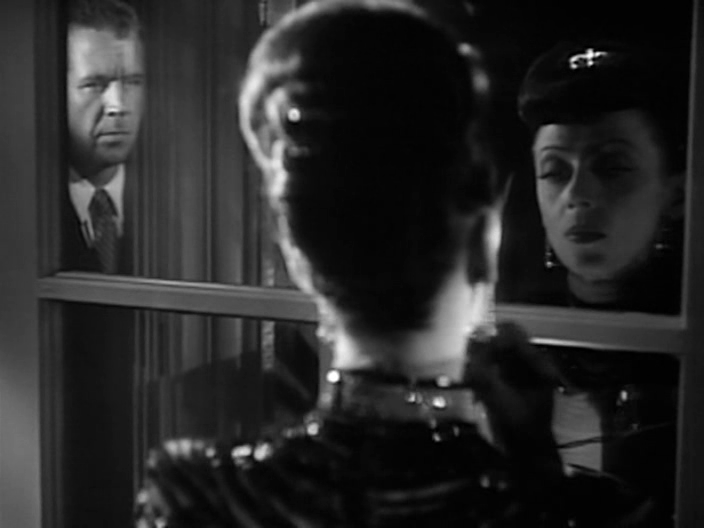
Saturday, July 18, 2015

Summer of Darkness: Tension(1949)

Well, it was bound to happen eventually. At least a few of the films in this summer-long project had to be duds. It's not that Tension is a complete failure, or even without merit. The plot holds promise, the direction is competent, and there are some interesting moments throughout, but the film is just so remarkably ill-conceived in it' execution that I was never quite sure whether I should be laughing or rolling my eyes. The tone veers wildly from one extreme to another, and never seems to hit a comfortable note.

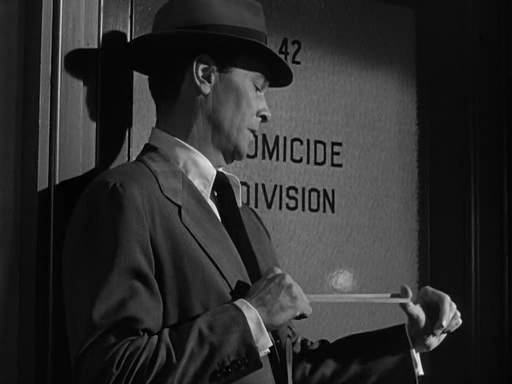
The film opens with Police Lieutenant Collier Bonnabel(Barry Sullivan) talking through his process on the job, how he gets criminals to crack during interrogations by carefully reading their body language and expertly applying various types of pressure. This prologue is all done with Lt. Bonnabel speaking directly to the audience, and to make the metaphor clear, he's pointedly fidgeting with a rubber band the entire time. As he reaches the climactic moment in his speech, Lt. Bonnabel snaps the rubber band, letting us know what always happens to criminals who happen to cross him. This scene is, to put it bluntly, ludicrously overwritten. The speech sounds like someone trying to come across as a two-fisted pulp hero when in actuality he's never been out from behind a desk. There's no authenticity here, and everything is incredibly on-the-nose. Then the prologue is over, and we enter the story proper, still with Lt. Bonnabel narrating. He pops up here and there to provide narration, which does little beyond describe what we see on the screen.


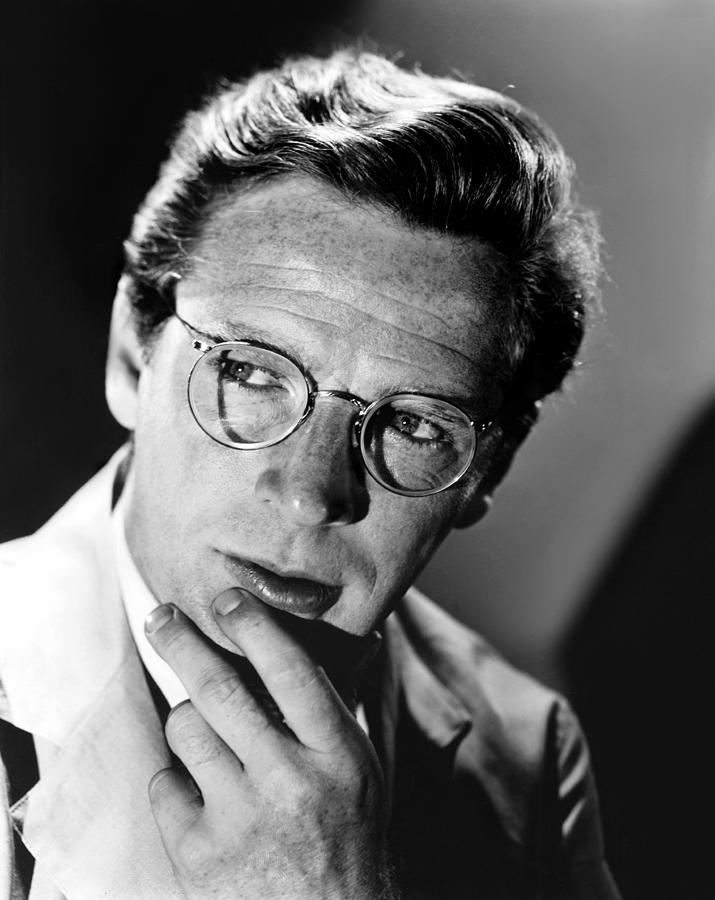
Richard Baseheart plays Warren Quimby, a pharmacist whose entire life is devoted to the idea of pleasing his wife, Claire(Audrey Totter). He works the graveyard shift for 12 hours a night to save up to buy a house, but his wife would rather spend the money on expensive perfumes while they live in the city where she can enjoy the nightlife. That Claire has a tendency to step out on Warren is no secret; Claire blatantly flirts with men she meets in the Pharmacy, and Lt. Bonnabel's narration relates the fear Warren faces every morning, never knowing if he'll return to find his wife in bed, or still out from the night before. Warren is comically milquetoast, in his pharmacist's smock, wearing glasses designed for optimal nerdiness. He can only whine at his wife as she pushes him around and propositions men in front of him.

Eventually Claire leaves him for a wealthier man named Barney Deager(Lloyd Gough), and Warren begins to fall apart. He goes to try and reclaim his wife, only to be beaten on the beach by his wife's lover, in a scene with all of the dramatic weight of a body-building ad from the back pages of a comic book. The jerk even steps on his glasses and kicks sand on him.

A trip to the optometrist, and the discovery of contact lenses, gives 'our hero' Warren the brilliant idea to concoct a new, secondary identity, one with perfect vision. A scapegoat for the police to pin the murder on once he kills his wife's lover. To this end, Warren rents an apartment in this new identity's name, makes himself visible to his neighbors in this new guise, and leaves threatening messages for Barney care of his new identity. All while also working 12 hour shifts at the pharmacy and maintaining his regular life, of course.

I'm discussing the nuts and bolts of the plot in much more detail than I normally do, and in my notes I still have another couple paragraphs to go, so I'm going to just cut right through it with some fastpaced recap. Warren meets a beautiful neighbor, and has second thoughts about murdering Barney, but still sets out to complete what he started. This is probably the best scene in the film. The writing and acting in this scene finally hit the same wavelength, and the lighting and staging capture the scene in striking shadow-filled images. It's a bright spot at odds with the rest of the movie. Warren never goes through with it, and he rushes out to excitedly propose marriage to his new girlfriend. But first: another complication! Barney ends up dead anyway, and now the police are seeking his alternate identity, the one that wants to get married. Enter Lt. Bonnabel, finally appearing on screen after narrating a ton of stuff he was not there for.


The plot doesn't really get any easier to swallow here. It takes the cops an incredibly long time to realize that Warren and their murder suspect are the same person, even though they have a rather large, clear photo of the suspect. The simple fact that he's not wearing glasses in the photo is enough to trip up the homicide detectives for a laughably long time. A lot of my problems with Tension arise from the character of Lt. Bonnabel, whose prologue gives the film an unintentionally cheesy vibe, like an Ed Wood film without the personality. His voiceover pops up randomly throughout the film, which is supposed to make this seem like notes from a casefile, but actually makes him seem like a voyeuristic outsider. It somehow gets worse once he actually enters the film as an actual character. His actions never seem professional or realistic, and he comes across as deeply, deeply creepy. He begins an affair with Warren's wife, and while it's later revealed that this was a ploy to get her to spill the beans, it never feels appropriate. The fact that he's apparently sleeping with Claire never actually plays into how she's caught, and feels like yet another chance for the film to humiliate Warren. This isn't Sam Spade allowing himself to be seduced to crack a case, this is like Joe Friday feeling up some hippy chicks before busting them for possession. It's uncomfortably sleazy.


As I've said, Tension is competently made, with flashes of what could have been a much better movie. If the movie had leaned harder into the cartoonish elements, it could have been a gonzo black comedy. Likewise if it had sustained the noir greatness of the scene where Warren decides not to kill Barney, it could have been an undiscovered classic of the genre. As it is, the film feels like a jumble of styles that never really mesh together.

Saturday, July 11, 2015

Summer of Darkness: Where Danger Lives(1950)

Where Danger Lives is another film noir fixated on travel, with the majority of scenes taking place in cars driving down lonesome south-wet highways, or in a variety of small towns that dot those roads. It also features one of my favorite types of noir protaganist; the addled hero who can no longer trust his own senses. It's a type that was there for La Bete Humaine, the very first film I wrote about for this project, where Jean Gabin would suddenly fall into lethal, misogynistic rages. Dick Powell played a variation on the theme for some parts of Murder, My Sweet, as his character was frequently being knocked unconscious and having to fight through the fog of being sedated. Powell will return to the well in an upcoming film I'll be covering shortly. I expect to see this character archetype again before the summer is over.

Robert Mitchum plays Jeff Cameron, a doctor so in love with his job that he has to be coerced into leaving the hospital after a fourteen hour shift. He works in the children's ward, and maintains a steady relationship with a nurse that appears to be heading towards marriage. His life seems perfect, but when he treats the beautiful Margo(Faith Domergue) who has attempted suicide, he finds himself falling in love with her. The two begin a fairly heated affair, which develops mostly offscreen as the film suddenly jumps to the point where Jeff is proposing marriage. Margo rebuffs him, saying her wealthy father would never allow it. After drinking and building up his courage, Jeff goes to confront Margo's father, Frederick Lannington, played by Claude Rains. An inebriated Jeff is barely able to process the shock at learning that Frederick is, in fact, Margo's husband. The scene that follows isn't quite what you'd expect, although it ends in the inevitable fight, leaving Jeff with a concussion and Frederick dead.

Margo convinces Jeff, in his confused state, to go on the run with her, setting the noir road trip in motion. At the airport the pair are spooked by a pair of cops who appear to be looking for them, but who are actually there on unrelated business. So the two head out on the road, believing the cops to be hot on their trail. They make stupid, desperate decisions that put them into tighter and tighter spots, so that by the time the cops are after them, their options have all been exhausted.

I'm going to revisit the tortured 'Body Horror' analogy I used when discussing Desperate, because I think it fits even better here. Both the film and Jeff undergo creeping, radical changes to their character as time passes. What begins as a light, hopeful drama full of kind and helpful characters becomes a grim and fatalistic story with hallucinatory touches. Jeff begins the film as a model citizen, liked by everyone and cool in tense situations, but slowly deteriorates both physically and mentally as the film goes along. He almost literally becomes a different person as the concussion impedes his cognitive reasoning, his memory, his personality, and finally his motor skills. In Where Danger Lives, murder is an act of self destruction, a cancer that infects the film and the characters, so that even things meant to be fun and friendly become nightmarish obstacles. Jeff, in his travels, frequently falls into unconsciousness, waking up in new towns full of strange, impenetrable customs.

The path of the film can be tracked through the interactions between Jeff and Margo, and in how the various characters see each other. When Jeff first lays eyes on Margo, she is on a hospital bed, unconscious. He is wearing a surgical mask, though the scenario does not appear to require one, that reveals only his eyes. We see Margo, placid, beautiful, and focus on Jeff's eyes as he takes this in. Through their courtship both Jeff and Margo frequently stare lovingly into each other's eyes, and they're almost always shown in the same frame. Once the nature of Margo's marriage is revealed to Jeff, there's an interesting show where Margo is centered, while flanked by Jeff and Frederick, who continue discussing her as if she's left the room. This is where the bond between Jeff and Margo breaks.


Throughout the rest of the film Margo and Jeff will not be in the same frame as often, will frequently be separated in the eyes of the audience. And speaking of eyes, they will almost never look directly at each other again. As if their combined scenes prove to great to acknowledge, Margo and Jeff spend the rest of the film looking into the distance as they talk, and when they do look into each other's eyes, it is only for a fleeting moment as their gaze is instantly pulled somewhere else.


After the murder, the two can't look at each other directly until the finale, when Margo's true nature has finally been revealed. At this moment, surrounded by cop, as both of their bodies fail them, the two can finally see each other. Jeff's mask is forgotten, and the invisible one worn by Margo has finally been removed. And yet, despite this newfound intimacy, the two are never in the same shot. Not even an over the shoulder shot while they speak to each other. They finally see each other clearly, but they're separated by the film's four walls, and the chainlink fence they've collapsed against.


What follows is an ending that might go a bit too far in closing on a happy note, but to end on the expected note of cynicism wouldn't feel right, either. The film's fever has broken, and now it's time to start recovering.


Wednesday, July 01, 2015

Summer of Darkness: The Maltese Falcons

Anyone who complains about the recent trend towards sequels and remakes as if it's proof of Hollywood's newfound lack of original ideas needs to bone up on their history. This is nothing new; films have been remade almost from the beginning, and often at a much faster pace than we have today. I mean, the Robocop remake at least waited nearly two decades before staining the world with its presence. It might surprise those critics I refer to above to learn that one of the most famous classic films of all times is, in fact, a remake. The 1941 version of The Maltese Falcon, with Humphrey Bogart in the lead role, wasn't even the first remake of that story. It was the third filmed version within ten years.

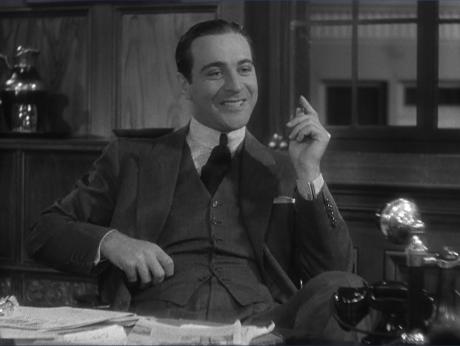
The first film was made in 1931 and features a lot of the stuff you would expect in a pre-code picture. A bit more sexual innuendo, some direct references to Casper Gutman's homosexuality, and a stronger air of seediness. The biggest difference of all for fans of the 1941 version is in the character of Sam Spade himself. Ricardo Cortez plays Sam Spade as a grinning hyena of a man, laughing at the misery he inflicts on others and treating every murder and betrayal as a joke for his own personal amusement. He's a hard man to root for, and he's introduced to the film more as a gigolo than a private detective. The very first shot is of a woman exiting his office and straightening her stockings before leaving. Spade exits, with that douchey grin of his, and asks his secretary if there are any more clients visiting that day. He then returns to his office, where the sex must have been acrobatic. Furniture is toppled, pictures have been knocked from the walls, cushions have been flung from the couch. Our hero, everybody.

Spade in this film is much more manipulative and deceitful, as well. He's unbelievably callous about the death of his partner, a good-natured slob unaware that his wife has been carrying on an affair with Spade. He does many of the same things the character does in later versions of the film, but here it just feels cruel and douchey. By the end of the film, when Ruth Wonderly is pleading with Sam to not turn her in for murder, because she loves him, she's not lying. The actress play it as completely sincere, and she's destroyed by the fact that Sam turns her in. That's understandable, and maybe the one ethical thing Sam Spade does in the entire film, but it's ruined by the very next scene where he visit her in prison to gloat about the big promotion he got by sending her to jail, all with that shit-eating grin plastered on his face as he crows to a woman who loves him that he's just profited from her eventual death. We also get the reveal that Spade knew Wonderly had killed his partner, had actual proof that would have sent her to jail, from the very beginning. In retrospect it makes it look like he hid this information so that he could make some money off the woman, get her into bed, and make her fall in love with him before he could send her to prison. And since he very clearly did not care about his partner, nor Ruth, this just seems like needless cruelty. Ricardo Cortez's version of Sam Spade truck me like film noir version of one of the characters on It's Always Sunny in Philadelphia; completely uncaring about the damage he inflicts because hey, it always works out OK for him. A character who finds himself charming while he coasts through life inflicting horrible damage to everyone around him.

Don't you just want to punch him?


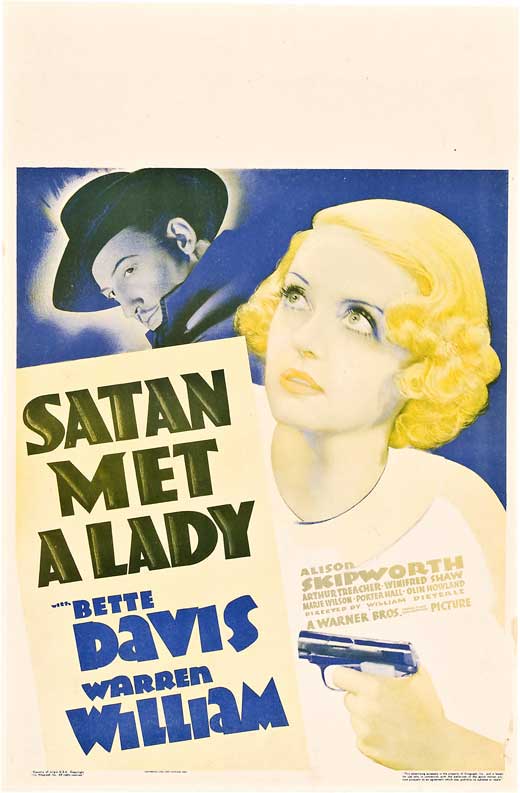
In 1936 the studio wanted to rerelease the film to theatres, but was stopped by the production code censors who balked at the sexuality and violence of the film. And so a remake was mounted, one that would be approved by the stricter censors, and one that would stray immensely from the source material in both content and tone, Many major plot details were changed, and the film was retitled Satan Met a Lady(a reference to the book's description of Sam Spade as looking like 'a blonde Satan'), but the story remains largely the same. It's still about a private detective(who here becomes Ted Shane) whose partner is killed, leading him to become embroiled in a hunt for a mythical object(which in this film is a Ram's Horn filled with jewels) involving three distinct parties scheming against each other. The Casper Gutman character is now played by a woman, which removes the homosexual subtext from the character in favor of a more oedipal reading.

The most important change, though, is one of tone. Satan Met a Lady is more of a screwball romantic comedy than a proper film noir, and the characters frequently engage in ridiculous scenes of wacky comedy. The scene where Ted Shane comes home to find his apartment ransacked by one of the treasure hunters is played for laughs, as the two trade droll witticisms while sharing a drink and casually destroying more of the apartment. Warren William turns the hardboiled detective in a dashing, witty gadabout. More Nick Charles than Sam Spade. He handles everything with unruffled, deadpan humor, a smile always playing on his lips. And surprisingly, this all works. Satan Met a Lady is light on its feet and humorous throughout, despite including all of the betrayals and murders familiar to the story. It may not be a classic destined to survive through the ages, but it's a surprisingly fun little movie that probably deserves more attention.

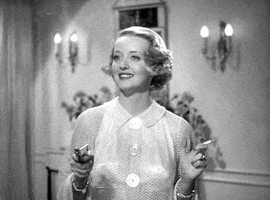
Bette Davis is there, too.


And then we come to the version everyone thinks of when they think of The Maltese Falcon. Humphrey Bogart, Peter Lorre, 'the stuff that dreams are made of.' This is the film all the previous version had been leading up to, the movie that nailed it completely and made the prospect of any future remakes unnecessary.  This version was so successful that if you were to read a Sam Spade story, you'd probably picture Humphrey Bogart even though the text explicitly describes him as someone who looks nothing like Bogart. It saved Bogart from the B pictures and dramas he had been making, inspired a working partnership between Peter Lorre and Sydney Greenstreet that would last over 9 films, and announced John Huston as a major name in American film, despite this being his directorial debut.


This version of The Maltese Falcon brings back some of the meanness of the Sam Spade character, though Bogart's charisma is able to soften the blow a little bit. He's a little more laid back, a little more understanding of human nature, and his smile isn't quite so irritating. He still sends a woman who loves him to jail, but in this film he does so for moral reasons, not selfish ones. His actions- playing along with the femme fatale, playing the various groups against each other, even lying to the police and others- all come from his attempt to avenge the murder of his partner at the beginning of the film. A man he didn't like, a man whose wife he was having an affair with, but a man he owed a debt to. He's not a great guy, but we get the impression that he has a moral code and lives accordingly. The earlier pre-code version, who committed many of the same sins, did not seem to have any sort of code or care for anyone else.

Everything in this film is on point. Every member of the cast is perfect, every camera angle and bit of dialogue hits exactly the right note. Take Peter Lorre as Joel Cairo, and effemanite(in the novel he was gay) man who hires Sam Spade at gunpoint. He is frequently the butt of Spade's abuse both verbal and physical, and while he occassionally rises to anger, he treats much of this with exasperated acceptance. Such as when Spade knocks him out, and Cairo comes to and simply walks to a mirror to clean himself up. Or Sydney Greenstreet, who had a hypnotic manner of speaking, low and confidential but also with a rapid machine gun rate. It might take a few listens to truly grasp what he's saying at times. But that's true of the plot as well; it may not make complete sense on an initial viewing, but that isn't a problem. The joy of the film is in how it's presented, how it moves along, how it's acted.

Volumes of critical writing have been devoted to this film, and I find I don't have a whole lot to add. It's a great film, hands down, and deserves it's reputation among film buffs. Every viewing is as fresh as the first.

Tuesday, June 30, 2015

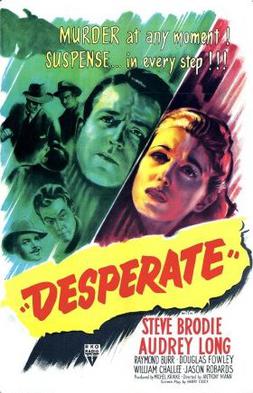
Summer of Darkness: Desperate(1947)

Desperate provides a great counterpoint to Hollow Triumph, a film I wrote about not too long ago for this project. Both films feature a plethora of illogical character decisions and ridiculous scenarios, but Desperate offers an example of how to keep that from becoming an insurmountable problem. Both Desperate and Hollow Triumph center around characters who make needlessly complicated and ill advised decisions throughout, but with several dramatic difference. First, the issue of pacing. Hollow Triumph is leisurely at times, and Desperate rushes along at a brisk 73 minutes(sometimes, I must admit, this is to the film's detriment; one segment that seems to span several days is revealed to have spanned 6 months). The second major difference is that of motivation.

John Muller in Hollow Triumph made stupid decisions under the guise of intelligence; we the audience were expected to believe he was an intelligent man taken down by karmic retribution, when really he led himself to that end one idiotic step at a time. He was an egotistical, selfish man who made his own bed. Steve Randall(Steve Brodie) in Desperate is an innocent, sucked into an awful situation without the luxury of planning or experience. He makes the wrong decision again and again, and yet he does it all out of a desire to protect his wife. A simple change in motivation ends up making all the difference, as Randall is immediately more sympathetic and identifiable.

The film begins with Steve coming home to celebrate his 4 month anniversary with his wife, who is making a cake for the occasion. A corny situation that sets this couple firmly in the idealistic, sunny world you often find in post-war romantic melodramas. Their celebration is postponed when Steve gets a call offering him a job hauling merchandise for $50. That's not the stupid decision, actually; Steve is a freelance trucker/delivery driver, and does jobs like this all the time. The first stupid decision belongs to gang leader Walt Radak, who knows Steve from their childhood, and somehow believes it would be a good idea to hire an outside agent to be his getaway driver from a big heist and not tell him about it.

Steve's first stupid decision, pretty much the one he keeps making throughout the movie, is to not go to the police when he has the chance. After escaping the gang's clutches for a second time, after a botched first attempt leaves him bruised and bloodied, Steve should have gone directly to the cops. However, Walt had threatened to kill Steve's wife Anne(Audrey Long) if he didn't take the fall for the murder of a cop killed in the heist, so his focus was entirely on Anne's safety. Seems to me that the cops would have been able to provide more protection than Steve's 'lets run to the country' plan, but he was caught off guard and scared. I'm willing to cut him some slack for not thinking entirely rationally at this point.

Much less forgivable are some of Steve's other stupid decisions while on the road. After being swindled out of $90 by a used car salesman, Steve steals the car he has, to his credit, actually paid for. When a cop picks him up and begins to take him back Steve takes advantage of a small wreck to steal the cop car and go on the run. It's easy to justify these thefts, and Steve isn't anywhere close to being a bad guy, but it should be clear to any audience member that he's behaving foolishly. My heart sank a bit each time he stole a car, as it lowered his stature in my eyes a little bit.

Steve and Ann eventually make their way to the farm of Anne's parents, where they are welcomed with open arm into a rustic life of warmth, happiness, and post-war wholesomeness that rivals even the domestic bliss they felt at the beginning of the film. Steve goes to the police and comes clean about his involvement in the heist, and is told he's completely in the clear on that score. But that turns out to not be the case when Walt Radak shows up in town, no longer looking to force Steve into taking the fall, but looking for revenge for his brother being sent to the chair. Time for another move.

You see what I mean about Steve making the same stupid decision over and over again? He even tries to run again later in the film, hoping to make it all the way to California. If that hadn't been far enough I'm sure he would have been on his way to Mexico in an instant.

I've been using the idea of noir films existing as a sort of purgatory quite a bit, but a new metaphor came to mind during this film. In Desperate the film noir elements felt more like the threat in a Japanese horror film, a curse that could be passed on to an innocent person on contact. A curse that you could never outsmart or outrun, that would find you no matter where you ran, that could only be stopped by means of a violent bloodletting. Every time Steve and Anne made it to a new place, the film would become bright and sunny, but eventually the shadows would creep in, and the gangsters would show up, and Steve and Anne would be forced to try and run yet again.

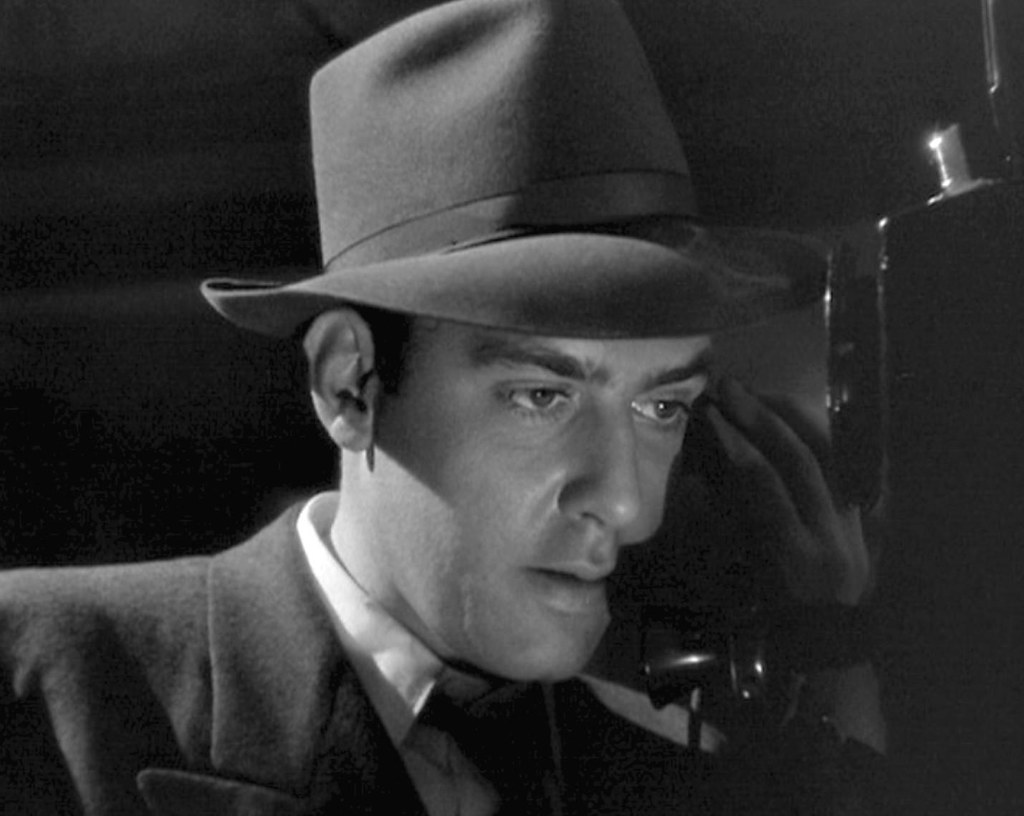
Steve and Anne begin the film in a state of domestic bliss, living in a picture perfect ideal of marriage. The film is brightly lit, comedic even, and there's one instantaneous edit that changes everything. Steve gets the note telling him to call a potential client, and heads to the hallway phone to make the call. The phone is in a clean, bright hallway, and the film cuts on Steve's hopeful face as the phone rings to a shot of the phone on the other end of the line. It hang on a dirty grey wall in a room filled with inky black shadows, and from that transmission from Noir Country Steve and Anne's lives are changed forever. When we cut back, the scene looks the same, but something has changed. There are notes of concern, and the threat of menace hangs over everything.


This is a repeating motif in the film; Steve keeps escaping to places that seem perfect, but the shadows always creep in. They go to work on Steve as well, as he turns to car theft and compromises his morals to keep his wife safe. Noir in Desperate is like a physical disease, a body horror where the body is the movie itself.

OK, maybe that's stretching things a bit, but my point is clear. Noir leaves a stain that isn't so easy to get rid of.

Saturday, June 27, 2015

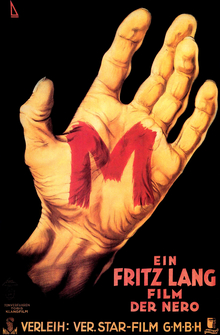
Summer of Darkness: M(1931)

M. is not a film noir, but it stands as one of the great precedents of the noir movement, helmed by a director who would go on to direct many influential noir films, and an actor who would become an icon of noir himself. It's a film that bridges the gap between noir and German Expressionism, grounding the formalist styles of Expressionism with a more realist, gritty approach. M., despite its sometimes whimsical inventions(an odd phrase for a movie about the hunt for a child killer, but I hope to make my use of it clear) is recognizably set in the real and the day to day. It's clear that Lang had an understanding of his subjects, but also no real sympathy, making this a view on society that looks ugly, dirty, and always on the brink of chaos.

The opening scene sets the stage for M.'s mix of the mundane, the menacing, and the theatrical in perhaps the most straightforward manner possible. The film opens on a group of children, circled around a girl standing in the center. The girls is repeating a sing-songy chant about a child killer, and pointing at each of the children in turn. As the girl gets to a certain refrain, anyone she's pointing at is 'out' of the game. This strikes many as a morbid, foreboding scene, yet as a parent, and one who remembers his own childhood, I had a different reaction to it. Consider it from the children's point of view; they are playing a game. To the children the song and its connotations hold no sense of danger, death in this sense only means being out of the game until the next round. To children death is not the same as it is for adults, and many children's games center around the idea death either metaphorically or literally. This view of death being intertwined with child's play will come up again and again in the film.


The first sign of actual trouble is when one of the children's mothers leans out over a balcony and shouts down for them to stop singing that awful song. Something about her alarm spreads to the audience; any parent would, under normal circumstances, see this as typical playground behavior. What has changed here?

There's an interesting visual interlude here, When the mother retreats back into the apartment, Lang holds the shot for 10 seconds. After a few moments the children begin singing again, and their insubordination is presented in such a manner as to make it humorous, and yet we remain on the empty balcony. Lang cuts next to an empty stairway, and it's another 6 seconds before the mother reappears, carrying a load of laundry. 16 seconds is an eternity for a film to be without any visible focal point or activity, and it stirs an anticipation, a dread for what is about to happen.


Let's skip ahead in this analysis a couple minutes, before I stop making this a scene-by-scene description of  a film more knowledgeable people than I have dissected. The first introduction we get to the child murderer, Franz Becker, we get to it through the act of a child playing. We watch a young girl leave school, and she's so distracted with her play that she wanders into the street and is almost hit by a car. A policeman shouts for her to be careful, but he stops paying attention once she's on her way, straight to her actual doom with Becker, as it turns out. Becker first appears only as a shadow, imposed over a poster describing his crimes as the little girl bounces a ball off of it. We are made aware of the girl's eventual demise by a series of heartbreaking shots. An empty spot at the dinner table, a mother shouting down a stairway, a balloon bought for the girl now tangled in electrical wires, and the girl's ball rolling out of a bush. M. combines the playful and the tragic in a dark perversion of whimsy.

Other notes of playfulness pop up throughout the film. Becker's red pencil he uses to write to the police, the tune from Peer Gynt that he whistles until it's jauntiness becomes a stand-in for the murders, in much the same way John William's score for Jaws would become a stand-in for the actual shark. The Brechtian concept of a beggar's union, where the homeless can buy props to improve their panhandling successes, sell goods and foods they've scavenged, and are assigned streetcorners to work in the same way many office workers get their daily projects. Lang gets a few good sardonic laughs out of how similarly the cops and criminals operate.

It's interesting to watch M. with an idea of historical context and try to decode what all of the various institutions represent. M. was co-written by Lang and his wife, Thea von Harbou, and the film's symbolic meaning seems such a loaded topic when you realize this film came out in 1931, when the nazi party was on the rise(though not yet completely in power). In a few years Hitler would be in power, Fritz Lang would have escaped from Germany to Hollywood, and Thea von Harbou would have joined the nazi party. It seems unlikely that M. could seem so metaphorically rich while not signifying anything, and yet the differing political viewpoints of its authors make that meaning difficult to parse.

Breaking it down a bit, M. has four major groups that almost every character falls into. We have The Law; the cops and detectives who hunt desperately for Becker. We have The Criminals, whose search for Becker is a means to an end, as it will get the cop to stop hassling them so much. There's The Public, who live in fear and descend into mob mentality at the merest hint of suspicious behavior. Finally there are The Beggars, who have formed their own shadow society largely unseen and unnoticed by the other three groups. They have no stake in the search, but The Criminals use their societal invisibility to make them the perfect eyes and ears in their search for Becker. Taken together, the four groups hang in almost perfect symmetry, with Becker, the only distinct character not belonging to any other group, occupying the center everyone else revolves around.


So, who does Becker represent? What is he a stand-in for? The outsider? The other? The very idea of a society led astray? Certainly he seem monstrous beyond belief, but he's also given more moments of sympathy than many other characters. He's seen early in the film prodding his face in a mirror, pulling skin to make hideous faces as if he's just gotten around to noticing he has one. Or, as Roger Ebert puts it, is he trying to see the monster inside that others see? Becker has a speech at the end of the film, as he faces a crowd of accusers, where he expounds on his impossible to ignore compulsion that he neither controls nor understands. Certainly this strikes a chord with the lifelong criminals who are slave to their own uncontrollable compulsions.

Becker is a virus in this film, or perhaps more accurately, a cancer. A threat that grows within the carefully structured organism, unnoticed until it's too late. But he had to have the opportunity to grow. It takes a blinded society to allow a man like Becker to not only develop, but flourish. If there were any real justice in the film's world, Becker would have been treated or helped long before his first murder occurred.

It can be hard to tell who the film expects us to sympathize with. At certain points everyone on screen will become sympathetic, but often that is due only to their station. We sympathize with the parents because they have lost their children, but the film points out that they would not have lost their children had they been paying attention to them. We root for the cops because we want Becker stopped, but they behave thuggishly and with an entitled snobbery that is continually offputting. Our sympathies grow for the criminals, as we see how the cops mistreat them in their search for Becker, but the film never shies away from letting us know these are not good men. The only ones to really escape any sort of blame are the beggars, who have made their abandonment from society a mutual affair, with their own separate society and their own governmental systems.

In my initial conception, I believe that the scenes concerning the plans of the cops, and the plans of the criminals, with their symmetrically framed smoke-filled rooms and speeches that echo each other, represent the shadowy forces that conspire to focus on a highly visible threat so that they may pursue their true ambitions without public scrutiny. The Public, with their tendency to fire-and-pitchfork witch hunts and mob mentality, represents a population eager to allow that subterfuge in exchange for a sense of security. That's a notion that would have seemed powerful in the early thirties, and it's surprising that the nazi censors let it pass. It's also an idea that should seem pretty powerful to modern audiences.


Friday, June 26, 2015

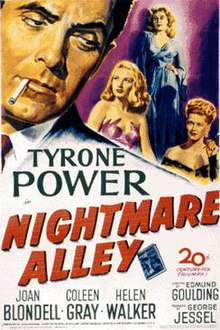
Summer of Darkness: Nightmare Alley(1947)

Here we are, folks, Nightmare Alley. The noirest of the noir, one of the darkest films to ever come out of the classic studio system, featuring one of the ballsiest cases of career self-immolation I can think of. This film is proof that the Hayes Code was great at keeping explicit sex and violence off of theatre screens, but completely ineffectual at protecting audiences from the depths of human depravity and degradation.

Nightmare Alley opens with the question 'What makes a geek?' The Geek, the lowest rung of any travelling carnival. The almost subhuman creature who decapitates live chickens with his teeth. The geek is looked down on with derision and disgust, and would never be found in any reputable carnival. The question of what makes a geek is one the film will circle back around to at the end, but for now it's mostly deployed as background flavor. It sets the tone of desperation that permeates the film.

Tyrone Power plays Stanton "Stan" Carlisle, a carnie who helps Madame Zeena(Joan Blondell) with her mentalist act, largely taking the place of her husband Pete, who lives in a drunken stupor and is too consistently wasted to do much more than menial behind-the-scenes work. Pete and Zeena once had a big time show, based around a complicated verbal code that allowed Pete to convey information about certain audience members to Zeena. Pete's alcoholism renders him useless for that function, however, so they joined the travelling circus and perform a less complicated, less impressive act. The code is apparently enough of a secret that Zeena refuses to teach it to Stan, planning instead to sell it off at some future date to provide for her retirement.

Once Stan hears about the code, he can't get the idea of performing in a big time show out of his head, and begs Zeena to teach it to him. She refuses, at least Stan accidentally kills Pete by handing him a bottle of grain alcohol by mistake while Pete's on one of his drunken benders. Now, this death is clearly an accident, but also not out of the realm of possibility that Stan would subconsciously try to kill Pete. He's clearly shocked by what he's done, but he also quickly removes any evidence of his involvement, and he's more than happy to benefit from the man's death. Stan and Zeena revive the old act, and Stan proves remarkably adept at it, causing them to quickly become the biggest act in the circus. Of course, that isn't enough for Stan, who we're beginning to see is driven completely by ambition. Soon his drive finds him forced into a shotgun wedding with Molly(Colleen Gray), and exiled from the circus.

That's what makes Stanton such a vile character; he's not evil. He has the capacity for love, friendship, even kindness, yet he ignores those tendencies in order to further his own ambition. He's aware enough to know that what he does in this film is wrong, but zealous enough to not care. Stan never seeks to hurt anyone, but he's more than happy to do it so long as it benefits him in some way. His downfall comes when he finally comes across someone with more brains, and somehow fewer morals. Stan finds himself separated from Molly- the only person who cares about him at all- broke, and wanted by the police for murder. If the film had ended there, it would be impressively bleak, but shockingly there's further for Stan to fall.

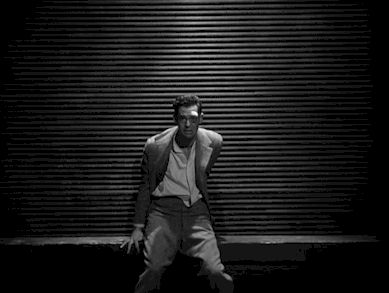
Stan becomes a drunk himself, living in a tiny motel room subsisting entirely on alcohol and room service. And then the money runs out, and he finds himself as a hobo, drinking cheap wine around campfires and reminiscing about his glory days and fighting for the last drop of alcohol. Stan's descent into destitution and alcoholism is presented via a brisk montage of sequences, each scene a lower rung Stan is climbing down. This stops when Stan wanders into a carnival seeking a job, a prospect the carnival owner clearly views skeptically, as by this point Stan is severely marked by his fall from grace. His face is lined, his eyes are dark, and his clothes are stained and torn. But the man invites Stan into his office, sits him down, and begins to talk about an available job. Not a glamorous job, but a job. A ground floor job that would give Stan a place to sleep and a bottle a day. And anyway, it's only temporary, only until they find a real geek. Stan looks up, smiles, and repeats his oft-stated phrase: "Mister, I was made for it."

"Mister, I was made for it."


Nightmare Alley seems to have found the bleakest note possible to end on, but then it still has one more scene to go. It's easy to see this scene, where Stan and Molly are reunited and Molly promises to take care of Stan, as a cop out happy ending. A studio or censor mandated relief from the grime and soul sickness that has come before. But look a little closer, and you'll see the happiness is false, an ironic mirroring of the relationship between Pete and Zeena earlier in the film. Stan may have avoided rock bottom as a geek, but he's found a level just above that, one that will keep him comparatively comfortable, but one that also lacks the ability to rise. Stan has sunk as far as he can without the capacity for hope.


Monday, June 22, 2015

Summer of Darkness: Johnny Eager(1941)

Robert Taylor and Lana Turner.


Let me just start off with my final judgement on this film; Johnny Eager is one of the most purely fun films I've seen as part of this project. It moves with a briskness of pace, it's plot is tightly wound, and its characterizations are enjoyable throughout. It may not break ground in the area of cinematic arts, but it doesn't need to. Johnny Eager sets out to entertain audiences with a gripping crime tale, and embraces the cliches of the genre instead of trying to skirt them. Though it does, in a way, subvert some of them, as I'll get to later. Johnny Eager is a pre-code crime film wrapped up in Hayes Code-era film noir trappings. A film noir variation on Public Enemy or Little Caesar, films whose 'crime doesn't pay' messages are undone by how much fun they make being a criminal appear.

Johnny Eager, the character this time, is not exactly a new invention. He's the criminal with a moral code, the smartest man in the room at all times. A man who uses his brains to destroy his enemies more than he uses his guns. He's a man who can be cruel and merciless, but is also kind and loyal to his subordinates, until they start thinking of crossing him. It's easy to run through a list of Johnny's crimes in this film and come to the conclusion that he's a heartless monster leaving nothing but tragic loss in his wake, but as played by Robert Taylor he becomes sympathetic to the point that the audience may find itself justifying his crimes in their minds. It's true that he kills those who threaten him, but it's also true that he'll find non-lethal solutions if given the chance. Johnny Eager typifies the sort of anti-hero criminal that would come to populate the crime pictures of the 60s and 70s, and at times feels like a prototype for the films of Martin Scorcese, Francis Ford Coppola, and Abel Ferrara.

Johnny Eager, the film, revels in the life of crime in a way that a lot of Hayes Code pictures wouldn't allow themselves. Johnny's life looks fun. By day he pretends to have put his criminal past behind him, working as a cabdriver and living with his sister. But at night, away from the eyes of his parole officer, he heads up a sprawling gambling syndicate with influence in nearly every social institution. The film that repeatedly came to mind as I watched this one was King of New York. Johnny Eager and Frank White have a lot in common, in both their ruthlesness and their implied moral code. Replace the hospital Frank is concerned with with the dog track Johnny Eager hopes to open, and King of New York could be a very(very!) loose remake.

I had so much fun watching Johnny outsmart his enemies that I forgot for awhile I was watching a Hayes Code film. It was entertaining watching Johnny get the upper hand on adversaries who continually thought he was down for the count, or who had seriously misjudged his deviousness, that I secretly hoped the film would find a way to skirt the restriction of the times that required all criminals to be brought to justice, or at least punishment, in the final reel. I knew his downfall was coming, but I didn't want to see it. Johnny was so much smarter than everyone else that to see him die in a hail of bullets seemed to be anticlimactic. Luckily, the film invests a bit more into it's finale than might be immediately apparent.

Yes, Johnny is punished for his crimes, but in the end it's his good deeds that lead to his fall from grace. It isn't the murders he's responsible for, it isn't the multiple crimes he's committed throughout the film, he's punished only once he tries to make amends to someone out of love. In the world of Johnny Eager, crime does pay, and it pays very well. As long as you remain clever and ruthless, as long as you form no meaningful attachments... well, in the words of the Geto Boys....


So, I realize now that I've not spoken about the plot at all, or even mentioned Lana Turner or Van Heflin. It should be clear, though, that I enjoyed the film quite a bit. But let me just add that Van Heflin, as Johnny's always-drunk Jiminy Cricket figure, deserved his Best Supporting Actor win.

Sunday, June 21, 2015

Summer of Darkness: The Set-Up(1949)


The Set-Up is not a traditional film noir, in that it doesn't feature many of the hallmarks of the genre. It's not something people would watch and immediately associate with noir. The film owes more to the naturalistic realism often associated with the French New Wave than it does to noir's most visible precedent, German Expressionism. Consider this a suburb on the borders of Noir Country, where the capital's influence is muted and often negligible.

Robert Ryan plays Stoker Thompson, a boxer in the midst of a long losing streak, at a point where everyone seems to have lost faith in his abilities. So convinced are people in his status as a has-been that his manager and trainer accept money to make sure he loses an upcoming match, and don't even tell him about it. They just assume he'll be fine at losing on his own. The opening of the film shows that his wife, Julie(played by Audrey Totter), has tired of the routine, as well, as she announces her intentions to not attend the big fight, because she's tired of seeing him beaten. Julie is the only main character in the film to show any faith in Stoker, and she's clearly losing the energy to believe in and support her husband. Stoker takes her ringside absence as a bad sign for their marriage, and indeed Julie does spend the night wandering the city, apparently considering leaving, but in the end she returns to their hotel room to prepare dinner.

Stoker eventually learns about the fix as he's about to enter the final round of what has been a remarkably brutal fight, but by then it's too late. His mind is made up. He can't sell himself out so his manager can pocket a measly fifty bucks, not when he's so close to proving his worth to the audience, to his peers, to his wife, to himself. And so he pushes himself, he goes all the way, and the epic fight ends, incredibly, in his favor.

It's likely that the fight scenes, full of quick cuts and closeups on sweaty, pummeled faces, were seen as the centerpiece to this film. The scenes are fine, action packed and well shot, but the real heart of The Set-Up lives in the shared locker room where the fighters prepare. No rivalries extend to this room, and the fighters await their bouts with honest camaraderie and good cheer. They help each other prepare, share anecdotes and dreams, and band together when one of them returns from the ring with serious injuries. These scenes have an enjoyable sense of reality that give the film a real lived-in feel. It's fun being a fly on that wall, as the evening progresses in almost real-time.


As I said, the noir elements of the film aren't very pronounced, and are mostly relegated to a handful of scenes involving the gangster, Little Boy, who paid for Stoker's dive. He's present at the fight, offering some quiet, smug menace to the proceedings, but he only becomes a real threat in the finale, when Stoker must find a way to escape the arena without falling into his clutches. In these scenes the shadows loom larger, and the movie's world seems ready to tip into the void. When the reckoning does come for Stoker, it's leavened by his new found confidence and the love of his wife.

Saturday, June 20, 2015

Summer of Darkness: 99 River Street(1953)


Ernie Driscoll is having one hell of a bad night. It gets off to a bad start when a televised repeat of one of his old boxing matches ignites an argument with his wife. It gets worse when he finds out his wife is seeing another man, continues to worsen when an acquaintance comes to him for help in disposing of the body of her would-be rapist, and hasn't even reached its nadir when his wife's diamond-thief lover tries to frame him for her murder. Yes, Ernie is having a rough night, and his simmering rage threatens to explode at any moment.

Ernie Driscoll is a noir hero who doesn't know he's living in a film noir, and in fact wants desperately to avoid that fate. His wife is the one in the film noir, his acquaintance wants to be in a film noir, but Ernie wants to live in a simple slice of life melodrama. He wants to live quietly, driving a cab while reminiscing about his golden years as a boxer. Regaling friends and coworkers with his plans to open his own filling station. Enjoying the camaraderie of an all-night diner and his fellow cabbies, buying chocolates for his wife and trying for children. It's only when the complications pile on too high that Ernie embraces his inner two-fisted hero and begins spouting lines like "There are worse things than murder. You can kill someone an inch at a time."

Yes, it turns out Ernie was born to be the world-weary hero of a film noir, and he takes to it naturally. To the film's credit, and what makes its plot work, is that the film never lets Ernie completely off the hook through his dark night of the soul. Sure, Ernie is the victim here, but it's easy to sympathize with the wife of a man so disappointed in his own life, who is so bottled up and quick to use his fists on the people who don't deserve it. The film never implies that Ernie ever beat his wife, but living with a man that full of rage couldn't have been a cake walk. It's easy to see why she might find comfort and romance in the arms of another man, even one as dangerous as Mr. Diamond Thief.

The film takes some twists and turns and features dozens of complications I haven't mentioned here. The film's surprises are worth experiencing on their own, and my sympathy for Ernie quickly turned into surprised laughter at how much punishment the film kept throwing his way. Ernie's journey from aggrieved hero of a melodrama to two-fisted hero of a film noir is so smooth, and seems so natural a fit for the character, that it becomes a bit difficult to buy into the film's convenient happy ending. It's hard to believe Ernie will be a success with his new wife and filling station, not when we've seen how comfortable and, dare I say, content he was pummeling men to within an inch of their lives. Not when we've seen what became of his previous marriage. Ernie may have consciously switched genres, but the shadows of Noir Country have a long reach.

Friday, June 19, 2015

Summer of Darkness; Hollow Triumph(1948)

Noir films have their fare share of behind-the-scenes superstars, names that come to mind when people think of the genre. Raymond Chandler and Dashiell Hammet for their two fisted detective novels, Fritz Lang for his expressionistic, formalist visual styles, and Howard Hawks for his concise, direct style of storytelling. One name that seems a little unsung, however, is John Alton. Film buffs know his name, and he gained recognition for a book he wrote on cinematography(Painting With Light), but most casual fans will probably say they've never heard the name.

That wouldn't quite be true, for as cinematographer John Alton lensed an impressive 102 movies, one short film, and the pilot for Mission: Impossible over a 40 year career. He was director of photography on one film I've covered so far this summer(Woman on the Run), and his name will pop up several more times before I'm done. Many of the films he worked on throughout the 40s and 50s would today be classified as noir, and John Alton did as much as anyone else you can think of to help define and codify film noir in the eyes of the public. His frequent use of chiaroscuro lighting, off center framing, and juxtaposed facial profiles embodied what we imagine when we think of the term film noir.

Hollow Triumph is a film that owes a great debt to the skills of John Alton. His framing and lighting enforce the metaphorical subtext of the scenes, in many cases adding a dramatic weight that otherwise might not come through. Take the shot below, taken from a pivotal moment in the film where John Muller(Paul Henreid) first gets the idea to steal another man's identity. Voice over plays through his head as he studies his own reflection, which is metaphorically apt enough. Probably a bit cliche, even at this point in the late 40s. But then notice that he's looking at his reflection through his own shadow, which is prominently figured in the shot. The mirror outside of his reflection is streaked and obscured by the light, but in the reflection his face is clear, though maybe blurry in this screengrab. This shot takes a somewhat cliche image and adds another visual layer to it, to make it more engaging to the eye, but also to add more depth to the metaphor.


Paul Henreid here is playing John Muller, a career criminal recently released from prison and on the run from a gangster he's robbed. He also, for a couple of brief scenes, plays Dr. Bartok, a psychoanalyst whose life he covets as a possible escape route. Muller is released from prison to much fanfare from the warden concerning his intelligence, and several characters remark throughout the film on Muller's intelligence, but we never see much evidence for it. He joins Gene Hackman's character in The Conversation in the pantheon of 'experts' who aren't very good at their jobs. Muller's brilliant scheme for robbing the casino owned by a widely-feared gangster with global connections(on his first day out of prison, no less) is to basically turn off the lights so no one sees him run away in the dark. This plan is foiled almost immediately when someone simply turns the lights back on.

Muller's lack of foresight extends even further, when he begins to actively plan to steal Dr. Bartok's identity. Bartok is a psychoanalyst, which is convenient because Muller has some schooling in the subject, but beyond that he's primarily clueless. He searches Bartok's office, looks over some patient files, but doesn't bother to look into Bartok's personal life, or discover if the man has any loved ones or a girlfriend(he does), or what his habits are. Bartok has a prominent facial scar, and Muller is smart enough to give himself an identical scar before making the switch, however he's caught in the act partly because he puts the scar on the wrong side of his face.

Steve Sekely's direction, combined with Alton's cinematography, is consistently inventive, making good use of semi-abstract montage and elliptical editing. Yet something in the film failed to grab me. It could be a problem of character motivation, as no one's actions ever really feel believable. What good will it do for Muller to steal another man's life when he still looks the same and is recognizable by the gangster's henchmen? Or maybe it was the way the airless way the story unfolded, which left no room for tension or emotion. The film ends on a great note, which would have made O. Henry proud, but getting there was never much fun. At the risk of channeling Gene Shalit, Hollow Triumph felt a little hollow itself.

Monday, June 15, 2015

Summer of Darkness: Crossfire(1947)

The classic period of film noir, as it's generally understood, came of age in the postwar years, counteracting the optimism most Americans seemed to be feeling with the fatalistic cynicism of a country who had just seen hell. Sure, things looked bright and cheery now, but it's hard to forget the nightmares and atrocities so recently committed. It's no coincidence that many of the early film noir directors were refugees from Hitler's Germany. Fritz Lang, Billy Wilder, Robert Siodmak all fled to Hollywood prior to the war, and their styles and preoccupations came with them. Almost all film noir, however, carried those weights with them, in either literal or more ethereal stylistic ways. Few, however, are as direct in their dealings with the horrors of World War Two as Crossfire.

That is not to say that Crossfire is a searing and nightmarish depiction of a world at war. Quite the opposite, actually. The film bears very little in the way of the trademark stoicism and resignation traditional to film noir, and instead embraces the optimism of post war America while also acknowledging the presence of the shadows. Crossfire deals with the attempts of police detective Finlay(Robert Young) to piece together the brutal killing of a Jewish man, where the only three suspects are servicemen back from the war. Mitch(George Cooper) is the initial prime suspect, having been seen last with the dead man, and being blind drunk to boot. Montgomery(Robert Ryan) plays a faintly antisemitic soldier who attempts to defend Mitch, and Sgt. Keeley(Robert Mitchum, rounding out the trifecta) lends his even handed judgment to Finlay's attempts to find the killer. 

Crossfire is a message movie, and handles it's subject matter bluntly and directly. Joseph Samuels was killed simply because he was Jewish, and the film's goal is to let us know why that's a tragedy. It would be easy today to look back and poke apart the film's simplistic moral, it's heavy handedness, or the direct way it conveys it's points, but it's important to remember when this came out. Crossfire premiered less than two years after the end of WWII, when much of the audience would have been returning soldiers, or their families. The worries presented here would have been very current, and it's easy to see why the filmmakers felt so compelled to impart this wisdom.

But again, this film isn't a miserablist bit of finger wagging. The film believes in the innate goodness of people. OK, of the innate goodness of Americans, at least. The military and other authorities are all depicted as morally upstanding and kind, with only Montgomery acting as the rare bad apple. The audience stand-in is most likely the character of Leroy(William Phipps), and as Finlay lays out the films grand statement, that bigotry and blind hatred are as dangerous as bullets in a gun, he speaks directly to us, the audience, through Leroy. Leroy is us; maybe a bit dull, but generally wishing to do good and follow the path of righteousness, but also too eager to follow the wrong leader at times.

The film may begin and end in the shadows, with a brutal killing on both sides, but in the middle comes the day. As Finlay reaffirms the ideals of America just after the nightmare of a worldwide war, the Declaration of Independence is framed just over his shoulder, and behind him the large windows show the sun shining on the Capitol Building. 

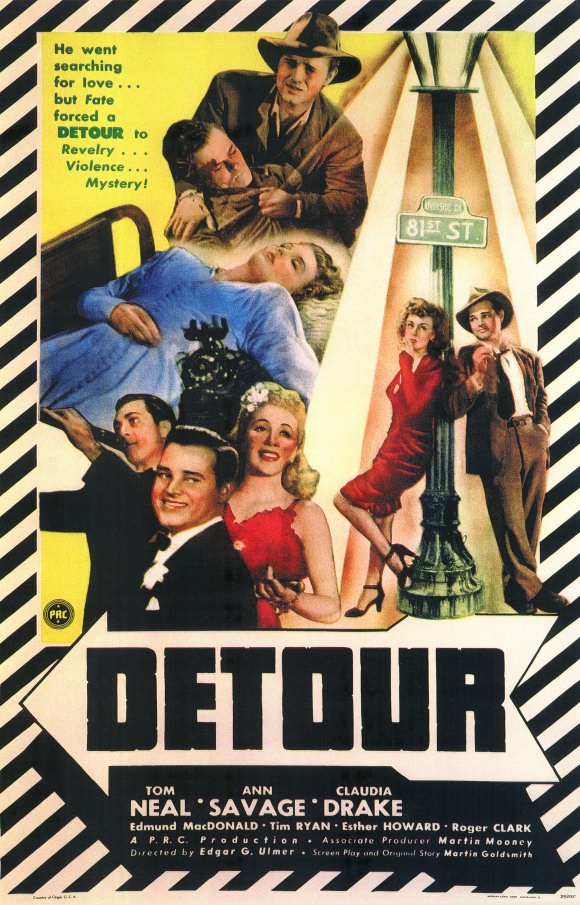
Summer of Darkness: Detour(1945)

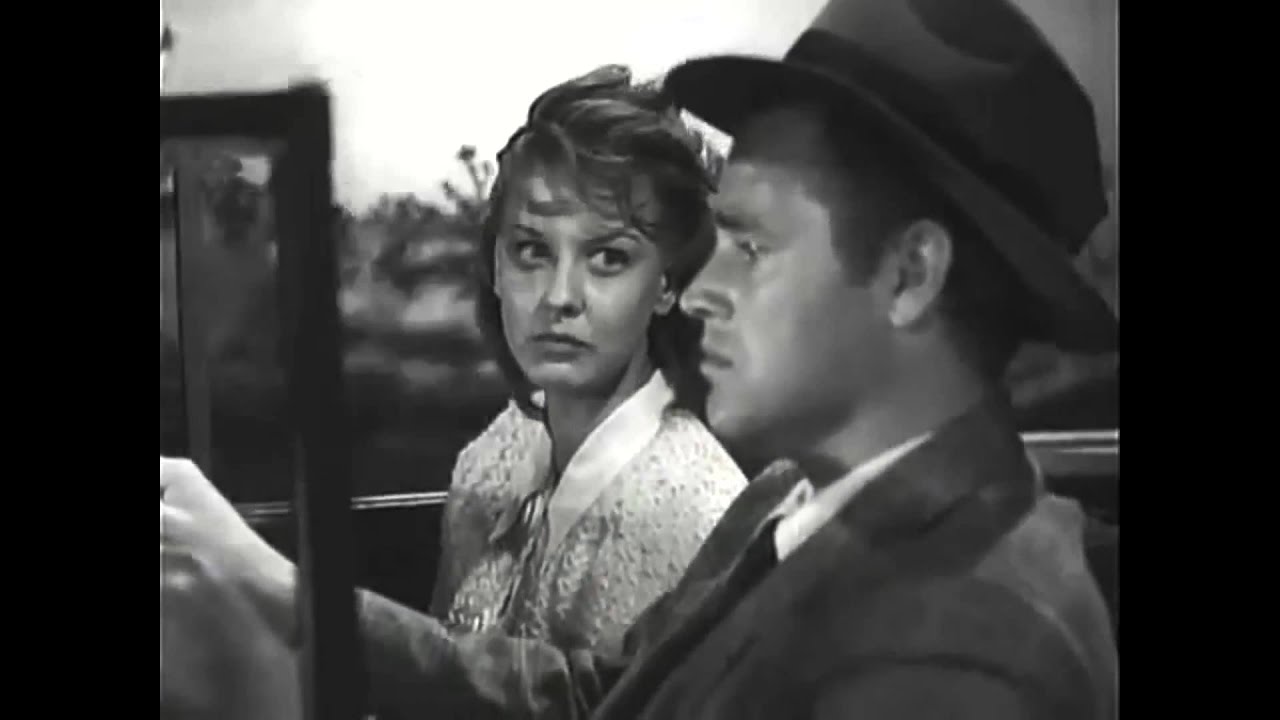
Detour is an odd movie to be considered a classic; shot on dingy, bare sets, full of cliches instead of characters, actors who are across the board unpleasant to spend time with, and with a brief running time barely making it to the feature film threshold. But it's also stylishly nightmarish, in a way that doesn't chill you but makes you feel soul sick. The basic plot is familiar to most fans of film noir; a down on his luck man happens to be in the wrong place at the wrong time and is poised to take the fall for a murder he didn't commit. On the way to avoid the authorities, he crosses path with the wrong woman and allows himself to fall under her spell. It's the specifics, though, that lend Detour it's power, both stylistically and thematically.

Detour follows Al, a piano player in New York who decides to sell everything he owns and hitchhike to Los Angeles to be with the woman he loves. After a period of time(days? weeks?) he's picked up by a man who happens to be heading all the way to LA. A gambler by profession, the driver is talkative and friendly, buys Al lunch at a diner, and allows him to drive part of the way so they can sleep in shifts and arrive that much faster. When the driver dies of a heart attack, Al is convinced the police will blame him for the murder no matter what he says, so he buries the body and assumes the man's identity. His plan is to ditch the car once he gets to LA and can disappear into the city. Stopping for gas, he picks up a hitchhiker, Vera, who unfortunately for him happens to be the one person on this stretch of highway that knows Al isn't who he says he is. Vera assumes Al has killed the driver for the several hundred bucks he had on him, and proceeds to keep Al on a very short leash, taking most of the money and scheming to get more.

Detour makes a good piece of evidence for my previously stated theory that noir films take place in their own parallel, tightly contained universe. It also makes a good contrast with Dark Passage, which is similarly obsessed with travel. But where Dark Passage displayed travel out of the purgatory of noir, Detour is very much about falling into that doomed arena. From the opening credits this is made clear, as the credits roll over a shot of highway stretching out before us. A car is racing down the highway, but our view is from the rear, so we see the highway disappear behind us. We're moving away from something, or towards Noir Country. Detour is all about how on man can make the wrong turn and wind up trapped in the fatalistic web of noir, with it's fog filled streets, canted angles, harsh, suspicious shadows and untrustworthy dames. Detour depicts a man's fall from grace, and even Al himself refers to his previous life as 'heaven'. Now Al is stuck in a world where the lights dim as he tells his story, coming to a pinpoint focus on his eyes. A world where all the cars seem to be travelling the wrong way down the road(a result of flipped negatives). The world of Detour is a world where something is fundamentally wrong, and Al represents the man who got lost on his way past, and is now stuck due to the vagaries of fate.

But is that really true? Is Al a blameless victim of circumstance? Surely that's what he'd like us to believe, and what we see on screen backs up that claim. But then again, what we're seeing is what he's telling us, and his story seems a bit too convenient. A bit too forgiving of a man who could. in the end, be held responsible for two murders. Did the driver really die of a heart attack, or did Al simply frame it that way to make his theft more understandable? Surely even in an allegorical film noir the evidence would show Al hadn't murdered the man through coronary thrombosis. And what about Vera? There's something about her unpleasantness that seems heightened. Her dialogue seems overwritten in a manner unlike anyone else in the film. It strikes me as a drastic rewrite on the part of Al's memory. Why would Al stay with Vera through this unless he initially wanted to? Even a character as spineless as Al would be able to see her threats were hollow, and her plans impossible. And surely her end is one of the more implausible cases of accidental homicide the screen has ever seen. There are two ways to read this; either Al committed those murders intentionally, or he was simply happy to do nothing to prevent them and reap the benefits.


Detour reminds me of an extended Tales From the Crypt or Twilight Zone episode. A story where the main characters tries to present himself as sympathetic but is truly just a heartless opportunist, and pays for his crimes with a harshly ironic punishment. Sure, the cops show up by the end, but the real punishment here is that Al has been sentenced to a living hell. He's left behind the sunny vibrant world of the living and exists in a sweaty, smoky, eternal night. He's entered Noir Country.

Monday, June 08, 2015

Summer of Darkness: On Dangerous Ground(1951)

"How do you live with yourself?"
"I don't. I live with other people."
-On Dangerous Ground

There's a passage in a Peter Straub story about someone trying to write the perfect version of a story, where every paragraph, every line, every word would be a microcosm of the whole. Where every sentence would be an arrow to the secret heart of the matter*. That's a phrase that's stuck with me for some reason, and it's one that I thought of a lot while watching On Dangerous Ground. This is a film rife with symbolism both obvious and subtle, all of it in service of one simple theme, which is perhaps most explicitly stated in the dialogue I quoted above. This film is about loneliness and desperation, and the heated exchange above comes from a tightly wound detective asking his senior partner how he lives with all of the crap they see on the job.

Robert Ryan plays Jim Wilson, a big city cop who's beginning to come apart at the edges. He's wound too tightly and takes the job too seriously. He lashes out at everyone he meets in the course of his job, has little time for conversation with his partners, and keeps looking through mugshots even while having dinner. He's clearly devoted, and it's clearly eating away at him. Several times we see his brutality on the job, first as he attempts to rough up a civilian who dares complain at less-than-polite treatment when he's stopped for matching the description of a burglar, and then later as he sends a man to the hospital in the course of an interrogation. Our tendencies here, and especially with the popular distrust of police officers these days, is to view Jim as the villain of the piece. Or at least the anti-hero, like Harvey Keitel in Bad Lieutenant. A cop whose dedication to the job has pushed him over the edge and made him worse than the criminals he chases after. But really, Jim isn't that bad of a guy. He's not naturally cruel or brutal, but has been corrupted by the brutality and cruelty he sees everyday, where everyone he deals with is either a victim or a perpetrator. And from the very opening scenes we get an enforcement of that exchange quoted above. While his partners get ready for work, they are shown surrounded by loving wives and children. As Jim is picked up for work, he's eating dinner alone while perusing mugshot photo in an efficiancy-with-a-capital-E apartment. He may be losing it, but he still takes the time to play a good natured game of catch with the paperboy outside his apartment.

Jim's commanding officer, played by Ed Begley, certainly senses this growing brutality in Jim, and transfers him temporarily to a rural community up north(I thought the film took place in New York, but the upstate community was filmed in Colorado, so I'm not really sure) to help with a murder case. At this point I thought the film would become a story of a brutal cop butting heads with more laconic locals, but the film swerved a bit by dropping Jim into the middle of a community thirsty for biblical eye-for-an-eye revenge. I'm going to point out a small plot hole here, that may be addressed in the film but I didn't catch it. When Jim is in the city, his captain tells him of the murder and that he'd like Jim to go and help investigate. Jim drives several hours to the rural community, and arrives seemingly just after the murder, as people are chasing the killer away from the scene of the crime. I bring this up to point it out, not to say that it ruins the enjoyment or believability of the film. I've never allowed a plot hole to ruin my enjoyment of an otherwise great film, and would suggest a similar outlook to all who would consider themselves cinephiles. I often point out boom mics in shots, mismatched continuity, or other mistakes, but those alone don't reflect on a film's quality.

Here in upstate wherever, Jim suddenly finds himself the true voice of reason as he hunts down the murderer alongside the father of the victim, who plans on shooting on sight. Jim's first instinct is probably to sympathize with the father, possibly even to assist him, but he's also a decent enough cop that he does try to rein him in. The two steal a car together-sorry, commandeer a car together- and chase after the killer, but the chase ends when they drive the car off the road, where they come across a farmhouse where Mary, a blind woman played, sorry to say, a bit too mawkishly by Ida Lupino, lives with her brother who has been on another ranch for several days. It doesn't take long for the two men to come to the opinion that Mary's brother is the murderer, and they decide to wait for him to return.

At this point the movie starts to get even blunter about it's meanings and messages, as Ida Lupino and Robert Ryan become opposite poles on the scale of humanity. Ryan has been turned callous and distrusting by his job, all the things he's seen, while Ida Lupino is more emotional, and says she must trust everyone because she can't see. This segment here, between tough cop Jim, sensitive blind woman Mary, and aggrieved vengeful father Walter, form the backbone of the film. Jim sees the two options available to him; close yourself off or open yourself up, and begins to sympathize with the latter.

Skipping past the specifics of the plot, the film ends with Walter realizing his daughter's killer is just a kid himself, maybe not deserving of death, and Jim heading back to the big city. Where earlier in the film Jim would sit in the backseat while driving around with his partners, here he is sitting in the front seat along with the aggrieved father. Between them we can see the rear window, which has been partially busted out, giving us a clear sign that a crack has appeared in Jim's shell. He may be closer to letting the outside world in. There's a neat dissolve here, from the POV of the father's truck driving down country roads to another POV shot of more urban neighborhoods, and a cut back to Jim, driving alone in his car. As he heads away from farmland and into the city, we stay on his face as he plays over the things people have been telling him throughout the movie. About how the loneliest people are those who are always around people, and about how you need to give in order to get in this world.

The ending comes suddenly, so suddenly that I was almost tempted to write an argument here in favor of it being a dream sequence. A wish fulfillment daydream for a man who's just going to return to the cycles that have been destroying him for years. But I think that's too simple, and cynical, a reading. Sure there are themes in the film to support it, but I think it's best to take it on face value. This film seems to be a retort to the nihilism and cynicism of most film noir. It looks past the hardboiled detective cliche, the man we root for when he uses his fists to get info from a thug, and exposes the wounded lonely boy at heart. This is a film about the need to connect in order to combat the evils in this world, and cares enough to give it's characters a shot at that connection.


*I went looking for the story in particular, hoping to quote it exactly, but couldn't find it. I'm pretty sure it comes from one of the stories in Houses Without Doors. Maybe The Bufallo Hunter.