The importance of music in my life is hard to overestimate; nearly every moment of my life is done to my own personal soundtrack. I listen to music on my walk to work, on my walk home, on break, I have CDs spinning while I'm online, or cleaning the house, or giving my daughter a bath, and I fall asleep to some songs that are usually, but not always, soothing. It's been this way my entire adult life, from the moment I first began to formulate my own tastes outside of what my Mom liked, or what the radio played. I got my first CD player when I turned 16, but I had already been buying CDs, making dubs to tape at a friends house and eagerly awaiting my birthday. From there I was hooked. I piggybacked on the BMG Music Club memberships of friends and relatives, and scoured used shops and new releases every time I got a few bucks. When I got my first job, a good half of each paycheck would go to music.
Over the years my collection has fluctuated a bit, but it's constantly growing ever bigger. Occasionally I'll decide I've outgrown something and either sell it or pass it along, but those moments are growing more and more infrequent. Of the 4 discs I bought from BMG in the days before my CD player, I think I only have one left, although nostalgia may lead me to one day rebuy them(for the curious, the discs were REM; Automatic for the People, Dire Straits; Brothers in Arms, The B-52s; Good Stuff, and the Waynes World Soundtrack, I only retained the REM album). My tastes are varied, if you name a genre I can name at least three bands I like in it, and if I can't, well, then a little bit of research and firsthand experience would lead me to them. My tastes are ever-changing. I'll find some new band(at least, new to me), and become obsessed with that sound for a short time, until the next sound comes along. Those older discs fade away for awhile, but become part of the larger mosaic that is my taste in music. For a few years in a row I would make mix CDs in October, not consciously, but it worked out that way. When I went back and reviewed them I found a bit of crossover in terms of bands, alongside whatever my newest obsessions were, so that each disc seemed like a slowly changing chronicle of my years.
Which is all to say that I like a lot of different styles of music, and I own a lot of it. So much of it that there are some discs I haven't listened to in years. Expecting that I'll listen to every disc in my collection regularly is just unrealistic, even if I was allowed to listen to my iPod at work every day. This has been a problem for awhile, actually, ever since my collection first grew past 100 discs(well over a decade ago). Looking over my collection recently, I realized how much stuff I haven't heard in years, and I've decided to try and rectify that.
My iPod makes this incredibly easy, and I can even track my progress by seeing when the last time I listened to something was. However, since I'm a completist, I'm going to ignore that and listen to EVERYTHING, regardless of how recently I had reviewed it. This isn't a new practice, I've done it several times in the past(though not since exiting my teens), and I know it's one of those things people do occasionally. I'm planning on going through my collection, and although I don't plan on doing any excising from my collection, I do plan on reflecting a bit on why I like a particular disc or band. I've not thought up a schedule for this, so it might be a bit infrequent, but I'm planning on posting my results at least biweekly. Ideally I'll listen to 10 full albums a week(give or take, because when Amber and I are home together I probably wont be sticking to this album-at-a-time formula), and then write about them. Of course we've seen how good I am at keeping a schedule, so I'm giving myself some leeway.
I'm going to be going through my iPod alphabetically, but by album instead of artist. There are two main reasons this appeals to me. 1) I like listening to albums more than singles, so this way I won't be splitting up my compilations or soundtracks that have multiple artists on them. 2) When I can listen to an album by Flogging Molly and follow that up with Mates of State, well, I stand less chance of getting bored, or at least burned out on a band. I have over 20 different albums by The Cure(their studio work, some live recordings, and fan club exclusives from back in the day. I'm a dork, I know), and having to listen to them all in a row may give me a greater appreciation of their musical evolution, but they also run the risk of running together on me.
I might not have something to say about every album I review, but for those interested(and if you are, really, what's wrong with you?), I'll be listing the albums I listened to at the end of the various posts. I'm also cutting this a bit short, since I'm using up space with introductions, and I don't want to get too far ahead of myself.
A-Haunting We Will Go-Go; The Ghastly Ones: I can't actually remember the exact moment I first heard this band, but it would have been in 1998, probably after I had started DJing at the local college station, and definitely after The Red Elvises and Man... Or Astro-Man? had destroyed my shoegazing, self important world and rebuilt it, brick by brick, into something much more open-minded and, well, fun. One of the very few records released by Rob Zombie's Zombie A Go-Go label, and so far the only disc I've heard by these guys. The album tells the story, in between tight surf instrumentals, of the band breaking down one dark night and seeking aide in a spooky old castle inhabited by Dr. Diablo and his evil Robot Atomico. It's not the best example of it's particular 'spooky surf' genre, but it's still an awesomely fun disc, and was one of my first introductions to the world of Surf Music.
The A-Team; Mike Post: Alright, if I was going to start cutting music out of my collection, I have to admit I'd probably start with this one. I'm not a big fan of television incidental music in general, and definitely not of mid-80s incidental music. But what can I say, I'm a big A-Team nerd. I own Mr. T's autobiography, and I love my A-Team t-shirt even though I can't wear it in public due to a washing machine mishap that melted something into the fabric. For awhile I wanted my first car to be a Custom GMC Van. Of course, maybe I just like that van. I love TV shows where the hero(s) drive around the country in a van. But back to this disc. The music is not good at all, but man, Mike Post can write an awesome theme song.
ABBA-Esque; Erasure: Erasure have a couple of really great synth-pop songs that I love listening to frequently, but none is more awesome than their cover of Take A Chance On Me, that only falters in the annoying reggae-ish vocals towards the end.
Absent Friends; The Divine Comedy: The Divine Comedy are one of my very favorite bands, although it took me a short while to appreciate them. I was initially put off by their overbearing romanticism and bourgeoisie pretensions, until I saw them live on TV and realized, it was all part of the joke. Oh, they actually are pretentious and ridiculous, but lead singer Neil Hannon at least recognizes this and delivers almost every line with the smile of a congenial drunk from a movie made in the forties. Absent Friends is currently my favorite album of theirs, although that sometimes changes. They frequently cause me to reevaluate every previous album whenever they release a new one, and I somehow end up liking them more each time. With this album, that combines Ennio Morriccone with chamber music and drunken romanticism, they hit a creative peak.
Albums this post: A-Haunting We Will Go-Go; The Ghastly Ones, The A-Team; Mike Post, Abba-esque; Erasure, Absent Friends; The Divine Comedy, Absolution; Muse, Accelerate; R.E.M.
Monday, January 26, 2009


Saturday, January 24, 2009
Facebook Games = Digital Herpes
This appears to be one of those games making it's way through Facebook, and that's where I came across it, even if it was actually in a link to my friend Rik's blog. Here's the rules:
Step 1: Put your music player on shuffle.
Step 2: Post the first line (unless the first line reveals the song title) from the first 30 songs that play, no matter how embarrassing.
Step 3: Strike through the songs when someone guesses both artist and track correctly.
Step 4: Looking them up on Google or any other search engine is CHEATING!
Step 5: If you like the game post your own!
Step 6: Make a new one... only after all 30 have been guessed
A couple of notes: It actually took me over 60 songs before I got a full 30, and not because of judicious skipping. I have a large collection of soundtracks and surf, and my ipod seemed to want to play those today. Also, I skipped any song that was in a foreign language, for a couple obvious reasons. A larger number of songs than I would have guessed have the title in the first line, so those were skipped as well. I also went further than just the first line, and basically used, in most cases, the first verse, to give greater context. There are a bunch of cover songs, and a few songs made famous by multiple people, in there, so if someone guesses the correct song but not the correct singer I'll still count it as a correct guess.
Now, without further ado, thirty random lyrics!
#1: Waitin', watchin' the clock, its four o'clock, its got to stop/ Tell him, take no more, she practices her speech
#2: Raise your glasses please into a toast/For we are many hometown ghosts./Let it spill all over the floor./What the hell are you saving it for?
#3: And you don't seem to understand/ a shame you seemed an honest man/ and all the things you hold so dear/ will turn to whisper in your ear
#4: What are you staring at/ in that hospital bed/ let me explain...
#5: Relax, you're quite safe here/ Am I dreaming, no/ Where am I, in bed/ Well, what am I doing/
Oh, t-t-t-t-talking to myself
#6: Now and then I get horny/ at night you do, at night you do/ Smile from side to side/ At night you do, at night you do
#7: We dig TV we dig remote control/ We dig the Furry Freak Brothers and the Twilight Zone/ We dig Marvel and D.C., we dig Run-DMC/ We dig Renegade Soundwave and AC/DC
#8: There's a nail in the door And there's glass on the lawn/ Tacks on the floor
And the TV is on/ And I always sleep with my guns when you're gone
#9: Walter, remember when the world was young And all the girls knew Walter's name/ Walter, isn't it a shame the way our little world has changed?
#10: Can you tell me why the bells are ringing/ Nothing's happened in a million years/ I've been sitting here since wednesday morning/ Wednesday morning can't believe my ears
#11: nothing ever gets in my way/ nothing ever gets on my mind/ nothing ever makes me stop to think about/ nothing of the kind
#12: Take away the sensation inside/ Bitter sweet migraine in my head/ Its like a throbbing toothache of the mind/ I can't take this feeling anymore
#13: And Abraham Lincoln town cars arive to dispose of our king and queen/ and They orchestrated dramatic new scenes....for celebration needs/ When one world ends something else begins/ but without a scream/ Just a whisper because we just started it over again
#14: Still don't know what I was waiting for/ And my time was running wild/ A million dead-end streets and/ Every time I thought I'd got it made/ It seemed the taste was not so sweet
#15: Too hard on the brakes again/ What if these brakes just give in?/ What if the car loses control?/ What if there's someone overtaking?
#16: Midnight, our sons and daughters/ Were cut down and taken from us/ Hear their heartbeats/ We hear their heartbeats/ In the wind we hear their laughters/ In the rain we see their tears/ Hear their heartbeats/ We hear their heartbeats
#17: I've got you/ You've got whatever's left of me to get/Our conversations are like minefields/ No one's found a safe way through one yet
#18: The bitch is getting ready to make my life unsteady./ I don't care, I just want a surprise.
#19: Those schoolgirl days, of telling tales and biting nails are gone/ But in my mind/ I know they will still live on and on
#20: wait for... everything evil in you comes out/ i'll stay when we'll only motivate sound instead
#21: Fire burned and blew out flowers/ Showing me its comely powers/ Still and all it would be hours/ Before I would get burned
#22: wherever I go/ I take a little piece of you/ I collect/ I reject/ photographs I took of you
#23: The secret rulers of the world/ Have stolen my girl/ The whisked her away in a black limousine/ And that was the last of her I'd ever see
#24: You gave up right away/ Never too tough to care/ You give a brighter way/ Never too notice her
#25: This is not love/ This is not even worth a point of view/ In Echo Park/ I pause for effect and whisper 'who are you?'
#26: Dark in the city night is a wire/ Steam in the subway earth is afire/ Do do do do do do do dodo dododo dodo
#27: I buried him down by the river/ cause thats where he liked to be/ And every night when the moon is high/ I go there and weep openly
#28: The lights go out and I can't be saved/ Tides that I tried to swim against/ Have brought me down upon my knees/ Oh I beg, I beg and plead singin...
#29: I got a pocket full of quarters, and I'm headed to the arcade./ I don't have a lot of money, but I'm bringing ev'rything I made./ I've got a callus on my finger, and my shoulder's hurting too./ I'm gonna eat them all up, just as soon as they turn blue.
#30: Hey Yo doctor, here's another proper track/ and it's phat, watch the sniper, time to pay the piper/ and let that real shit provoke, so you's a wanna be 'loc/ and you'll get smoked and i hope that yer fans understand/ when ya talk about sprayin me, the same records that ya makin' is payin' me/ Motherfuck Dre/ Motherfuck Snoop/ Motherfuck Death Row/ yo and here comes my left blow
Step 1: Put your music player on shuffle.
Step 2: Post the first line (unless the first line reveals the song title) from the first 30 songs that play, no matter how embarrassing.
Step 3: Strike through the songs when someone guesses both artist and track correctly.
Step 4: Looking them up on Google or any other search engine is CHEATING!
Step 5: If you like the game post your own!
Step 6: Make a new one... only after all 30 have been guessed
A couple of notes: It actually took me over 60 songs before I got a full 30, and not because of judicious skipping. I have a large collection of soundtracks and surf, and my ipod seemed to want to play those today. Also, I skipped any song that was in a foreign language, for a couple obvious reasons. A larger number of songs than I would have guessed have the title in the first line, so those were skipped as well. I also went further than just the first line, and basically used, in most cases, the first verse, to give greater context. There are a bunch of cover songs, and a few songs made famous by multiple people, in there, so if someone guesses the correct song but not the correct singer I'll still count it as a correct guess.
Now, without further ado, thirty random lyrics!
#1: Waitin', watchin' the clock, its four o'clock, its got to stop/ Tell him, take no more, she practices her speech
#2: Raise your glasses please into a toast/For we are many hometown ghosts./Let it spill all over the floor./What the hell are you saving it for?
#3: And you don't seem to understand/ a shame you seemed an honest man/ and all the things you hold so dear/ will turn to whisper in your ear
#4: What are you staring at/ in that hospital bed/ let me explain...
#5: Relax, you're quite safe here/ Am I dreaming, no/ Where am I, in bed/ Well, what am I doing/
Oh, t-t-t-t-talking to myself
#6: Now and then I get horny/ at night you do, at night you do/ Smile from side to side/ At night you do, at night you do
#7: We dig TV we dig remote control/ We dig the Furry Freak Brothers and the Twilight Zone/ We dig Marvel and D.C., we dig Run-DMC/ We dig Renegade Soundwave and AC/DC
#8: There's a nail in the door And there's glass on the lawn/ Tacks on the floor
And the TV is on/ And I always sleep with my guns when you're gone
#9: Walter, remember when the world was young And all the girls knew Walter's name/ Walter, isn't it a shame the way our little world has changed?
#10: Can you tell me why the bells are ringing/ Nothing's happened in a million years/ I've been sitting here since wednesday morning/ Wednesday morning can't believe my ears
#11: nothing ever gets in my way/ nothing ever gets on my mind/ nothing ever makes me stop to think about/ nothing of the kind
#12: Take away the sensation inside/ Bitter sweet migraine in my head/ Its like a throbbing toothache of the mind/ I can't take this feeling anymore
#13: And Abraham Lincoln town cars arive to dispose of our king and queen/ and They orchestrated dramatic new scenes....for celebration needs/ When one world ends something else begins/ but without a scream/ Just a whisper because we just started it over again
#14: Still don't know what I was waiting for/ And my time was running wild/ A million dead-end streets and/ Every time I thought I'd got it made/ It seemed the taste was not so sweet
#15: Too hard on the brakes again/ What if these brakes just give in?/ What if the car loses control?/ What if there's someone overtaking?
#16: Midnight, our sons and daughters/ Were cut down and taken from us/ Hear their heartbeats/ We hear their heartbeats/ In the wind we hear their laughters/ In the rain we see their tears/ Hear their heartbeats/ We hear their heartbeats
#17: I've got you/ You've got whatever's left of me to get/Our conversations are like minefields/ No one's found a safe way through one yet
#18: The bitch is getting ready to make my life unsteady./ I don't care, I just want a surprise.
#19: Those schoolgirl days, of telling tales and biting nails are gone/ But in my mind/ I know they will still live on and on
#20: wait for... everything evil in you comes out/ i'll stay when we'll only motivate sound instead
#21: Fire burned and blew out flowers/ Showing me its comely powers/ Still and all it would be hours/ Before I would get burned
#22: wherever I go/ I take a little piece of you/ I collect/ I reject/ photographs I took of you
#23: The secret rulers of the world/ Have stolen my girl/ The whisked her away in a black limousine/ And that was the last of her I'd ever see
#24: You gave up right away/ Never too tough to care/ You give a brighter way/ Never too notice her
#25: This is not love/ This is not even worth a point of view/ In Echo Park/ I pause for effect and whisper 'who are you?'
#26: Dark in the city night is a wire/ Steam in the subway earth is afire/ Do do do do do do do dodo dododo dodo
#27: I buried him down by the river/ cause thats where he liked to be/ And every night when the moon is high/ I go there and weep openly
#28: The lights go out and I can't be saved/ Tides that I tried to swim against/ Have brought me down upon my knees/ Oh I beg, I beg and plead singin...
#29: I got a pocket full of quarters, and I'm headed to the arcade./ I don't have a lot of money, but I'm bringing ev'rything I made./ I've got a callus on my finger, and my shoulder's hurting too./ I'm gonna eat them all up, just as soon as they turn blue.
#30: Hey Yo doctor, here's another proper track/ and it's phat, watch the sniper, time to pay the piper/ and let that real shit provoke, so you's a wanna be 'loc/ and you'll get smoked and i hope that yer fans understand/ when ya talk about sprayin me, the same records that ya makin' is payin' me/ Motherfuck Dre/ Motherfuck Snoop/ Motherfuck Death Row/ yo and here comes my left blow
Friday, November 28, 2008
Download
I don't want to step on the toes of the great Comics Curmudgeon(seriously, everyone follow the link and start reading, daily... it's funny stuff), but since he didn't mention this creepy creepy strip on his blog, I figured it would be fair game here.
The Family Circus, from the day before thanksgiving.

There are oh so many ways this can be twisted into something horrid and creepy, and absolutely no way that this can be taken as wholesome and religious, which is basically what Family Circus is from day to day.
Anyone still reading this? I'd love to get some alternate text for that panel.
The Family Circus, from the day before thanksgiving.

There are oh so many ways this can be twisted into something horrid and creepy, and absolutely no way that this can be taken as wholesome and religious, which is basically what Family Circus is from day to day.
Anyone still reading this? I'd love to get some alternate text for that panel.
Sunday, October 12, 2008
Spout #13(Part Two): Gowanus, Brooklyn
 It's going to be almost impossible for me to really, fairly review Gowanus, Brooklyn. As a short film, a visual short story with beginning, middle and end, it's a horrible failure. And yet it's also a complete success, as a compelling piece of drama, a showcase for some good acting on the half of some previously unknown talent, and as a glimpse into the abilities of a talented young filmmaker trying to show the world what he can do. I'm sorry, that last bit might seem hyperbolic, but it's also true, and it needs to be noted because of the success he has with his attempts. Director Ryan Fleck intended this film as the feature-length it would eventually become, 'Half Nelson', and filmed a 25 minute short film/segment to drum up interest and financing. That he eventually succeeded, to critical acclaim, needs to be considered before judging the merits of this film alone.
Stranded at school when her brother fails to pick her up, Drey heads back inside to use the gym's restroom facilities, where she finds one of her teachers, Mr. Dunne, getting high in one of the stalls. She immediately asks him for a ride home. There are brief glimpses of a relationship that may build between the two, wary friendship or outright dependence, but that isn't the focus of this short. Drey seems well adjusted, but sullen, quiet, and lonely, and is obviously disconnected from all aspects of her life. Her mother seems loving, but absent most of the time due to work. Her brother, likewise, seems close to her, but he's older and part of a different world. She has friends at school, but while they chatter and laugh, she seems more interested in clusters of older children hanging out on the street corner. That probably explains why she grasps onto Mr. Dunne; she has something on him, proof of the fallibility of adults, and it brings him down closer to her level. Their both out of place in their own lives, and hiding something from the world. We don't see much of Mr. Dunne, but his misery is clear enough. It's there in his drug problem(always the cinematic sign of misery), and the extended pause he takes after getting into his car before he drives away.
We get a flurry of possible conflicts in this short film, and none of them are anywhere near resolution. Drey's mother has her own sadness and seems to be preoccupied with some horrible thoughts, Drey's brother is apparently involved in some not-quite-legal activities, and of course there's Mr. Dunne and his drug problem, and Drey herself and her alienation. Most of these conflicts aren't directly addressed, but are conveyed by lingering camera takes, and some meaningful glances.
A word should be said about the acting. I actually really like low-budget films and their non-actors. There's something appealing and even emotionally affecting about the sometimes stilted or borderline flat delivery. I like it's rhythm, and it's awkwardness. Not to say that any of that appears here. With the possible exception of the important Mr. Dunne, every single person appearing on screen seems to not even be acting, but to be living these events out. Every one of them is utterly convincing. I don't mean to say that Mr. Dunne, played by Matt Kerr, is a bad actor, but he doesn't seem a perfect fit for a role that should be much more magnetic and, yes, charismatic.
So there, a quick overview of a fantastic short film that should really only serve as a companion piece to a larger work. I find it very encouraging that Ryan Fleck was able to get his feature film made from this short, and look forward to seeing how everything plays out. There are many predictable ways in which this story could go, which we can call the 'after school special' approach, but judging from the work on display here, I don't have much fear about that.
Final Analysis: Would I pay money for a feature film directed by Ryan Fleck(and co-written by Anna Boden, can't forget her)? If it weren't already obvious, I plan on doing so later this week.
Monday, October 06, 2008
Spout #13 (Part One): Hyper
 The disc I'm reviewing this time is a collection of short films, 13 to be exact. I didn't plan on writing individual reviews for each film, and I still don't. My friend and fellow Spout Maven Rik did that far more impressively than I could hope to do here. I'm leaving it up in the air right now, some posts may have only one short film, others may include a few, or I may just burn through the final dozen in the next post(that last one is highly unlikely). I do plan on treating each of these shorts as an individual film, however, and will be taking time to review all of the special features they may have(each includes at least one commentary). To many of these filmmakers, this short film they've produced represents just as much passion, sweat and ingenuity as a feature length film, and maybe more of that stuff than many features. I've also decided that the best way of reviewing these films, the best criteria, is a single question I'll ask myself at the end of every viewing; would I pay to see a movie directed by this artist? I'll answer the question for the first of these shorts, Hyper, in the following paragraphs.
Like the Ace, the subject of the fake documentary that is Hyper, and Rik, who suggested this disc to me, I move at a personal speed that is noticeably higher than that of the rest of the world. Part of that is my height, longer legs and longer strides, but most of it is motion. I fidget a bit, I pace constantly when I'm required to be on the phone, and I've somewhat mastered the ability to weave in and out of clusters of shoppers at the mall. And yes, this brings with it a level of frustration. Constantly slowing down to the speed of the people I'm with, or facing the terror of a packed mall where I'll have my own personal rhythm interrupted by some teenager who decides they don't need to see what's going on behind them before they stop short to stare at something in the window. That stuff can sometimes be annoying. I sympathize with Ace. But there is where the similarities end.
I may move at a faster than average clip when walking, and may experience mild annoyance when that clip is interrupted, but in general I am not worried about time. It does not appear logical to me to live your life watching the clock, or constantly measure time in a series of positive or negative blocks. In my life, as anyone reading my infrequent blog can attest, I am not averse to stopping to smell the roses, as it were. But Ace, well, Ace is a bit more extreme. Every moment of his life is lived in fast forward, counting every minute and adding or subtracting to some vague, unmentioned total. Working out while riding the train to work gains him an hour, while spending time with the girlfriend loses him 15 minutes. I'm not sure what he's keeping track for, or what he's doing with the total, but it completely consumes his life..
I guess that would be the biggest question: Why? What is Ace hoping to accomplish? What is he going to do with all that extra time? It's not as if it sits somewhere, accruing interest until some magical day when he retires. And besides, Ace seems to have no real goal or desire to be anything other than a courier, which he already is. He obviously doesn't want a family one day, as private time with a magazine in a public restroom seems more than enough domestic satisfaction. Sure, the point may be that all of Ace's tips for faster living are, in fact, pointless. That in the end Ace winds up stuck in his own rut, alone and never at rest. But I'm still unsure as to why this man would feel so compelled.
By the time I made it through this film for a third time, watching Ace gave me the sort of annoyance I normally reserve for those people who use wheelchairs but push themselves around with their feet.
Final analasis, would I pay to see a feature length film directed by Michael Canzoniero and Marco Ricci? Well, I wouldn't avoid it. I know that sounds like faint praise, but it's hard to judge from this short. Hyper was quick and fun and mildly stylized, but there was nothing to it to set it apart. Nothing in the film gave any idea about the philosophies, ideas or style of the talent behind the camera. So yes, if the subject matter of the film appealed to me, I'd love to see more from these guys.Tuesday, August 26, 2008
Spout #12: Clean (Or; the redemption of Courtney Love)
 OK, so perhaps the connection isn't that major, and it certainly isn't anything brought up by the movie itself, but the parallels are hard to deny. It's safe to assume that at some point in the production of this movie, which follows a woman blamed(by some) for the overdose of her more famous rock star husband as she tries to get her act together and regain some of her fame, someone must have brought up Courtney Love and Nirvana frontman Kurt Cobain. Perhaps Olivier Assayas even looked back to the story of that couple for some inspiration or ideas, but that's probably as far as it went.
At the opening of the film we see Emily(Maggie Cheung) and her musician husband arriving in a small town for a gig. Most of this is irrelevant, and only serves to impress upon us that Emily is a junkie, and she's blamed by those around her for dragging her far more talented husband into her addiction. In fact, the first thing we witness Emily doing is setting up a connection so she can score drugs later that night. Did I say most of this was irrelevant? I suppose it might be, except for that little action there. It's the drugs that Emily buys from this connection that propel the rest of the movie. After an argument(about drugs), Emily storms out on her husband that night, and separately the two get high. Emily wakes up in the morning, her husband does not. Returning to their hotel room, which is now a crime scene, Emily makes an ill-advised emotional outburst, drawing the curiosity of the cops, and landing her in jail once they find the heroin in her purse. Almost overnight, the fame that the drug-addled couple had been searching for finds them. Emily's husband becomes an overnight sensation. It's never stated what his level of stardom is, but we hear that his death made the cover of Mojo magazine, and his family is being helped out by old friend Tricky, so we can assume he was a bit of a one-time superstar in the indie music world. Emily, on the other hand, attracts nothing but derision, and everyone in the world is apparently convinced that she killed her husband. She denies this, to everyone, whether or not she actually believes it herself.
After 6 months in prison, Emily meets with her father-in-law, Albrecht(Nick Nolte), at a small diner somewhere. He offers to give her money, she refuses, he asks her to not visit her son, she agrees. Both of them seem to think that the child needs stability, and Emily can't give that to him. As a father, this sort of thinking bothers me a bit, and although I can't completely agree, I have to give Emily kudos, because this is undoubtedly the best decision for everyone. With the small amount of money left in her bank account, Emily heads home to Paris, where she gets a job at a restaurant, and dreams of regaining the fame she once had as a VeeJay for an MTV-like cable channel. Maggie Cheung here(it's important to give her credit for this, not just her character), is marvelous here, flitting from Canada to Paris to London, alternating between English, Chinese and French with ease, and always looking completely at home wherever she is. The irony is that she never feels at home, and seems endlessly restless and always wanting more.
As much as Emily constantly talks about it, she actually doesn't seem too interested in regaining any fame. Or perhaps it's the work she isn't interested in. She gives her friends some demo tapes, she has an interview with her old boss, but that's pretty much it. She doesn't seem interested in getting some like-minded musicians together or singing in a band, or hell, even karaoke. She just continues her addictions(methadone now, not heroin) and talks about how she should be famous. Eventually, as her life becomes on disappointment after another, Emily moves in with some friends and decides to get clean, taking a menial job at a department store. She even turns down her one best chance at making an album because it would clash with her plans to see her son. Suddenly, with none of the signposts familiar to most drug addiction movies, Emily has matured and started to change her life. Around this point Nick Nolte re-enters the film(Nolte suffers a bit from 'star cameo syndrome,' in that he never interacts with most of the main cast, and often feels like he's starring in a separate film). In London so his dying wife can see some specialists, he reintroduces Emily to her son, and helps end the movie on a positive note.
Clean is a bit of an odd duck; not really gritty or emotional enough to fit into the scores of other drug films, the film is surprisingly upbeat, but never really reaches 'after school special' levels of schmaltz. What it is is a calm, intelligent meditation on addiction and the ways we try to lie to ourselves to make us fit in. Emily, while certainly not the best mother in the world, is still surprisingly honest and open with her son. While not expressly admitting guilt in her husband's death, Emily is refreshingly straightforward with her son, telling him about his father, and their life together, and how drugs gave them both some very good times, admitting that it could have been either or both of them that died(which is true). Like I said, she never admits guilt, but the discussion does bring a catharsis of some sort, and it seems to cleanse Emily of some of the guilt and baggage she's been carrying around. The ending disappointed some, but it felt right to me. Emily is recording in San Francisco, with the prospect of a loving relationship with her son in front of her, and she walks off into the sun of a new morning, clean.
Wednesday, August 20, 2008
Tales From The Discount Bin: The Forever War
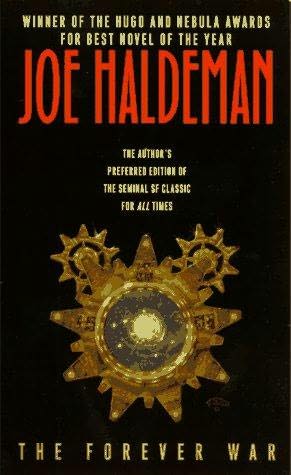 I'm cheating a bit with this entry, because Joe Haldeman is far from discount bin material(The Forever War is widely regarded as one of the 20 best sci-fi books of all time, which is an amorphous but still impressive honor), but considering how often sci-fi is marginalized in popular culture, I'm willing to allow it. Plus I made up the rules, and if you don't like it, tough.
I am not, typically, a sci-fi aficionado. I'm changing that, slowly, with this 'Discount Bin' feature, but it's still a genre that I'm largely ignorant of, and as such I have a fairly basic way of categorizing science fiction novels into two categories; soft sci-fi and hard sci-fi. Hard sci-fi is where the science is front and center, and dense, and often meticulously researched. Soft sci-fi is where the science exists merely as a kind of rack to hang the story on, and isn't explained more than is necessary to propel the story. Hard sci-fi is often full of big mind blowing ideas, but often, by design, is not very emotionally engaging. On the other hand, soft sci-fi, which I have to admit I usually enjoy more, is more geared towards exploring emotional and philosophical questions and uses the science as a starting point. The works of Samuel Delaney would edge towards hard sci-fi, while the works of Kurt Vonnegut would be clearly soft sci-fi.
I shared this viewpoint with my friend Eric, and it turns out he had a complimentary way of categorizing science fiction. He viewed sci-fi as either space opera or deconstructive. Space Opera was basically our myths transplanted to space, a way of reaffirming the truths we hold dear. Deconstructive sci-fi was the opposite, and used the medium to explore, subvert or argue against the ideals we as a society hold on to. Star Wars would be space opera, while Star Trek would be deconstructive(actually, it would bounce all over the place, since they tried to do so many different things with that show). If you were to take those and form a quadrant graph, with each corner of a square devoted to one category, The Forever War would form a pretty symmetrical shape smack dab in the middle.
The Forever War starts in the mid nineties where humans are much more technologically advanced, having discovered near-light speed travel(aided by wormholes which advanced the study of physics dramatically). When one of their research ships comes back horribly damaged, and all of it's crew dead, the military minds become suspicious. When first contact is made with an alien race(dubbed Tauran), humanity shoots first and asks questions later. So begins the Forever War, where the military drafts not dropouts, but the smartest and strongest college students(wanting physicists who would understand the technology needed), and then sends them out into deep space. If they survive, they will return to an Earth several generations on, where everyone they know is dead and everything has changed.
Given the option to resign after his first two year tour, William Mandella returns to an Earth several decades on. His father is dead, but his mother is alive, and Earth is suffering from the effects of a war that steals the strongest and brightest of it's children. He and Marygay, whom he developed a relationship while in space, find themselves unable to fit in to this violent, soul-deadening society, despite being immensely wealthy(military pay plus several decades of interest in their Earth bank accounts), and re-enlist as instructors. The army has other needs, and sends Mandella and Marygay back into battle. And so it goes. The two are sent back into the war, together for awhile until separate assignments make it impossible that they would ever see each other again(relativity being what it is, they will most likely die hundreds of years apart). Occasionally Mandella returns to Earth, or at least to humanity, to gear up with the latest technology and head back to the aptly named Forever War.
There are so many ideas in this book that I don't really know where to start. The science is at the forefront, and each idea is theoretically possible with what we know(or knew, in 1974) of physics. And yet, unlike some novels I've read, the technical details never go too far into mind-numbing statistics. Scratch that, it goes VERY far into the statistics, theories and practical uses of the technology, but it was like a really amazing PBS documentary that makes you want to go out and research the scientific theories at work. Much of this science is applied in weapons, of course, and there are some really fascinating things there, but a lot of it is also given over to relativity and the disorienting affects it has. It's one thing to leave for two years and come back to find Earth is 20+ years on, it's another to never know what type of enemy you're going to run into, whether they will be more or less technologically advanced than you. On first contacts, the Taurans prove to be horrible fighters, completely ignorant of warfare. They have some devastating weapons in space, but on ground they seem to have no concept of hand to hand combat. This changes as things go on, but it's never steady. They never know if, due to the physics of time travel, they will run into a group of Taurans that left port earlier, the same time as, or decades later than the humans did.
I think what makes The Forever War so distinguished among other Hard Sci-Fi books I've read is that he's applied the same conjecture to the social, emotional and philosophical ramifications of such an immense and expensive war. Each time Mandella returns to Earth, we are told of all of the changes on Earth, but also given explanations for how things got that way. For an arm-chair doomsayer like myself, all of it seemed completely plausible, and a bit more subtle than the average 'descent into savagery and fascism' than most sci-fi has. At several points Earth is even better off than when Mandella was drafted, since these things tend to go in cycles; things get better, things get worse.
By the end of the novel, Mandella has lived through over 1,000 years of human history, although of course it's been less than a decade for him. Towards the end he keeps getting sent out on missions because, as the oldest soldier, and one of only a handful to survive more than two encounters, he's become a folk hero, something for the propaganda machines on Earth to celebrate. The ending pulls out some sudden emotion, which seems slightly out of place against the fairly grim and emotionless events recounted prior, but it still gave me chills, and was immensely satisfying. I won't spoil it here, because it's a book that has surprises on almost every page, and really should be enjoyed blind(I've been careful to avoid some of the bigger shocks). I will, by necessity, be spoiling the ending when I review the sequel, but I'll give you all a few days head start.
I know I recommend stuff all the time, but right now I'm going to say that anyone reading this on a regular basis needs to go buy this book as soon as possible. I'm gushing, I know, but it really was a great book and surprised the hell out of me.
Subscribe to:
Posts (Atom)