Friday, November 28, 2008

Download

I don't want to step on the toes of the great Comics Curmudgeon(seriously, everyone follow the link and start reading, daily... it's funny stuff), but since he didn't mention this creepy creepy strip on his blog, I figured it would be fair game here.

The Family Circus, from the day before thanksgiving.


There are oh so many ways this can be twisted into something horrid and creepy, and absolutely no way that this can be taken as wholesome and religious, which is basically what Family Circus is from day to day.

Anyone still reading this? I'd love to get some alternate text for that panel.

Sunday, October 12, 2008

Spout #13(Part Two): Gowanus, Brooklyn

It's going to be almost impossible for me to really, fairly review Gowanus, Brooklyn. As a short film, a visual short story with beginning, middle and end, it's a horrible failure. And yet it's also a complete success, as a compelling piece of drama, a showcase for some good acting on the half of some previously unknown talent, and as a glimpse into the abilities of a talented young filmmaker trying to show the world what he can do. I'm sorry, that last bit might seem hyperbolic, but it's also true, and it needs to be noted because of the success he has with his attempts. Director Ryan Fleck intended this film as the feature-length it would eventually become, 'Half Nelson', and filmed a 25 minute short film/segment to drum up interest and financing. That he eventually succeeded, to critical acclaim, needs to be considered before judging the merits of this film alone.

Stranded at school when her brother fails to pick her up, Drey heads back inside to use the gym's restroom facilities, where she finds one of her teachers, Mr. Dunne, getting high in one of the stalls. She immediately asks him for a ride home. There are brief glimpses of a relationship that may build between the two, wary friendship or outright dependence, but that isn't the focus of this short. Drey seems well adjusted, but sullen, quiet, and lonely, and is obviously disconnected from all aspects of her life. Her mother seems loving, but absent most of the time due to work. Her brother, likewise, seems close to her, but he's older and part of a different world. She has friends at school, but while they chatter and laugh, she seems more interested in clusters of older children hanging out on the street corner. That probably explains why she grasps onto Mr. Dunne; she has something on him, proof of the fallibility of adults, and it brings him down closer to her level. Their both out of place in their own lives, and hiding something from the world. We don't see much of Mr. Dunne, but his misery is clear enough. It's there in his drug problem(always the cinematic sign of misery), and the extended pause he takes after getting into his car before he drives away.

We get a flurry of possible conflicts in this short film, and none of them are anywhere near resolution. Drey's mother has her own sadness and seems to be preoccupied with some horrible thoughts, Drey's brother is apparently involved in some not-quite-legal activities, and of course there's Mr. Dunne and his drug problem, and Drey herself and her alienation. Most of these conflicts aren't directly addressed, but are conveyed by lingering camera takes, and some meaningful glances.

A word should be said about the acting. I actually really like low-budget films and their non-actors. There's something appealing and even emotionally affecting about the sometimes stilted or borderline flat delivery. I like it's rhythm, and it's awkwardness. Not to say that any of that appears here. With the possible exception of the important Mr. Dunne, every single person appearing on screen seems to not even be acting, but to be living these events out. Every one of them is utterly convincing. I don't mean to say that Mr. Dunne, played by Matt Kerr, is a bad actor, but he doesn't seem a perfect fit for a role that should be much more magnetic and, yes, charismatic.

So there, a quick overview of a fantastic short film that should really only serve as a companion piece to a larger work. I find it very encouraging that Ryan Fleck was able to get his feature film made from this short, and look forward to seeing how everything plays out. There are many predictable ways in which this story could go, which we can call the 'after school special' approach, but judging from the work on display here, I don't have much fear about that.

Final Analysis: Would I pay money for a feature film directed by Ryan Fleck(and co-written by Anna Boden, can't forget her)? If it weren't already obvious, I plan on doing so later this week.

Monday, October 06, 2008

Spout #13 (Part One): Hyper

The disc I'm reviewing this time is a collection of short films, 13 to be exact. I didn't plan on writing individual reviews for each film, and I still don't. My friend and fellow Spout Maven Rik did that far more impressively than I could hope to do here. I'm leaving it up in the air right now, some posts may have only one short film, others may include a few, or I may just burn through the final dozen in the next post(that last one is highly unlikely). I do plan on treating each of these shorts as an individual film, however, and will be taking time to review all of the special features they may have(each includes at least one commentary). To many of these filmmakers, this short film they've produced represents just as much passion, sweat and ingenuity as a feature length film, and maybe more of that stuff than many features. I've also decided that the best way of reviewing these films, the best criteria, is a single question I'll ask myself at the end of every viewing; would I pay to see a movie directed by this artist? I'll answer the question for the first of these shorts, Hyper, in the following paragraphs.

Like the Ace, the subject of the fake documentary that is Hyper, and Rik, who suggested this disc to me, I move at a personal speed that is noticeably higher than that of the rest of the world. Part of that is my height, longer legs and longer strides, but most of it is motion. I fidget a bit, I pace constantly when I'm required to be on the phone, and I've somewhat mastered the ability to weave in and out of clusters of shoppers at the mall. And yes, this brings with it a level of frustration. Constantly slowing down to the speed of the people I'm with, or facing the terror of a packed mall where I'll have my own personal rhythm interrupted by some teenager who decides they don't need to see what's going on behind them before they stop short to stare at something in the window. That stuff can sometimes be annoying. I sympathize with Ace. But there is where the similarities end.

I may move at a faster than average clip when walking, and may experience mild annoyance when that clip is interrupted, but in general I am not worried about time. It does not appear logical to me to live your life watching the clock, or constantly measure time in a series of positive or negative blocks. In my life, as anyone reading my infrequent blog can attest, I am not averse to stopping to smell the roses, as it were. But Ace, well, Ace is a bit more extreme. Every moment of his life is lived in fast forward, counting every minute and adding or subtracting to some vague, unmentioned total. Working out while riding the train to work gains him an hour, while spending time with the girlfriend loses him 15 minutes. I'm not sure what he's keeping track for, or what he's doing with the total, but it completely consumes his life..

I guess that would be the biggest question: Why? What is Ace hoping to accomplish? What is he going to do with all that extra time? It's not as if it sits somewhere, accruing interest until some magical day when he retires. And besides, Ace seems to have no real goal or desire to be anything other than a courier, which he already is. He obviously doesn't want a family one day, as private time with a magazine in a public restroom seems more than enough domestic satisfaction. Sure, the point may be that all of Ace's tips for faster living are, in fact, pointless. That in the end Ace winds up stuck in his own rut, alone and never at rest. But I'm still unsure as to why this man would feel so compelled.

By the time I made it through this film for a third time, watching Ace gave me the sort of annoyance I normally reserve for those people who use wheelchairs but push themselves around with their feet.

Final analasis, would I pay to see a feature length film directed by Michael Canzoniero and Marco Ricci? Well, I wouldn't avoid it. I know that sounds like faint praise, but it's hard to judge from this short. Hyper was quick and fun and mildly stylized, but there was nothing to it to set it apart. Nothing in the film gave any idea about the philosophies, ideas or style of the talent behind the camera. So yes, if the subject matter of the film appealed to me, I'd love to see more from these guys.

Tuesday, August 26, 2008

Spout #12: Clean (Or; the redemption of Courtney Love)

OK, so perhaps the connection isn't that major, and it certainly isn't anything brought up by the movie itself, but the parallels are hard to deny. It's safe to assume that at some point in the production of this movie, which follows a woman blamed(by some) for the overdose of her more famous rock star husband as she tries to get her act together and regain some of her fame, someone must have brought up Courtney Love and Nirvana frontman Kurt Cobain. Perhaps Olivier Assayas even looked back to the story of that couple for some inspiration or ideas, but that's probably as far as it went.

At the opening of the film we see Emily(Maggie Cheung) and her musician husband arriving in a small town for a gig. Most of this is irrelevant, and only serves to impress upon us that Emily is a junkie, and she's blamed by those around her for dragging her far more talented husband into her addiction. In fact, the first thing we witness Emily doing is setting up a connection so she can score drugs later that night. Did I say most of this was irrelevant? I suppose it might be, except for that little action there. It's the drugs that Emily buys from this connection that propel the rest of the movie. After an argument(about drugs), Emily storms out on her husband that night, and separately the two get high. Emily wakes up in the morning, her husband does not. Returning to their hotel room, which is now a crime scene, Emily makes an ill-advised emotional outburst, drawing the curiosity of the cops, and landing her in jail once they find the heroin in her purse. Almost overnight, the fame that the drug-addled couple had been searching for finds them. Emily's husband becomes an overnight sensation. It's never stated what his level of stardom is, but we hear that his death made the cover of Mojo magazine, and his family is being helped out by old friend Tricky, so we can assume he was a bit of a one-time superstar in the indie music world. Emily, on the other hand, attracts nothing but derision, and everyone in the world is apparently convinced that she killed her husband. She denies this, to everyone, whether or not she actually believes it herself.

After 6 months in prison, Emily meets with her father-in-law, Albrecht(Nick Nolte), at a small diner somewhere. He offers to give her money, she refuses, he asks her to not visit her son, she agrees. Both of them seem to think that the child needs stability, and Emily can't give that to him. As a father, this sort of thinking bothers me a bit, and although I can't completely agree, I have to give Emily kudos, because this is undoubtedly the best decision for everyone. With the small amount of money left in her bank account, Emily heads home to Paris, where she gets a job at a restaurant, and dreams of regaining the fame she once had as a VeeJay for an MTV-like cable channel. Maggie Cheung here(it's important to give her credit for this, not just her character), is marvelous here, flitting from Canada to Paris to London, alternating between English, Chinese and French with ease, and always looking completely at home wherever she is. The irony is that she never feels at home, and seems endlessly restless and always wanting more.

As much as Emily constantly talks about it, she actually doesn't seem too interested in regaining any fame. Or perhaps it's the work she isn't interested in. She gives her friends some demo tapes, she has an interview with her old boss, but that's pretty much it. She doesn't seem interested in getting some like-minded musicians together or singing in a band, or hell, even karaoke. She just continues her addictions(methadone now, not heroin) and talks about how she should be famous. Eventually, as her life becomes on disappointment after another, Emily moves in with some friends and decides to get clean, taking a menial job at a department store. She even turns down her one best chance at making an album because it would clash with her plans to see her son. Suddenly, with none of the signposts familiar to most drug addiction movies, Emily has matured and started to change her life. Around this point Nick Nolte re-enters the film(Nolte suffers a bit from 'star cameo syndrome,' in that he never interacts with most of the main cast, and often feels like he's starring in a separate film). In London so his dying wife can see some specialists, he reintroduces Emily to her son, and helps end the movie on a positive note.

Clean is a bit of an odd duck; not really gritty or emotional enough to fit into the scores of other drug films, the film is surprisingly upbeat, but never really reaches 'after school special' levels of schmaltz. What it is is a calm, intelligent meditation on addiction and the ways we try to lie to ourselves to make us fit in. Emily, while certainly not the best mother in the world, is still surprisingly honest and open with her son. While not expressly admitting guilt in her husband's death, Emily is refreshingly straightforward with her son, telling him about his father, and their life together, and how drugs gave them both some very good times, admitting that it could have been either or both of them that died(which is true). Like I said, she never admits guilt, but the discussion does bring a catharsis of some sort, and it seems to cleanse Emily of some of the guilt and baggage she's been carrying around. The ending disappointed some, but it felt right to me. Emily is recording in San Francisco, with the prospect of a loving relationship with her son in front of her, and she walks off into the sun of a new morning, clean.

Wednesday, August 20, 2008

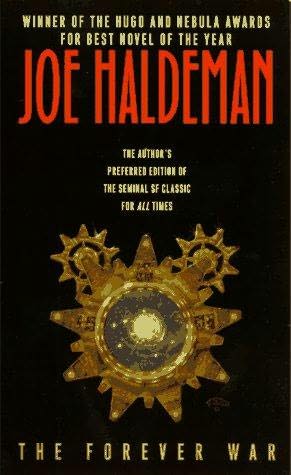
Tales From The Discount Bin: The Forever War

I'm cheating a bit with this entry, because Joe Haldeman is far from discount bin material(The Forever War is widely regarded as one of the 20 best sci-fi books of all time, which is an amorphous but still impressive honor), but considering how often sci-fi is marginalized in popular culture, I'm willing to allow it. Plus I made up the rules, and if you don't like it, tough.

I am not, typically, a sci-fi aficionado. I'm changing that, slowly, with this 'Discount Bin' feature, but it's still a genre that I'm largely ignorant of, and as such I have a fairly basic way of categorizing science fiction novels into two categories; soft sci-fi and hard sci-fi. Hard sci-fi is where the science is front and center, and dense, and often meticulously researched. Soft sci-fi is where the science exists merely as a kind of rack to hang the story on, and isn't explained more than is necessary to propel the story. Hard sci-fi is often full of big mind blowing ideas, but often, by design, is not very emotionally engaging. On the other hand, soft sci-fi, which I have to admit I usually enjoy more, is more geared towards exploring emotional and philosophical questions and uses the science as a starting point. The works of Samuel Delaney would edge towards hard sci-fi, while the works of Kurt Vonnegut would be clearly soft sci-fi.

I shared this viewpoint with my friend Eric, and it turns out he had a complimentary way of categorizing science fiction. He viewed sci-fi as either space opera or deconstructive. Space Opera was basically our myths transplanted to space, a way of reaffirming the truths we hold dear. Deconstructive sci-fi was the opposite, and used the medium to explore, subvert or argue against the ideals we as a society hold on to. Star Wars would be space opera, while Star Trek would be deconstructive(actually, it would bounce all over the place, since they tried to do so many different things with that show). If you were to take those and form a quadrant graph, with each corner of a square devoted to one category, The Forever War would form a pretty symmetrical shape smack dab in the middle.

The Forever War starts in the mid nineties where humans are much more technologically advanced, having discovered near-light speed travel(aided by wormholes which advanced the study of physics dramatically). When one of their research ships comes back horribly damaged, and all of it's crew dead, the military minds become suspicious. When first contact is made with an alien race(dubbed Tauran), humanity shoots first and asks questions later. So begins the Forever War, where the military drafts not dropouts, but the smartest and strongest college students(wanting physicists who would understand the technology needed), and then sends them out into deep space. If they survive, they will return to an Earth several generations on, where everyone they know is dead and everything has changed.

Given the option to resign after his first two year tour, William Mandella returns to an Earth several decades on. His father is dead, but his mother is alive, and Earth is suffering from the effects of a war that steals the strongest and brightest of it's children. He and Marygay, whom he developed a relationship while in space, find themselves unable to fit in to this violent, soul-deadening society, despite being immensely wealthy(military pay plus several decades of interest in their Earth bank accounts), and re-enlist as instructors. The army has other needs, and sends Mandella and Marygay back into battle. And so it goes. The two are sent back into the war, together for awhile until separate assignments make it impossible that they would ever see each other again(relativity being what it is, they will most likely die hundreds of years apart). Occasionally Mandella returns to Earth, or at least to humanity, to gear up with the latest technology and head back to the aptly named Forever War.

There are so many ideas in this book that I don't really know where to start. The science is at the forefront, and each idea is theoretically possible with what we know(or knew, in 1974) of physics. And yet, unlike some novels I've read, the technical details never go too far into mind-numbing statistics. Scratch that, it goes VERY far into the statistics, theories and practical uses of the technology, but it was like a really amazing PBS documentary that makes you want to go out and research the scientific theories at work. Much of this science is applied in weapons, of course, and there are some really fascinating things there, but a lot of it is also given over to relativity and the disorienting affects it has. It's one thing to leave for two years and come back to find Earth is 20+ years on, it's another to never know what type of enemy you're going to run into, whether they will be more or less technologically advanced than you. On first contacts, the Taurans prove to be horrible fighters, completely ignorant of warfare. They have some devastating weapons in space, but on ground they seem to have no concept of hand to hand combat. This changes as things go on, but it's never steady. They never know if, due to the physics of time travel, they will run into a group of Taurans that left port earlier, the same time as, or decades later than the humans did.

I think what makes The Forever War so distinguished among other Hard Sci-Fi books I've read is that he's applied the same conjecture to the social, emotional and philosophical ramifications of such an immense and expensive war. Each time Mandella returns to Earth, we are told of all of the changes on Earth, but also given explanations for how things got that way. For an arm-chair doomsayer like myself, all of it seemed completely plausible, and a bit more subtle than the average 'descent into savagery and fascism' than most sci-fi has. At several points Earth is even better off than when Mandella was drafted, since these things tend to go in cycles; things get better, things get worse.

By the end of the novel, Mandella has lived through over 1,000 years of human history, although of course it's been less than a decade for him. Towards the end he keeps getting sent out on missions because, as the oldest soldier, and one of only a handful to survive more than two encounters, he's become a folk hero, something for the propaganda machines on Earth to celebrate. The ending pulls out some sudden emotion, which seems slightly out of place against the fairly grim and emotionless events recounted prior, but it still gave me chills, and was immensely satisfying. I won't spoil it here, because it's a book that has surprises on almost every page, and really should be enjoyed blind(I've been careful to avoid some of the bigger shocks). I will, by necessity, be spoiling the ending when I review the sequel, but I'll give you all a few days head start.

I know I recommend stuff all the time, but right now I'm going to say that anyone reading this on a regular basis needs to go buy this book as soon as possible. I'm gushing, I know, but it really was a great book and surprised the hell out of me.

Sunday, August 17, 2008

Step Brothers

I'm choosing to review Step Brothers not because I have anything incredibly insightful to say about it, or that the movie inspired an intense reaction, but because I've given this movie a 4 star rating on Spout and feel like I need to qualify that a little. For those reading this on my Working Dead Productions site, a rating of 4(out of 5) literally means 'I liked it.' And I did. Kinda.

Oh sure, I got my two hours worth of laughs out of it, but in the end, I don't feel that there's really anything to recommend watching the full movie over the trailer. You get the joke in that short 2-3 minute montage of clips. The only joke. Will Ferrel and John C. Reilly are 40 year olds that aren't just man-children, but children whose bodies have become man-sized. There's some funny bits in between, some of it quite hilarious, and seeing Ferrel and Reilly dropping F-bombs at the top of their lungs never really loses it's comedic charm, but in the end, you see the trailer, you see the movie. I never really understood or agreed with critics who call a movie easily forgettable, but I will say that Step Brothers is just that. I'm sitting here trying to remember some of the one-liners from the movie, and I just can't do it. People will probably memorize and quote the movie, although probably not to the extent of Anchorman, but I won't be one of them.

Critics lately have been complaining about Judd Apatow's theme of arrested adolescents finally having to grow up, but I have to admit i still find it enjoyable. Perhaps it's because I count myself as one of that tribe, with my house full of comic books, video games, action figures and movie/music posters. I occasionally feel like I should grow up and start to put this stuff behind me, but then I realize that's just crazy talk. That scene in the 40 Year Old Virgin where Steve Carrell starts packing up his toy collection, it saddens me every time. The scenes in Step Brothers where the two guys just spend their nights watching Steven Segal movies and eating cereal? I wish that was my life. And I know it isn't just me. Just about everyone I know from my generation is going through the same thing. Apatow has struck a nerve with his films, but this one suffers from his more direct input(he produced, but neither wrote nor directed).

Step Brothers is stupid(purposefully so), silly, crass, and lazy. It's like an SNL skit, where it's a pretty funny idea, and then kinda settles and runs out of inertia as you realize you're going to have to wait for them to drag the gag out to movie length before they end it.

Friday, August 15, 2008

Get Off My Intellectual Property!

I'm halfway interested in the new horror film Mirrors for a couple of reasons. The first is director Alexander Aja, who directed the stylish(but completely inconsistent and mindless) slasher chase film High Tension, and the remake of The Hills Have Eyes. I almost thoroughly enjoyed High Tension when I saw it in theatres, and felt that his Hills Have Eyes remake was technically superior to the original, but emotionally and viscerally not in the same league. The other reason is that the film's central idea is eerily similar to an idea I've been kicking around since high school.

As a teenager I had a dream where mirrors weren't just reflections, but windows to alternate universes that were almost perfectly identical to our own. They looked exactly alike, but I was convinced that people in that mirror world were living their own separate lives. I could only imagine what they were doing when I wasn't watching. In the dream it wasn't malevolent, but it's hard to deny the creepiness in that idea. So it's made it's way into several ghost stories I've tried to write, and I made it a concept in my long(and slowly) gestating haunted house script. It's not a close enough similarity to seem like more than a mild coincidence, and it certainly doesn't mean I need to change my story, but it is a bit irritating now that if I ever do make my movie, I'll have the inevitable comparison to contend with. Or maybe Mirrors will be forgotten by then. It seems likely.

Or, maybe the moral is that I need to get off my ass and do something.

Stay tuned...