Sunday, July 27, 2008

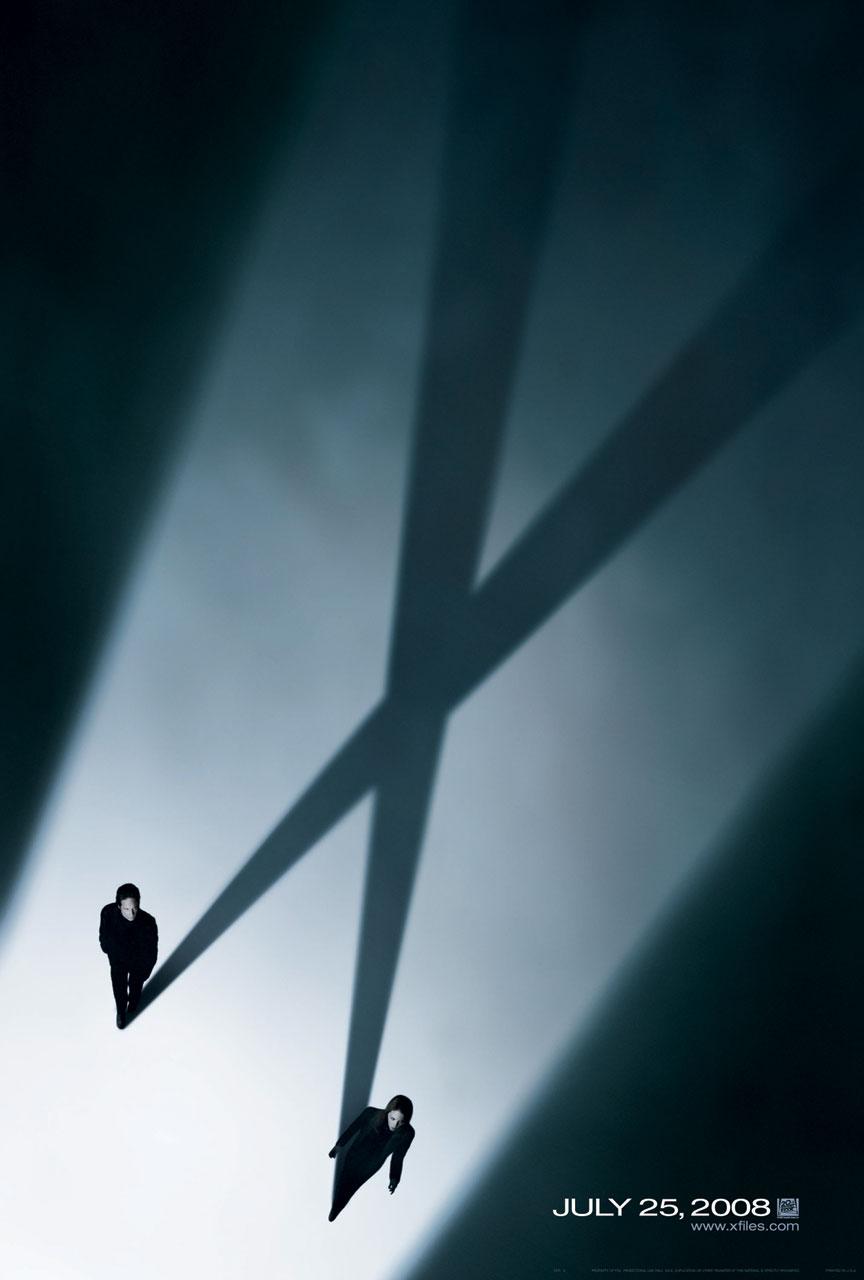
I Want to Believe That There is a Better Film In This Franchise's Future

It should be noted, before I go into this review, that I was never a huge X-Files fanatic. The closest I got was during the shows first 4-5 seasons, when I think I watched every new episode as it aired. I didn't join any clubs, write any fan fiction, or read any message boards about it, but I watched it all. I remember watching a few episodes with my grandfather, but it wasn't really his thing and eventually it was just me, in the dark, watching some of the scariest television I'd seen at that point in my life. But then, around the time the first film came out, I started to drift away. I would watch the show if I was home on a Sunday night, or if it was in syndication and I happened across it, but I stopped following the increasingly labyrinthine mythology. And then, for no good reason I can recall, I started watching again on it's last season. And for awhile, because I was so lost, the show fooled me into thinking it was more intelligent than it really was. In the end, I never blindly enjoyed the entire series, the way I will admit to doing with Twin Peaks, but it was always fun to sit down and watch a frequently creepy hour of television.

With that in mind, I think it's safe to say that my expectations were at a sufficiently low level for me to enjoy this film. I've read all the reviews from critics who were big fans of the show, and how this is a letdown after so long a wait, but I like to think I'm a bit more clear-eyed. After the first film, and the screaming nosedive the show took in it's final season(I will lay none of this blame on Robert Patrick, who did a fine job with a shit role), and the Seinfeld-esque clip show of a finale, I wasn't expecting too much. In the end, I think The X-Files: I Want To Believe can basically be described as a not-bad, but not-great episode.

Set, apparently, six years after the show ended(which would make it pretty much set today), the new X-Files movie finds Mulder living in the middle of nowhere, still meticulously clipping strange newspaper headlines and pinning them to his walls. Scully is a doctor at a catholic hospital, caring for a young boy who has a condition for which there is no cure. The FBI coerces Scully into tracking down Mulder(who's been hiding from the since they put him on trial in the series finale) to help with a case involving a kidnapped agent. In return they'll grant him a full pardon, although for the life of me I can't remember what crimes he was accused of, or why he ran away. The reason they were called in on this particular case is because the FBI's main lead comes from an ex-priest who claims to be having visions from God about the victims. The ex-priest is played by Billy Connely- even when he acts as grim and dour as he does in this film- and is a convicted pedophile, having molested 27 boys.

So here we have a pedophile priest, full of self loathing and practically forcing himself to believe God can forgive him. Scully, incongruously full of doubt and skepticism about the supernatural(9 years on the show and she still doubts Mulder and gives him the 'you're so crazy' look when he talks about psychics?), but also looking for validation for her own belief in God. A new FBI agent(played by Amanda Peet) who hopes that the priest is for real, and idolizes Mulder. And of course Mulder, who of course jumps to the most outlandish and ridiculous explanations before even considering something logical. Is the title of the movie making sense yet? Everyone in this movie- at least the four leads- is searching for proof that their beliefs are the right ones.

Thematically this fits in with the shows constant search for answers, but other than that it's hard to tell what really makes this an X-Files movie. It almost seems as if the filmmakers, impatient after years of aborted attempts, decided to take a pre-existing script and change the character names to "Mulder" and "Scully". The film is characterized by a distinct lack of supernatural events, and the ad campaign does everything it can to avoid this. That scene in the trailer where Billy Connely rises from the snow with black goo running out of his eyes? I immediately thought of the "Black Oil", a thought that was reinforced by a new "Black Oil" box set being released. Well, turns out he was just crying normal old tears of blood(a phrase I never thought I would use), and they digitally increased the amount and changed the color for the ads. Knowing how detail oriented some of the X-Files fans I can't help but think it was a deliberate attempt to garner more intense fan interest. Also, that scene where some dude is running away through a dark room, and he makes a dramatic leap while emitting a soft blue light? Also digitally altered. It was just a normal dude running from the feds. In fact, forget any mention of aliens in this film(aside from a quick reference to Mulder's sister), as the villains this time out are harvesting organs. And they're Russian, which I suppose is alien, in a different sense of the word.

Also, watching Mulder and Scully's sexual chemistry, which was once electrifying, is now like watching your parents trade sloppy kisses in front of your best high school friends. It was slightly uncomfortable. Don't get me wrong, there were more than a few times where I just had to smile because it was so cool to be watching some new X-Files after so long, but for the most part the film was a sluggish and mediocre.


Thursday, July 24, 2008

These Pipes... Are Clean!

You've probably noticed the silence around here, and all I can do is apologize. It's an old song of mine, I know, to make excuses for my inability to keep anything close to a normal schedule of posting. Let's face it, I'm a procrastinator. I'll always err on the side of lazing about. And all I can do is apologize again. To you, and to me. We both deserve better. Well, it's my pleasure to say that the times might be a-changin'.

Primarily, two things have caused my output to slow from infrequent to downright rare. A host of smaller issues helped, but the two big ones were a couple of projects of mine. One was a music cataloging project I was undertaking, and which now appears to be finished. You'll be seeing a couple of tangentially related musings over the next few days. The other was my latest review for Spout.com, which you can read by scrolling down the page for a bit. I can't explain it, but that review was the hardest one yet, and I sat on it for almost a month before I just decided to sit down and write whatever came to mind in one sitting. It's not the review I'm proudest of, but I think it pretty accurately conveys my pleasure in the film and my inability to form coherent thoughts about it. Maybe that's a good thing. Now that that is out of the way, I can focus on more personal, and, frankly, more rewarding projects. I had a few gestating, but in order to force myself to work on the review, I refused to work on them too much.

Add to those issues a full time job, my daughter starting pre-school(it's her first time in any sort of daycare program... big changes), some visiting friends I haven't seen in a long time, and other friends leaving state for good, and I just haven't been keeping my end of this little bargain. Now, however, with the obstruction that was causing all of the work stoppage cleared, and with this little bit of throat clearing out of the way, I dive back into work, and you will hopefully be seeing the fruits of those endeavors soon.

Thursday, July 17, 2008

Spout 11: Manda Bala

This review is a long time coming. A very long time. It's been weeks since I saw, and loved, Manda Bala, and yet I haven't gotten off my ass(or, to be truthful of my actions right now, ON my ass) to write up a review, or even a collection of thoughts. Manda Bala was excellent, more than I expected in every way possible, and yet I find myself grasping for things to say about it. The movie speaks for itself so perfectly that I don't think I could add anything that would heighten the experience. Or maybe I'm just having trouble finding a way into the movie.

Manda Bala is a documentary about... well... just what is it about? It opens with a man being interviewed about frog farming in Brazil, and he good-naturedly refuses to answer questions about some sort of scandal involving frog farming. So is it about frog farming and government corruption? Yes. The movie then shows us a young businessman who has invested thousands of dollars into protection, walks with a dummy wallet for random(and frequent) carjackings, and takes courses teaching how to outrun gunmen on the highway. So is this film about the insanely high rate of crime in Sao Paulo? Yes. Then we meet a woman who was kidnapped and held for ransom for 16 days, eventually having her ear cut off and sent to her father. So is Manda Bala about the human cost of corruption, violence and class distinction in one of the most impoverished parts of the world? Also yes. But wait there's more; the plastic surgeon with a surprisingly healthy God-complex who has made his name, and fortune, on reconstructing all of the dismembered ears of kidnap victims, the overworked and understaffed anti-kidnapping squad, the corrupt politician who has bilked millions- billions, even!- from his countrymen, and the masked kidnapper who sees himself as an urban Robin Hood, protecting and providing for his neighbors in the slums of Brazil.

Manda Bala is a complex spiderweb of a documentary, a project much more ambitious than the filmmakers apparently set out to make, and completely unlike the more high profile documentaries that make it to theatres. There is no narrative here, and no narrator. What we get are a series of interviews, some instances of found news footage and a few uses of title cards. But really the focus is on the personalities at play, and the filmmakers let their subjects speak for themselves. Obviously there is some judicious editing here; someone chose exactly which statements would make the cut, and someone chose how to arrange them to make certain ideas more resonant, but overall the film feels more honest and real than any documentaries I've seen lately. And yet the film has a distinct theatricality to it, which would seem to play against the realism on display. For one, Manda Bala is shot on film stock, which gives it a theatrical, commercial sheen. For another, all of the shots are shamelessly set up in advance. How else to explain how locations are perfectly lit as characters walk through them, purportedly for the first time?

The theatricality does not, as you would expect, detract from anything. Instead it lends Manda Bala a more exotic locale. The stories being told are all the more shocking with they take place in the middle of a postcard perfect color palette, and everyone is lit like a movie star. Perhaps I'm playing this up a bit much, since there would be no mistaking this for a Hollywood production. And yet, for all it's production values and manipulation of the image, the filmmakers don't attempt to create any sort of story out of this, other than what appears on screen. Obviously our natural inclinations will be to view the kidnapper(who has, presumably, disfigured victims, and has admittedly killed several cops) with disgust, the corrupt politician as a scumbag, and the plastic surgeon with the contempt we normally reserve for plastic surgeons. But think for a minute, and listen to their words. Sure the doctor seems like a prick of the first order, but he is helping people who more genuinely require his services than the average socialite. The kidnapper uses heinous acts of violence against strangers for money, but in his eyes he's fighting for survival, not just his, but his neighbors, in a country where the government and the wealthy are bleeding the life out of them. He has the most striking moments in the film, particularly when he talks of his own children. He has 9, and his wife is pregnant with number 10. He seems to view it as the only way out of the entire mess, and dreams that one of his children may grow up to be president and fix his country. And the politician... well... he's still a scumbag.

The point being, none of these characters has any judgments cast their way. And that, as great as it is, leaves me a little lost. I'm not used to documentaries not telling me how to think. What is this new feeling? Is this what those public radio hippies call independent thought? It feels good. And I'd recommend it to anyone out there reading this.

Tuesday, June 10, 2008

The Church of Cinema: Lost Highway

In the spring of 1997, my life was changed forever.

In the spring of 1997 I was out of high school, and doing nothing but lounging around and hanging out with my friends, working the occasional odd job for a temp agency here and there for spending money. Larger and more verifiable changes would be coming in the fall and winter, after I started going to college and began to expand my horizons past my basement apartment in my mom's house. And yet the spring of 1997 marked an important shift in both my perception of the world and my habits within it. Most of the time revelations are seen in hindsight, people rarely recognize life changing moments as they happen. But this time I did.

In the spring of 1997, Lost Highway came to town.

Lost Highway may seem like an odd film to lionize as much as I'm about to, especially considering it's reception, which ranges from outright hatred to bored indifference. A hardcore David Lynch fan is unlikely to point out Lost Highway as a pinnacle of his career, but to me it was an honest to god life changing event. In 1997 I had seen nothing like it, and I was completely unprepared for the film's dark world of sex, crime, doppelgangers, time shifts, mysterious men and dangerous women and just pure weirdness. Lost Highway opened my eyes to a whole new world of film that I didn't even know existed, and it shaped the course of my cultural cravings for, well, just over a decade now.

But let's back up for a minute.

Like I said, in 1997 I was still living at home, and while I watched several movies almost daily for this year long period, my tastes had not yet been defined. I was devouring everything I saw, but not really processing it. I'd like to say I enjoyed foreign and arthouse films, but really I was a blockbuster fan. I liked spectacle, and that's what I went for at the video store. That was on it's way to changing in '97, but I was still pretty blind to the world of cinema past whatever was in the horror or new release section of the local video store. I came to Lost Highway because of the involvement of two people. Trent Reznor of Nine Inch Nails produced the soundtrack and contributed two songs, while Marilyn Manson had a brief, brief cameo late in the film. Marilyn Manson and Nine Inch Nails carry with them some pretty negative and embarrassing connotations, but both bands were big in my personal high school life, so when I began reading about this new film both of them would be connected to, I became interested.

At this point I know I'd seen an episode of Twin Peaks; I'd flipped over to it one night because you couldn't open a single publication in the first two years of the 90s without hearing how great the show was. But I was too young, and came to the show too late, so it made absolutely no sense to me and I never returned(I would later, and that obsession would grow and deepen to almost Star Trekian proportions). I'd also seen Dune, but I only had vague childhood memories. My point being that I had no real idea who this David Lynch guy was, but several people in bands I liked had cited him as an influence, and he was spoken of in terms that made me feel as if I were somehow depriving myself by not seeing his films.

When Lost Highway was released, it took a few months to reach Alaska, because at the time there was only one theatre that ran arthouse films; the Capri. I miss the Capri immensely, even though I only saw a handful of films there. It was a tiny, tiny place with a postage stamp screen and some pretty dilapidated chairs. But what it lacked in luxury it made up for in style. There was a cafe attached, with some chairs and magazines, and a collection of old lobby cards and posters for sale. The place exuded a love for cinema, be it underground, foreign, old-time Hollywood, or unapologetic junk(Hitchcock posters shared the same space as DC Cab advertisements). Also it was the only place in Anchorage you could see movies not put out by one of the major studios unless you wanted to wait for video. When the Capri got Lost Highway, I made sure I was there on opening night. And then every other night of the one week that it played. Each night I went with another friend, and each night we spent a few hours discussing the film and each night we had another theory as to what it all meant, and what had actually happened.

I can cite some specifics, but I don't know how well it will describe the film. Fred Madison(Bill Pullman) is a man apparently unable to express any emotion in his daily life, as he lives in a large home with his beautiful, distant wife, Renee(Patricia Arquette). The only time he perks up is when he's on stage playing the saxophone at a smoky nightclub. He and his wife speak in monotone sentence fragments with each other, disconcertingly direct without actually saying anything of meaning, and they have passionless sex. The two begin receiving a series of unlabeled VHS tapes that contain footage of their house, each successive tape becoming more and more intrusive, finally showing footage of a distraught Fred lying amid the scattered body parts of Renee. Fred has no memory of this, but is still sentenced to death for her murder. One morning, when the guard checks on Fred, he finds instead Pete(Balthazar Getty), with a nasty bruise on his head. No one can explain how Pete ended up in the cell, or where Fred went, and the film never fully explains it either. The clues are there, but the answer isn't.

Pete is released, because there's no real legal reason for him to be on death row, and he goes home. His parents and girlfriend make some cryptic statements about 'that night', but they won't speak about it, they only say that he was with a man they've never seen before. Pete works at a garage, where he's become the favorite of over the top crime boss Mr. Eddie. Mr Eddie's girlfriend Alice is also played by Patricia Arquette, and she and Pete begin a very dangerous and very passionate relationship. I'm going to stop my description there, because to go further will not really explain anything, and will ruin some of the bizarre happenings still to come. And really, if you haven't seen the film I haven't done it justice. It's like a fever dream version of Vertigo(the film has more than a few allusions to the Hitchcock classic).

The film is full of mysteries, and piles enigma on top of enigma. Is the man in white face(Robert Blake) that exudes such creepy menace with Fred at a party the same man who was seen with Pete the night he ended up in jail? Are Alice and Renee the same woman, or are they two separate women that both men see as one? Did Fred switch places with Pete, or did Fred become Pete? You can come up with any number of theories, but none of them will be completely satisfying. Some reviewers have stated the movie is going for style over substance by not clearly defining it's world, which I don't see at all. Lynch's films have repeatedly put the focus on the mystery, not the answer. His original plan for Twin Peaks was to never solve the Laura Palmer mystery, but instead focus the show gradually on the town's other residents. I think this is key, in that decoding Lost Highway isn't the point. The point is to get lost on the journey.

After watching the movie several times with several groups of people, I eventually happened upon a theory that made the entire movie make sense, in a loose, figurative sort of way. I began to believe that the entire film was Fred/Pete in a fugue state, along the lines of Incident at Owl Creek Bridge. The idea was that the night where Fred became Pete was actually the night Fred was executed, and that the entire next part of the film was him trying to escape into a fantasy life where he's young, passionate, and desired by women. That fits, mostly. There's a few glitches in there, most notably the actual end of the film, but it could all be explained away. And that stuck with me for a few years. And I actually began to enjoy the movie less when I thought I had figured it out. Luckily that didn't last.

I recently rewatched the film, as it had finally come out on an acceptable North American DVD(the previous Canadian disc was pan and scan), and I tried to ignore my old theory and watch it again with fresh eyes. And I loved it. I saw that the fugue state theory doesn't really hold up. For one it makes everything in the movie- all of the clues- meaningless. The characters who repeatedly pop up in key scenes are now suddenly merely coincidence, and all of the doom-infused foreshadowing really doesn't matter at all. Some cynics may think that's the joke, that Lynch was merely pranking his audience, but I think otherwise. David Lynch is so specific in every little thing he does(although making room for some happy mistakes, like the inclusion of Bob in Twin Peaks), from building many of the props himself, to set design, framing, delivery and dialogue, that I think it all really must add up to something. But I also think he's removed a few clues, or obscured them deliberately. Like I said, the point isn't to know, but to wonder.

David Lynch is a director I've always felt I understood emotionally more than I've understood him intellectually. I can't dissect his films with a clinical eye and speak about them completely critically, but I always feel like I'm on their wavelength. His movies speak to some part of me that I haven't yet fully discovered, but that still affects me. I may laugh, cry, or become absolutely terrified of his films, but I may not be able to pinpoint exactly why.

As a film, Lost Highway may have it's faults(though you'll have a hard time convincing me of that), but in my life it's grown to something more. It symbolises the turning point where I stopped passively consuming entertainment, and began to hunt down the hidden gems. David Lynch was actually the first director where I began to understand what a director really does. I began to seek out films by certain directors, and I began to notice their individual techniques. I began to study films, notice things like writer or director or even director of photography. I began to ask what it means, or maybe just what it means to me.

The Church of Cinema: A Preamble

I love movies, obviously, and I love my home entertainment center. I love DVD(and, slowly, I will come to love Blu-Ray), and I love popping a disc into the player in the wee hours before I go to bed at night. But above all, I love going out to the theatre. I don't do it as often as I once did, or as often as I'd like. Partly that's due to the consequences of having an 8-5 job, a child, bills, and a healthy ongoing relationship. But it's also partly due to the changing theatre experience. And yet, despite the fact that theatre chains are charging us more for less, and all major chains now play television commercials and military propaganda advertisements-sometimes under the guise of an exclusive 'short film'- I will continue to treasure the theatrical experience above the home theatre experience. There's just something to be said for surrounding yourself with strangers in a dark room while this fantasy plays out in larger than life scales, knowing that for those few brief hours you are connected with the people around you in your emotional responses.

Our local arthouse theatre, the Bear Tooth Theatre & Pub, which isn't quite an arthouse theatre but plays arthouse films more than any other movie house in the state, is a wonder. Great seating, tables or booths, a balcony, a restaurant on site with the best pizza in town, and a bar with locally brewed root beer, cream soda, or alcohol. All for 3 bucks a movie(they make their money back on expensive, but worth it, food). Heaven, right? Well, sometimes. Part of the problem, in fact, the main problem, lies in the audience. I love going to a movie and getting involved in the audience experience, but when you give people beer and pizza at a movie, they start to feel too much at home, and the Bear Tooth has the most vocal audiences in town. And not in a fun, Rocky Horror way, but in the way that they loudly talk to their friends, or forget to turn off their cell phones. This is something everyone has dealt with while out at the movies, and I for one have decided to not put up with it anymore. If you find yourself in a theatre, and your cellphone goes off, and you answer it, or if you have in depth conversations with your friends about what boys at school you think are cute, don't be surprised if I walk over and very politely ask you to 'shut the fuck up!' I do not tolerate people at the theatre who think they're at home. And so far this has not been a problem, most people are so shocked by a stranger saying anything to them about their bad habits that they apologize and spend the rest of the film in silence. I urge you to try it. You don't have to be mean, as I sometimes am, just quiet and insistent.

My other problem with the Bear Tooth is their increasing dependence on DVD. It used to be that all of their 'classic' films(every other Monday) were from old touring prints, complete with scratches and sometimes faulty audio. But now they have a DVD player, and use that as their primary projector when it comes to older movies. And they don't even have to be older films. Is there a foreign film currently touring the arthouse circuit? Well, if the Bear Tooth is playing it, it's likely the imported DVD version, which often has less than suitable subtitles, and has the added problem of occasionally freezing or shutting off.

I had an argument with a projectionist friend about this recently, saying that I preferred film prints, with all of their defects, over a DVD copy I can just watch at home. This is why I stayed home instead of venturing out to watch Carnival of Souls or Night of the Living Dead, two of my favorite black and white horror films. That, and the drunken Tooth crowd is not always very friendly to B-movies. My argument was that I actually kinda like the scratches and missing frames. They add character to an old film that's been around the block a few times. Her rebuttal was that, as a projectionist, she hates to see any imperfections on screen. I think I won the argument when we saw The Shining on Halloween(at a different theatre), and it was an old print with plenty of glorious imperfections.

[At this point I need to acknowledge that I might be a bit unfair in my portrayal of the Bear Tooth. It's a wonderful establishment and I look forward to going there every chance I get. My disappointment comes from how great the place COULD be, in addition to how great it already is.]

Maybe I'm just being an elitist snob, unwilling to accept this newfangled digital revolution, but I can't help it. I'm always going to prefer seeing a movie on film stock, much the same way that old music fans can't let go of vinyl. And in fact, I think there's a reasonable explanation for this preference. Scratches in the film remind me of my childhood. They remind me of watching horror movies on TV in the days before I could handle them, when every cheesy rubber monster or skeleton on strings sent me under my covers and probably scarred me for life. Even now, as a jaded adult who complacently sits through some of the most horrible gore, a simple skipped frame or scratched negative gives me a whiff of childhood terror. It's why I enjoyed Grindhouse so much. Particular Planet Terror which got the feel of those old late night horror movies down just as well as the overall look. And that viewing of The Shining still had the power to scare me. Part of it was the scratches, and another part of it was the crowd. It was a small crowd, but everyone there was caught up in the same sweeping waves of terror.

And I remembered again why I can't use a bathroom with a closed shower curtain.

Saturday, June 07, 2008

The Pull List

Every week I buy a small stack of comics. It can range depending on each week, but I'd say it's an average of 6 or 7. It's also, primarily, the only reason I'm holding on to my job at the comic shop now that I am gainfully employed full time elsewhere. Comics are getting more expensive, and although their still a few bucks each, that starts to build up when you look at what I buy monthly. And yes, I am cutting back. Here's a small sampling of my most recent purchases. I bring these up because it was a pretty good couple of weeks, and I think these comics would be of interest to people who read my blog.


Stephen King's Dark Tower: The Long Road Home #4(Of 5)
Script: Peter David, Art: Jae Lee & Richard Isanove
As I wrote awhile back, I have a sort of love/hate relationship with Stephen King's Dark Tower series. On the one hand I find the early books to be long winded and exceedingly dull, full of aimless wheel spinning. On the other hand, I really dig the first novel, and I found the final 3 books to be exceptionally entertaining, despite a few embarrassing missteps(the weird, out of nowhere Harry Potter references were cringe inducing). The first comic series, Gunslinger Born, was pretty faithful adaptation of Wizard & Glass, the 4th book(the comics will be tackling the story chronologically, not by the release date of the books). The oddly distorted art by Jae Lee and Richard Isanove, along with Peter David's writing, which can be hard to get into if you aren't used to the speech patterns of King's characters, gave the whole book the epic tone it deserved. Now we're into the second series, which picks up directly where Gunslinger Born left off, and is showing us a part of the story not really mentioned all that much in the book. It gives the writer a bit more freedom, and it's safe to say he's using every bit of it he can. I'll have to wait until the final issue hits next month to make any real judgment, but so far I'm not sure I like all the new changes. It was already established that this series is a reinterpretation, and not a strict retelling, but I can't quite divorce the story of this comic from the one in the books, and something in me keeps balking at most of the changes. I figure eventually I'll get over it, and nothing has happened yet that actually contradicts the book, so I guess it could go either way.

Giant Size Astonishing X-Men #1
Script: Joss Whedon Art: John Cassaday
So it's finally here, the final issue of Joss Whedon's incredible Astonishing X-Men run. The series was an immediate hit with fan boys, who quickly turned on it when the publishing schedule became... irregular to say the least. But shipping delays aside, the book has been consistently hilarious and emotional and epic, basically what you'd expect from a Joss Whedon project. It's saying something that Whedon has finally made me accept that Cyclops might have the makings of a true badass after all. The story line is supposedly in continuity, meaning that the events in this series have affected the overall Marvel universe, but it's also been entirely self contained, meaning that the Marvel universe hasn't affected this story at all. Bringing together plot threads that Grant Morrisson brought up in New X-Men, Whedon has mined some terrific storytelling opportunities that have been largely ignored by the rest of the Marvel universe. And here it all comes to an end. A bittersweet, entirely awesome end. I had chills. Warren Ellis is set to take over this title soon, and I love Ellis, but I honestly don't think I want to see another writer continuing this team's adventures.

Buffy The Vampire Slayer Season 8 #15
Script: Drew Goddard Art: Georges Jeanty
Speaking of Joss Whedon, things at his flagship property just keep getting better. Drew Goddard's arc, which garnered attention from the news media when Buffy had a lesbian tryst with another slayer, concludes quite spectacularly here. It's odd that my favorite moments in the series have mostly been by people other than Joss, when the exact opposite is true in the television series. While this issue gets a bit over the top in an enjoyable, but completely silly way with, say, the giant Mecha-Dawn in Tokyo, it pays off with Andrew's geekgasm as he watches from a rooftop. The ending to this story line is anything but neat and tidy, with some pretty doom infused foreshadowing, and some serious emotional content familiar to anyone who's seen the show(hint; when the characters are happy, bad stuff is about to happen). Any fan of the show should be picking this up.
P.S. Favorite moment of the issue; Willow's exchange with Buffy: And, just so you know, I never wanted to sleep with you either.

Trinity #1
Script: Kurt Busiek Art: Mark Bagley
(Backup story art by: Scott McDaniel & Andy Owens)
The first issue of DC's new weekly comic, following in the footsteps of the excellent 52 and the overall average Countdown. Kurt Busiek left Superman to write this, and at the time I was a bit depressed, since his Superman run has been one of my favorite reads over the last couple years, but now, reading this, some of my sadness has disappeared. The focus of the series is apparently going to be Batman, Superman & Wonder Woman, the holy trinity of DC comics, as they investigate the meaning behind some cosmically ominous dreams. This storyline didn't do much for me, and Mark Bagley was great on Ultimate Spider-man, but is less than stellar here. He seems particularly ill-suited to drawing Wonder Woman. But then came the backup story, which runs concurrently with the main story but from a villainous perspective. This was much more intriguing, with some creepy glimpses into the possible future of the DC universe; one, showing Green Arrow clashing with Ragman over who gets to guard Gotham City, seems to tie into the currently running Batman R.I.P. story that Grant Morrisson is writing. I'll be picking this up next week, and hopefully the quality of the first story will rise to meet the standard of the second story.

Final Crisis #1
Script: Grant Morrisson Art: J.G. Jones
Forget what you've heard about this being a confusing let down, it's all just over reactive backlash against the hype. I found this to be a pretty solid affair, although much less flashy and bombastic than most DC 'events'. Most DC comic books require a PHD in comic book continuity to fully appreciate them, and either I'm picking this stuff up through osmosis, or this comic book is toning that down a bit. I didn't have to open up Wikipedia once! Ok, but ONLY once. The story seems to be following some of the other DC books I haven't been reading, like Death of the New Gods, but it's grounded enough in the main stories that I had no trouble following along. Grant Morrisson loves 70s comic books, and he resurrects a couple villains here that haven't been seen since. As a primer it might help to read Justice League of America #21 or DC Special: Justice League of America #1, both released last month, one reintroducing the pivotal character of Libra, and the other reprinting his only previous appearance, from 1979. He's a cool villain, and the possibilities look to be just the kind of cosmic psychedelia that Morrisson loves so much.

Kick-Ass #3
Script: Mark Millar Art: John Romita Jr.
And here it is, the entire reason I chose to write about comics this post. Kick-Ass has been enjoyable from the start, with lots of sickening violence and humor, with a character that probably describes just about every kid(or man stuck in adolescence) that reads comics. Or, at least the vast majority of them. David is kinda a dork, but not a caricature. He isn't unpopular or despised, he has friends, he just doesn't fit in with the cool crowd. It's a much more honest portrayal of teenage life than most comics even attempt. Plus there's lots of violence. Did I mention that? In his free time, David reads comics, and has become obsessed with putting on a homemade costume, grabbing a couple of bats, and prowling the streets looking for criminals to beat up. Usually this goes wrong, and he gets beaten up a LOT, but he keeps trying. He becomes an instant sensation when someone puts a video of him protecting someone from gang members on youtube, and suddenly he's adored by millions. He starts a myspace page that people with problems can use to contact him, as we see in this issue. Things go typically awry and David seems to be about to get his ass kicked again, until someone very unexpected arrives to save the day, and adds another dimension to the idea of dressing up in tights and beating up evildoers. My pulse quickened reading this book, and I have made it my mission to annoy everyone into reading this book. So go do it!

Tuesday, May 27, 2008

Download

I can't speak for everyone, because I am, unfortunately, not able to read minds, but I'm going to assume that most people are like myself in that we all think in literal terms. I mean, we all think in words, sentences and paragraphs. I do this all the time, I'll think of something as if I'm composing a letter. It actually bothers me sometimes, because I'll actually get caught on a word and stumble around trying to complete the thought even though the thought was already fully formed in my head. I'm only assuming that this is how most of us view the world and compose our thoughts; with language.

Something that jumped into my mind for some unknown reason is; How did Helen Keller think? I don't mean to imply that Helen Keller could not think, or was mentally inferior to others(quite the opposite in fact), but I cannot at all imagine how her brain must have worked. To have to piece the world together without a picture to go with it or a language to express it in. Of course, eventually sign language came into it, but that's still a stumbling block for me. She wouldn't have had a visual image to think with, or words to compose. I can't conceptualize how she must have seen the world and how her thought process must have worked. She wouldn't have had a visual image to think with, or words to compose.