Wednesday, April 30, 2008

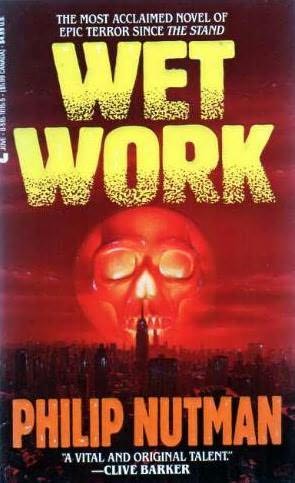
Tales From The Discount Bin: Wet Work

I've got mixed feeling about this book, which was expanded from a short story that appeared in the Night of the Living Dead inspired anthology Book of the Dead. In many ways Wet Work is spectacularly, awesomely bad, but in other ways it's just plain bad.

Phillip Nutman does deserve credit for creating a fairly unique vision of a zombie apocalypse, where Comet Saracen rains down radiation that revives the dead and weakens the immune systems of the living. The twist here is that not all zombies are brainless, although all of them are bloodthirsty. For reasons not explained in the book, some zombies retain all of their mental capacities, and actively choose people to recruit to their ranks, saving the rest to live as cattle. Sounds promising, right? Unfortunately the book takes until nearly the halfway point to actually bring the zombies into the heart of the action, leaving them mainly on the sidelines while the action is focused on two disparate storylines, neither of which is incredibly fast paced or interesting.

Story A follows Dominic Corvino, an Italian CIA assassin with a penchant for Billie Holliday and silk Karate Gis. Most of his story is devoted to a botched job in South America and his investigation into who betrayed his team. It's no real surprise to say his investigation doesn't stop when he's shot to death by a fellow assassin, although it should have. I mean, you'd figure a seasoned CIA assassin would know enough to shoot someone in the head. That's common knowledge even when there aren't zombies running around. Story B follows Nick Packard, a rookie cop teetering on the edge of alcoholism as he begins his career on the mean streets of Washington D.C. while his wife is away to be near her dying mother.

While I can't say Mr. Nutman is a horrible writer, he isn't an especially spectacular one either, particularly when it comes to pacing. The book lurches unsteadily along, seeming to build up speed repeatedly only to veer away from any buildup of action to focus on some fairly tedious domestic action, and then suddenly picks up steam and races to it's conclusion in the last 60 pages or so. Nutman is the type of author who explains characters rather than allow them to reveal themselves through their actions, so it's hard to get fully involved in the parts of this book where we're supposed to be worrying about their predicaments.

On a side note, this book was written in 1993, and takes place in 1995, and yet the president, although never named, is clearly George Bush, and Dan Quayle is the vice president. It's never explained, although I am curious as to how he could have made such a mistake, or why he would employ such an anachronism. That's the largest, although not the only, error in the book. It's clearly stated early on that the Zombies feel no pain, and yet when it suits the story they are shown and described as being in pain from certain wounds.

Still, the book passed a boring day answering phones at a temp job(no, I wasn't slacking, they told me to bring a book!), so it has that going for it. And really, what's not to love about a climax that features a full on kung-fu fight between two zombies in the lobby of the Pentagon(which had been converted into a farm where live humans are kept to be fed to the politically elite?

Sunday, April 20, 2008

Another in the Continuing Saga of the End of the World

One of my favorite sci-fi/horror films, and based on a great Richard Matheson novel, The Incredible Shrinking Man remake had the potential to be a pretty fun film, with the right creative team at the helm. Of course, notice I used the past tense in that statement. The Hollywood Reporter broke the news the other day that there's a new director looking at this project, and it's none other than Brett Ratner, and the plan is now to turn the film into a comedic vehicle for Eddie Murphy, who apparently has had enough of fat suits and is planning on taking the other direction.

The only glimmer of hope is that Thomas Lennon and Robert Ben Garant, of Reno 911! and the awesome The State, are the latest writers to take a stab at the script. Unfortunately, their absurdist, edgy humor will almost certainly be whitewashed by the increasingly pedestrian Murphy.

Really, there is nothing about this story that I'm happy about.

Monday, April 14, 2008

We Now Resume Our Regularly Scheduled Programming

In retrospect, Poultrygeist probably wasn't the best film to be eating a large meal at. But I couldn't help it; Bear Tooth has such good food. I can't sit through a movie there without scarfing down a pizza, or their Pesto Treats, or their steak and cheese nachos. If there isn't a law against going to the Bear Tooth without eating, there should be. But still, had I given it much thought, and considered that I was about to watch a Troma film, one directed by Lloyd Kaufman himself, I probably would have opted out of the Brewhouse Favorite pizza. Luckily food was delivered during the opening scene, which, as vile as it was, was still tolerable and well within expected Troma standards. However, a few minutes into the movie, when Michael Herz showed up and proceeded to disrobe while the audience got a way-too-personal view of his bathroom behavior, I pushed my pizza away, never to be touched again(actually not true, I had leftovers for lunch the next day).

To be honest, Troma films haven't changed much over the last 20 years(they've been in operation for over 30, but I only became aware of them with the Toxic Avenger in the late 80s), which is either a good thing or a bad thing, depending on who you ask. I suppose I'm of the opinion that it's a good thing, and Troma has certainly cultivated and appeased a very rabid audience with their shenanigans. I myself have grown past the time in my life where I avidly devoured Troma films and bought whole-heartedly into their gung-ho obscenity, but every now and then I'm in the mood for some mindless T&A, gore, and outrageously indecent humor(to call it politically incorrect would be a vast understatement).

And yet, with Poultrygeist, there's some sign of growth. Sure, the jokes are meant to offend more than to make any actual point, the gore is nonstop and amateurish, the cast is full of people who, though they lack talent, have no shortage of enthusiasm, and Mr. Kaufman seems to be of the opinion that fart noises make everything high-larious, but it all comes together much more smoothly than in any film of theirs I've seen since the original Toxie. Lloyd Kaufman(and co-screenwriters Daniel Bova and Gabriel Friedman) seem to have a pretty sharp satirical eye(the faux-lesbian, anti-corporate protesters all drink Starbucks), but for the most part are content to go for the easy mark, and opt for buckshot rather than precision sniper fire. Oh yeah, and it's a musical(at least for the first half).

A lot of credit for the success of this film needs to go to it's two leads, who are not just good in comparison to past Troma actors, but are actually decent actors.. Kate Graham(Wendy) and Jason Yachanin(Arbie, yes, all the characters are named after restaurant chains) play high school sweethearts reunited after a semester of college. Wendy is now a lesbian protesting the arrival of a new chicken restaurant because it was built on an old Indian Burial Ground, and Arbie takes a job at the place to spite/impress her. Of course, undead chickens begin to rise, creating undead chicken/human hybrid zombies. The two leads make the most of a script that occasionally asks them to pantomime wild sex with a cash register and cross eyed exclamations of surprise and show some real presence and comic timing. Kate Graham is particularly notable for her excellent singing voice, which is nice enough that I was paying as much attention to that as I was to her lesbian make-out sessions during the musical numbers.

Poultrygeist is the first Troma film I've ever seen in a theatre, with an audience not completely made up of my trash-loving friends, and I have to say, the change in surroundings did wonders. Apparently the audience the night before was no so appreciative, with about half of the spectators walking out, but my audience seemed to get it. Riotous laughter filled the theatre, and there were even a few claps at the end of the movie.

And so, take it from me, Poultrygeist is the best musical horror film about undead chickens with a scene in which a man grows breasts that turn out to be eggs that give birth to baby chickens and then he begins to regurgitate food for them that you will ever see.

Or at least in the top 5.

Just don't plan on eating anything else that night.

Wednesday, April 02, 2008

Send Me Your Mixes!

Earlier tonight I discovered the site muxtape.com, which is a super simple form of music sharing. Basically you upload up to 12 MP3s in your own customizable mixtape. You choose your URL("URL".muxtape.com) and then send it out to your friends for them to hear. It's super simple, and not really an essential activity, but it's a pretty fun timewaster. I spent some time on it tonight, and made a quick mix, and it really couldn't be easier. Which is also a bit of a drawback. There's no real organized way to search mixes, although there is a large, constantly changing list on the homepage. You can't download songs from another mix, only stream them, and so far there's no way to comment on someones mix. You can add it to a small list of your own private favorites, but nothing else. So really, the only way people can find your mix is if you tell them about it. Also, you can only have one list per account, but on the plus side you can always change it.

Here's my first mix, which is really nothing special. I basically threw up a few songs that were already on my hard drive. And I don't usually keep music on my computer, so the pickings were rather slim, mainly some oddities I had recently downloaded.

I encourage you all to make your own mix, and send the link to me. I love hearing people's mixtapes.

Wednesday, March 19, 2008

Spout #9: A Peck on the Cheek

Prior to A Peck On The Cheek I had no real experience with Indian movies, outside of some of the more notorious Bollywood knock-offs of American films. Obviously those films do not constitute the entirety of Indian arts and culture, just as craptacular diversions such as Epic Movie or the Larry the Cable Guy oeuvre do not constitute a balanced view of American culture. So I set out with the direct purpose of dispelling the stereotypes I had built up in my head, and hopefully I would be rewarded with an eye-opening, mind expanding look at a completely foreign culture. On that front it both succeeded admirably, and failed miserably.

A Peck on the Cheek is the story of Amudha, a girl orphaned by the violent uprisings in Sri Lanka, who is adopted by a well-to-do(I'd imagine upper middle class, like the Cosby's, would be most accurate in describing their station in life) family as a baby. On her 9th birthday she is told of her real mother, and eventually talks her parents into traveling to find her. That's the condensed version, but the film itself is much, much more than that.

A pre-credits sequence shows an arranged marriage between Shyama and Dhileepan. These scenes are short, but we see through their shyness and awkwardness at their first meeting during the marriage tells us these are good people, and the humor of that wedding night, and the few domestic images we get, only reinforce that idea. Unfortunately this happiness is not going to last. An idyllic day out, swimming and walking through the woods, is interrupted by a troop of soldiers marching through the woods. Dhileepan orders to Shyama to run to her father's, while he remains behind to attack the soldiers in some unseen fashion. We find out that Shyama is pregnant, and is sent out of Sri Lanka with a boatful of refugees by her father, and she gives birth in a Red Cross center. This is the last we see of Shyama for most of the film as we jump, post-credits, to the 9th birthday of Shyama's daughter Amudha.

Amudha's parents seem loving and wholesome, but they show some pretty inept parenting skills. Choosing to tell the girl of her adopted status isn't in itself a bad thing, but choosing her birthday, of all times, seems needlessly cruel. The parents take turns reacting in sullen disappointment when Amudha is less than thrilled by this news, and her younger brothers use this information to tease her mercilessly. It's understandable that Amudha attempts running away to her birth mother several times before Indira & Thiru(her adopted parents) agree to help her locate Shyama. It's a noble enough endeavor, and certainly made with only the best of intentions, but it shows a slightly malnourished world view.

Sri Lanka is still in the midst of a violent uprising, and bringing a young child into the middle of a guerrilla war may not the wisest of moves. But it is in these scenes that the film kept surprising me. Every time I settled in for some rote melodrama, the film took a turn into some fairly gripping scenes of urban warfare. Almost immediately upon their arrival, Amudha is slightly injured in a suicide bombing, and guerrillas are constantly lurking in the background as tanks and soldiers march down public streets. Still, the family perseveres, with the help of a local doctor who acts as their guide, and eventually they find Shyama, who is now in charge of teaching the children of the revolutionaries who themselves march through the jungles with automatic half their size in their arms. The few scenes in the beginning with Shyama didn't do much to establish the character in our minds, but despite being absent for 90 minutes of screen time, those scenes speak volumes for the type of person she has become, and the life she is currently living. This is a person who gave up her happiness, her child for the chance to rid her homeland of war and oppression, and in the end she doesn't even have the hope that her dream will ever be realized.

A Peck on the Cheek was miles away from what I was used to in regards to Indian cinema, and yet it still kept up some of the traditions. Several musical numbers serve to lighten the mood and keep the pace up, but they feel out of place and amateurishly directed, with the visual aesthetic of a skin cream commercial at times. The story was undoubtedly going to be a highly emotional one, no matter how you cut it, but a penchant for rampant melodrama actually made some of the scenes slightly laughable, to my Western sensibilities. Also, and this may be due more to my ignorance of the local politics, but I found the Sri-Lankan elements to be slightly lacking. Perhaps if I actually lived there it would be more obvious to me, but I felt like the violence was merely backdrop, and not something that was actually explored, and could have used some expanding upon.

All in all an enjoyable, enlightening experience. I hear good things about the director, Mani Ratnam, who seems to be a fairly popular filmmaker both in and out of his country. This film, at the very least, has inspired me to check out more of his work.

Wednesday, March 12, 2008

Tales From The Discount Bin: Richard Matheson Edition: I Am Legend & Various Short Stories

This past week I rectified a hideous error, and filled a gaping hole in my pop culture knowledge by reading Richard Matheson's famous I Am Legend, along with a handful of his short stories. Previously my only exposure to Matheson was through the numerous films made from his work(which include three versions of I Am Legend and some of the most famous Twilight Zone episodes), and quite recently I picked up a copy of The Shrinking Man, partly because the movie has long been a favorite, and partly because the cover showed a man fighting a giant spider. And that's always awesome.

Reading the book was interesting, because, as my friend Rik pointed out, none of the film versions thus far have come anywhere near the apocalyptic excellence of the originals ending. I looked forward to a completely shattering, shocking finale. But, despite the fact that three films have thus far changed the outcome, the novel was still not as surprising to me as I expected it to be. That's the problem with immersing yourself into so much pop culture; eventually this stuff just seeps in by osmosis. I think, however, that if I had read this story fresh, without having seen any of the films, I would have been flabbergasted at that finale. Don't get me wrong, it's a killer ending, but the shock of it was ruined for me some time ago.

Reading the short stories so quickly after I Am Legend was illuminating, and helped me put my finger on what it is about I Am Legend, and Richard Matheson in general, that just doesn't jibe with me. As an author he's very dry, and spends more time focusing on the day to day mundanity of his character's lives than he does on the horror aspects. There's a section in I Am Legend where Neville spots a wild dog who has somehow survived both the plague and the scavenging vampires. For 18 pages he woos and entices the dog into his home, desperate for companionship, and we're given long accounts of him watching patiently as the dog eats food he's left out for it. Then, after grabbing the dog, we're given this sudden sentence; 'a week later, the dog was dead.' This is something Matheson does a lot; he spends all his time on the buildup, and then gives us a premature and almost incomplete finish. For the most part, that alone doesn't bother me. I enjoy the sense of how even the most horrific circumstances can become not only bearable, but boring, only to be punctuated by sudden, often senseless tragedy. My real problem comes in how far he takes it.

I've come to the conclusion that Matheson is that rare horror author who really doesn't believe in any of that supernatural hogwash. He repeatedly takes great measures to explain in scientific terms the reason for the apparently supernatural events. In The Shrinking Man I wrote off his psuedo-scientific explanation as an unfortunate necessity, because in the end the science made no sense and was unsatisfying, but I imagine Matheson probably felt pressured to explain things at least a little bit. In I Am Legend it's a little harder to ignore. I really dig the idea that Neville, an intelligent but not highly educated man, has so much time on his hands that he decides to study infectious diseases and try and discover the cause, and maybe cure, of vampirism. For the most part these experiments make sense and serve the story. The germ causes a severe reaction to sunlight and garlic(although only when smelled, not when injected, for some reason I don't think holds water), increases skin resiliency, so bullets wont pierce the skin but a strong blow from a wooden stake will. Other parts of the Vampire myth don't hold up; running water won't stop a Vampire, and a cross will only cause a psychosomatic response in Vampires who were once Christian or Catholic. A lot of this was pretty interesting, but after awhile I got tired and hoped that Matheson would shift the focus, since the scientific exploration eventually became redundant.

Perhaps more extreme an example would be Mad House, my favorite of the short stories I've read so far. It's a pretty unique take on the whole haunted house idea, with a man caught in a sort of feedback loop where the house has gained enough sentience to enrage the main character(by giving him splinters whenever he touches wood, or having rugs slip out from under his foot), and that man's rage in turn feeding the power of the house. This is all pretty evident by the story itself, and yet Matheson includes a scene where a scientist friend of the main character explains his theory about the house, and that it may be some aspect of science that they don't yet fully understand. He goes on a bit about physics and atoms, and it doesn't really explain anything concretely, but it serves Matheson's habit of making the horror more scientific than supernatural.

Most of the short stories he's written don't really do much for me, or at least not as much as his novels have(so far). They seem more like writing exercises than actual works of art. That's not necessarily a bad thing, and a lot of the stories are entertaining precisely due to the way he chooses to write them. The story Dance of the Dead is written as a story from the future, with little dictionary excerpts to define some of the unfamiliar slang, Witch War has a shifting focus of narrator that's a bit more subtle than most, and Dress Of White Silk is written from the point of view of a little girl around 8 years old(I assume) who's done something horrid that isn't quite explained. And that in itself is another major problem I have with Matheson; despite his long passages of scientific explanation, he never really explains anything at all. In his novels I actually really enjoy that. He gives just enough information that you can start to piece things together on your own, but not enough that he spells it out for you. But in his short fiction you're more often than not left with the impression that SOMETHING has happened, but you really couldn't say what it was.

Tuesday, March 04, 2008

Weekly Roundup; Movies 03//01 to 03/07

One of the greatest things about having cable, as I mentioned last week, is the ability to watch movies that have been eluding me thus far. The thing is, I don't have netflix, and I don't have an active account at ANY rental place. True, most of the movies are repeated ad nauseum, and many channels insert commercials, but for someone trying to fill in the blanks of his movie knowledge, something like TCM, or even AMC, is an indispensable aid. A quick note; if you're the sort of person to be bothered by spoilers, you may want to watch the movies first.

The Ox-Bow Incident
Rating: 5

I think it's due to the fact that my idea of the 40s and 50s is so informed by the squeaky clean television shows of that era, but I am constantly surprised by the amount of cynicism, despair and overall bleakness that can seep into some of these films. Sure, I expect grimy atmospheres and unhappy endings when it comes to film noir, but when I'm watching a black and white western with Henry Fonda and Colonel Potter from M*A*S*H, well, I expect things to be a little sunnier. And so I'll freely admit to being surprised by the places this film went, and up until final showdown I expected rational shot to win out. Of course, that would have softened to impact and completely gone against whole focus of this film, which is about a trio of farmers accused of murder and cattle rustling and eventually hung by an impromptu, illegal posse.


Duck, You Sucker(AKA: A Fistful of Dynamite)
Rating: 4

This is typically the period I tend to associate with anti-heroes and unhappy endings; the sixties and seventies, and the revisionist westerns of Sergio Leone and Sam Peckinpah. This film may not be as grand and epic as The Good, The Bad & The Ugly or Once Upon a Time In The West, and it may not be as tightly woven as A Fistful of Dollars, but this is still a superior western. James Coburn plays an IRA member fleeing his own memories of being a revolutionary in Ireland who crosses paths with Rod Steiger's Mexican bandit. Steiger wants to utilize Coburn's skills with explosives to aid in robbing a bank, but Coburn seems to have other plans. This fits in nicely with Sergio Leone's other westerns, which seem to be the type of westerns David Mamet grew up on. Full of two-fisted action and ironic plots twists and double crosses galore. It's interesting how the film shifts it's idea of who the hero is. James Coburn, who seems to want to aid in the Mexican revolution, is also happy to remain in the shadows while manipulating Steiger, who wants nothing more than to steal a lot of money, into becoming a hero of the people.


Extras- The Extra Special Series Finale
Rating: 5

It's time for another credibility-shattering admission. I'm actually afraid to publicly state this, so fervent is the following Ricky Gervais has accumulated. But, wait for it... I actually prefer the American version of the Office to the bone-dry original. I know, this goes against everything pop culture holds to be true, and don't get me wrong, I like the original, and have mighty high respect for Gervais for getting there first, but I still like Steve Carrell and Co. better. I think it's because the British version of The Office is too realistic. The humor is buried beneath layer after layer of soul crushing depression, and I'm more often than not depressed rather than amused.


Extras, Ricky Gervais' follow up series(which aired on HBO) had much of that same attitude, showing how demeaning and soul destroying Hollywood can be, with the emphasis on failure instead of success. It's also odd that when the main character finally does get success, things only get more depressing. Andy Millman has success, but not respect, and although he's generally a good man, he never knows when to stop talking, and all of his faults are magnified for the entire world to see. The second(and final) season of Extras really veered into darkness, with some HIGHLY uncomfortable moments.. For most of this feature length finale, I thought I had misread the last regular episode, which hinted at some brightness in store for it's main characters. Andy Millman leaves his highly successful(but artistically hollow) television show, only to find there aren't a lot of offers for him, which leads to some embarrassing guest spots on trashy BBC shows, and, at the height of indignity, a spot on Celebrity Big Brother. Where it goes from there, however, was a nicely emotional capper to this TERRIFIC series. I'll stop talking about it for now, but I would recommend it to everyone reading this.