Monday, December 31, 2007

Once in a Lifetime

Something I've had to admit lately, as much to myself as to others, is that I like musicals. Now, I don't have much experience in this area, but I think it's safe to say I'm becoming a fan. It isn't a genre where I'm rushing out to see all of the new releases(I'm fairly ambivalent about what I've seen so far of Chicago and Dreamgirls and, sorry to say, Hairspray), but I find the trappings of the genre highly entertaining. I love the theatricality inherent in using music and dancing to tell the story, and if that movie is one where it's realism would seem to preclude such flights of fancy, well, all the better. The scene in Magnolia where all of the characters begin singing the same Aimee Mann song gives me chills, and the musical numbers in the 40 Year Old Virgin and Anchorman gave some of the most hilarious, utterly joyous moments in both of those films. Admittedly, Anchorman is not a movie grounded in any conventional reality, and it's technically not a musical number, but it's still a bit unexpected when the characters break into Afternoon Delight. And so I came into my viewing of the movie Once a little bit predisposed to enjoy myself. The fact that it turned out to be not really a musical at all did little to change my disposition.

It's going to be very easy to overpraise Once, and a little overhyping is a dangerous thing for a movie where much of the enjoyment comes from how low-key and scrappy this film is. So a little focus on some of the flaws is probably in order. Director John Carney, with a few films and television shows already under his belt, is decidedly amateurish in his direction here. The camera switches between handheld and static shots with no real underlying reason, and often floats around a scene to the point of distraction rather than giving a fly-on-the-wall impression. At several moments the background cast or secondary characters acknowledge the camera directly. Sometimes it's only a glance, at others it's a group of children staring and following the camera as the character goes about her scene. And the story? As simple, bare-bones as you can get, not even filling an entire 90 minute running time.

I mention the film's flaws not to denegrate the film, but actually as a strange little honor. It would be a disservice to not mention the various flaws of this film. Because somewhere along the way the films flaws become it's strengths, and the scrappy, rough-hewn look and feel mirror and magnify the story's emotional core. As in the film's inspirational musical numbers, where all of the disparate pieces come together. The guitar with holes worn in it, the borrowed piano, the strangers gathered at the last minute to play backup. The pieces are unspectacular, but as they come together the whole is more than the sum of it's parts, and the music and movie begin to soar as something more emotional and genuine than multiplex audiences can usually expect to find.

Thursday, December 13, 2007

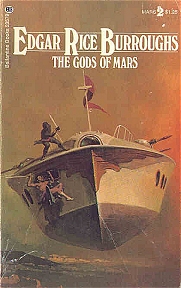
Tales From The Discount Bin: The Gods of Mars

Edgar Rice Burroughs continues his slightly-less-famous-than-Tarzan series of Martian stories with Gods of Mars, furthering the outlandish interplanetary adventures of John Carter. For the most part this offered exactly what you would want in a sequel to A Princess of Mars, assuming of course that you enjoyed that book. Gods of Mars begins, as A Princess of Mars did, with a prologue in which Edgar Rice Burroughs meets up with John Carter, who has long been a friend of his family, and receives the manuscript which details John's adventures on the red planet. There's a bit of ret-conning here, where Burroughs makes reference to the fact that John Carter has never, as far as he's seen, aged. This is minor, but it is odd that this fact hasn't been mentioned before. There's a moment in the first book where Burroughs remarks that John Carter has not aged in the ten years since he had last seen him, but it's mentioned with shock, while in this book it's mentioned that Burroughs has never seen Carter age. From childhood on, apparently, John Carter has been in the periphery of Edgar Rice Burroughs' life, and has been stuck at the same age. Indeed he may be incalculably old, having little to no memory of his own youth. Perhaps this complaint only strikes me because the first book was so obviously written with sequels in mind. Even if he didn't have specific ideas about the following books, he left many obvious threads hanging and obviously wanted to revisit them. So it's a bit odd that some aspects would be so well set up, and others would seem sudden and forced.

There were plenty of questions left unanswered at the end of the first book; did John Carter save the dying planet by fixing their air pumps that feed the planet? Who actually sabotaged those air pumps? What was the deal with that weird tableau that greeted John on his return to Earth in that mysterious cave? How exactly is John being transported between worlds? We get the answer to only one of those questions(of course he saved Mars, silly!), but indications that the others may be answered in future books. John Carter mentions that he's discovered how to harness whatever power whisks him between worlds, and can actually travel to other planets if he so desired. And perhaps the fact that he doesn't age has something to do with the fact that all inhabitants of Mars live several thousand years, often only ending their life voluntarily by taking the(literal) voyage down the river Iss to the Valley Dor, which is basically Heaven. Imagine Tolkien's Gray Havens where all the elves and ring-bearers have gone.
As I remarked in my review of the first book, I'm a bit surprised at how much thought has gone into developing Edgar Rice Burroughs' version of Mars. This isn't exactly JRR Tolkien filling appendix after appendix of information detailing the lineage of every character and kingdom mentioned in his books, but it does feel a bit more fleshed out than most pulp sci-fi. That aspect of the series is furthered in Gods of Mars considerably, as Burroughs explores the religions and hierarchy of the various races on Barsoom(Mars). Upon returning to Mars, John Carter finds himself in the one place on Mars that no person is allowed to leave; the Valley Dor. The one person who returned from this place was killed as a heretic and blasphemer. Unfortunately the Valley Dor is not the paradise that the inhabitants of Mars think it is, and instead is a place of savagery and slavery. There's a religious hierarchy I won't get completely into, but pilgrims to the valley are either killed outright by horrific plant-men who drink their blood, or, if they somehow escape these monsters, put into slavery by the holy Therns.

The Therns are, they believe, the custodians of the true afterlife, and they view all the races of outer Mars as lower beasts, and it is their holy right to use them as they see fit. The Therns have their own personal heaven, the Temple of Issus, which is as closely guarded as the Valley Dor is to the rest of Mars, meaning that no living Thern has ever returned to tell the tale of what lies inside. It's a sign of the anti-religious streak in this book that this 'heaven' turns out to be false as well, as Issus is actually a member of the First Born, who do unto the Therns pretty much the same way the Therns do unto everyone else. Throughout the novel it seems that Burroughs has a particular axe to grind with religion, making allusions to Christianity and remarking at the drop of a hat what damage a blind superstition can do to an otherwise logical people. It's not altogether subtle, but it wasn't at all what I was expecting from popular genre fiction in the early 1900s.

I should make a quick mention here of the categorization of races on Mars. Burroughs, perhaps unfortunately, in hindsight, labels all of the races with colors. The Tharks are Green Martians, the Therns are White, the First Born are Black, and then there are the Red Martians. It would be easy to cry 'racism' at this practice, especially considering the First Born('Blacks', as they are called several times) are bloodthirsty villains, by far the worst the series has yet introduced, using all others as either brute labor or food. And yet that would be a surface complaint, and underneath I think Burroughs was hinting at something a bit more Utopian. When John Carter escapes the Valley Dor and battles his way to freedom, it is with a rainbow coalition of First Born, Thern, Thark and Red Martian, and he makes note of this specifically, remarking how the disparate races work together towards a common goal. And then you have the Red Martians, who are held up as the highest and most civilized society on Mars, both in the text and by the characters in these books. The Red Martians, it is revealed, are actually the result of breeding between all of the varied humanoid races on Mars. Quite literally Burroughs is stating that the advancement of society depends on the cooperation and co-mingling of different nationalities and cultures.

And no, I don't think I'm reading too much into these stories when I come to that conclusion. If anything it's all but bluntly stated. Burroughs is criticising religion and promoting a multicultural lifestyle, which is all very progressive for 1912 popular fiction.

I'm taking a bit of a break from Burroughs' Mars to visit another version of the planet in HG Wells' War of the Worlds. I'll be done with that in time for a post early next week. So stay tuned!

Sunday, December 09, 2007

Cthulhu

This last few weeks have marked the passage of the seventh annual Anchorage International Film Festival, an event for which I was lucky enough to be a judge(in one of the short film categories). This presented me with a golden opportunity to attend every screening for free. I was in heaven. Unfortunately, this happened to coincide with my increasingly stupid looking decision to take on a second job for extra holiday money. Coupled with normal familial duties, I was unable to attend all but two films. The first of the two, Once, was extraordinarily enjoyable, and I'll be writing about that one at a later date. The second film, and subject of this post, was Cthulhu, a low budget, DVE-shot horror film loosely based on HP Lovecraft's Shadow Over Innsmouth.

In this filmed version, the main character, Russ, is a gay history professor in Seattle who is called back to his home town of Rivermouth when his mother passes away. Back in Rivermouth, Russ can't wait to return to Seattle, finding nothing but antagonism from his father(who leads the church of the Esoteric Order of Dagon) and the townsfolk who view his sexuality as the height of mental degeneration. His father, and indeed a few of the townspeople, take a very aggressive interest in wanting to see Russ have children(for reasons I'll explain later, but will probably make a bit of sense to people familiar with the story). The only friendly face he sees is that of his childhood friend Mike, a divorced father with whom he had a... sexually ambiguous relationship growing up. I suppose at this point something should be said about the homosexual themes in this film, since the protagonist's homosexuality is a large part of the plot both literally and metaphorically. Russ' father is upset at his son not for being gay, it seems, but for not having children, and metaphorically Russ' homosexuality heightens the tension and fear of returning to a small town, let alone one as bizarre as Rivermouth.

The plot(and I'm going to give spoilers here, so if you haven't read the story, or want to see this fresh, I'd suggest you skip ahead a paragraph) revolves around Russ' heredity, and the Esoteric Order of Dagon that his father leads. Dagon, as Lovecraft readers know, is one of the Deep Ones, a fish-god that grants wealth to those who offer up human sacrifices. There's also a lot of inter-species breeding going on, as the fish-men mate with humans and produce immortal offspring, and the people themselves begin to become more fish-like. Russ' family is so intent on him having children because his family has long been the emissaries of Cthulhu(although the church names Dagon, he is never specifically mentioned in the movie, instead they use the more popularly known Cthulhu), and they need him to father the next generation of fish-people and pave the way for the return of the Deep Ones. This is a little ill-defined in the movie, as much of the film is. A lot of it still works, however, to heighten the confusion and fear, but at times is the ambiguity is a bit off-putting. It works well when the characters are confused and unsure of things, but when they seem completely aware of everything and the audience is in the dark, it's a bit frustrating.

Now, I'll be honest here and admit that my initial reaction as the film went to black was 'god, what a mess!' The film is so jumbled and switches scenes and tones at such a jarring rate that it seemed to me a horribly confused mess. But, as the credits rolled, and that final image stuck with me, and I thought back over the film, I realized that the film had some very good ideas, but was slightly off the mark. The film feels one or two drafts, and several days in the editing bay away from being a really good film. The director, Dan Gildark, was at the screening I attended, and said that his distributor was imposing 8 minutes of edits on him, and I really do think that with those trimmings the film could be something special. Particularly, the flashbacks seem largely unnecessary and confusing. There's a brief flashback of Russ entering a room where a woman is crying, you see him with a shocked face as the woman screams 'What did you do to me?' Later in the film Russ is seen attempting suicide in flashback. Who was this woman? Was it his sister(the only prominent female from his childhood we see)? What was done to her? Did Russ attempt suicide because of this or some other reason? It's not clear at all, although when I asked him the director said there was a whole side story there that he cut out, choosing instead to make that vague and mysterious. I think this was a mistake, because without any context the flashbacks only serve to distract from an already convoluted plot, and it seems like these scenes should be important but there's absolutely no connection to the rest of the film.

But let's focus on what does work. As I said, the idea of an ostracized gay man returning home to face malevolent cosmic forces AND unfriendly townspeople is well realized, and more literally turns the hero into 'the outsider', something the film is tactful enough not to hammer you over the head about. The more mundane family and relationship moments work very well, which is something that doesn't happen often in horror movies. There's frequent, albeit brief, suggestions that place this movie in the near future; radio programs talk about increasing violence and ecological decay, one reports that the last surviving wild polar bear had died in Siberia, and every television station seen in the background has a 'breaking news' banner and blurry images of violent events. This all serves to heighten the 'Lovecraftian' horror of the story, with the madness being an ever present threat around the edges of the characters lives until it forces it's way into the center stage. The ever-present threat of rising ocean waters brings with it the implication that the world of the Deep Ones will be coming to overtake the world of man, which is a pretty clever twist.

Cthulhu was shot on DVE, which gave the theatre image a slightly blurry, out of focus look(I don't know if this will be the same for the image on a smaller television set), but made the colors incredibly bright and pure. This is a fairly low budget horror film, so anyone expecting a horror-fest like the Stuart Gordon/Brian Yuzna Lovecraft adaptations is going to be very disappointed. The effects, what little there are, are only briefly glimpsed and, at one point, slightly cheesy. Instead this film is more of a character driven drama with horror elements in it. Some of the horror elements, unfortunately, rely a little too much on the trappings of the genre, such as a scene where a little boy in front of a staticy television screen says "we're waiting... for Cthulhu" and the camera jump cuts a bit closer as he says Cthulhu. Or the crazy old aunt in a mental ward who turns away from the character, towards the camera as she starts over-emoting her forebodings of doom. Or a scene with a weird glowing tentacle thing that would look cheap no matter what, but is made slightly silly by the jump-cut and ominous, piercing string music that accompanies it. All of these scenes are played with such straight-faced seriousness that they stumble over the line and into camp, and are at odds with the tone of the rest of the film.

Speaking of things at odds with the film; Tori Spelling. The director had nothing bad to say about Tori Spelling, but I wanted to comfort him and give him my condolences that she was in this film, because her completely over the top performance suggests an alien trying to emulate femininity after watching hours of Marilyn Monroe, Betty Boop and really bad porno dialogue. I might be a bit harsh on her, but she was really, really unconvincing, and while her plotline was funny and integral, a better actor would have focused the laughs on the humor in the script, not the horrible line readings and unattractive come-ons. Aside from her, I have nothing but good things to say about most of the cast. Although some of the supporting characters ham it up a bit, the two male leads are generally well suited to the parts they play.

So in the end my rating for this film would put it around 3 out of 5 stars, which may be a bit misleading. I don't dislike this film, in fact I quite enjoyed it and plan on seeing it again when it gets an official distribution. But, due to some jarring tonal shifts and jumbled plotting it didn't fully engage me. I have high hopes that a slightly edited version, released in the spring, will improve my rating for this film. The director mentioned as his influences the films of Japanese directors Takashi Miike and Kyoshi Kurosawa. Miike I didn't spot, but anyone who enjoys the glacial pace and subtle horror of Kurosawa's films(particularly Charisma, a film I should admit I understand not a goddamn bit) will probably find a lot here to enjoy.

One last thing should be said about the sexual themes in this movie; I've been lurking around in the wastelands of the IMDB comment board, seeing what people had to say about this film. Many are purists upset at the liberties taken with the source material, and angered by the lack of tentacled monsters and outright scares(there are a few in Cthulhu, but that isn't the main focus), but a surprising amount of them are angered by the fact that the film has a publicly gay main character. This is upsetting, and surprising to me because I assumed that anyone open-minded enough to read Lovecraft, with his mind-bending mythology that isn't exactly Judea-christian friendly, should be open-minded enough to deal with a movie where two men kiss(yes, there is a love scene, and although it will gross many people out, it is filmed with more class, tenderness and romanticism than most heterosexual love scenes, and has 100% less testicles than Borat did). Some have argued that Lovecraft didn't write about sex at all, and so it should be left out of any filmed adaptations. And while that's true to a point, it should be mentioned that many of his stories dealt indirectly with bestiality. What is The Shadow Over Innsmouth about, if not a bunch of fishermen having sex with fish?

Friday, November 23, 2007

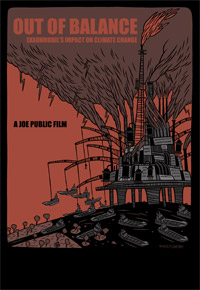
Spout #8: Out of Balance

This latest entry in my Spout Mavens reviews is probably the one I was looking forward to most, which makes the length it took me to view it a bit puzzling. Out of Balance plays into one of my pet obsessions; global warming and the corporations at the heart of the problem. Leaning more towards the left side of the political spectrum, environmental concerns and a distrust of large corporations is almost hard-wired into my thinking. And here the target is Exxon, the largest oil company, and, as the film argues, the largest CORPORATION in the entire world(I have no idea if that's true, and the film offers no quotable sources, but it sounds like it could be true). The only way this could be more up my alley was if the corporation being targeted was Wal-Mart.

Living in Alaska I may be quicker to distrust Exxon than most. The 1989 oil spill in Prince William Sound was a huge disaster that we're still reeling from today. It wasn't just the largest oil spill in history, but it was in an area where people made almost their entire living on the water, from tourism or fishing, and both were, essentially, ruined for years to come. I remember two trips to Homer to study the beaches, both during school field trips. One trip was in 1988, the other was in 1990, and the difference, even in an area not directly in the path of the oil spill, was noticeable. The year after the oil spill the beaches in Homer were not devastated, but they were a little more empty, with not quite so many fish, crabs or octopus, and the sand was noticeably looser, and you would sink in above your ankles where the year before you would stand comfortably on the hardpacked sand. To me the Exxon oil spill is not the firsthand disaster it was to the people who lived in the Prince William Sound area, but neither is it the empty headline of some faraway tragedy that it must have been for people living in, say Missouri. The continuing problems are increased by Exxon's refusal to pay the $5 billion in punitive damages they were court-ordered to pay, money that would help cover cleanup, health care for those with problems stemming from the spill, and the loss of income to many families who depended on fishing as a way of life. Just a couple weeks ago there were a new string of news stories detailing Exxon's continuing, and partially successful, attempts to get the Supreme Court to lower the amount they're required to pay. You don't need to try and convince me that Exxon is an immoral, harmful corporation.

Tom Jackson, the director and our guide through a list of Exxon's atrocities, seems like a well balanced, likable enough guy. That actually is important, because many of these anti-establishment style documentaries come off as reactionary, pretentious, and unlikable. Tom Jackson, however, puts himself right alongside the audience as he asks questions and learns the truth with us. He admits that global warming was something he didn't want to believe, in part, because he loves to just get in his car and drive. This everyman persona works slightly better than Michael Moore's attempts; his films may be more successful, both message-wise and monetarily, but he should stop trying to play the ignorant American constantly amazed by the things he puts in his movies.

The only real complaint to this film is it's brevity. At barely over an hour long, the film doesn't delve too deeply into specifics. There are plenty of talking heads, scientists, journalists and the like, but they focus more on the problem of global warming as a whole than Exxon's contributions. In fact, there's not really a lot here that the people watching this film wouldn't know already. Or maybe that's me, and people outside of Alaska aren't as aware of Exxon's misdeeds, but I couldn't help feeling that this film was preaching to the choir. It's unlikely that anyone not yet aware of global warming would pick this film up at their local video store, while anyone who would be interested in this sort of thing probably already knows this already. Still, Mr. Jackson is a decent guy, and the decision to film his own personal journey to find out why Exxon was so evil wasn't a bad one. The movie's heart is in the right place, and this is definitely a message that needs to be said, but there's not much here to recommend it over the other films of it's ilk.

Tuesday, November 20, 2007

The Convent

The Convent is an odd film, and certainly not for everyone, but I still find myself subjecting my friends to it whenever someone comes over who hasn't heard of the film, and I tend to enjoy it a little more each time I watch it. That may be due to the opening scene, which sets a high water mark that the remainder of the film cannot hope to sustain. It's a knockout of an opening that ranks among my favorite movie moments. This gives the rest of the film a sense of anticlimax, which is unfortunate because it's actually quite fun, although very low-rent and goofy.

Opening with a woman wearing black leather walking in slow motion into a convent, where she promptly chugs some whiskey, and proceeds to pull a baseball bat out of her duffel bag, attacking the nuns with abandon, all to the strains of a perfectly placed pop song from the sixties. This act goes unexplained for a bit as the film flashes forward several decades, to present day where the condemned convent has passed into urban legend, and Christine, the leather-clad woman from the opening, lives unseen in a spooky house after being released from a psychiatric ward. It's a bit suspect that a woman responsible for so many violent murders would ever be released, but if this bothers you, you may want to stop watching; logic isn't necessarily something you should expect from this movie.

The movie follows a group of college kids as they head out on an annual rite of passage to sneak past the local police and vandalize the convent, immortalizing their fraternity's logo. The "witty'' banter between these kids is anything but, and yet I still find myself chuckling at the atypical goth girl's perkiness and horndog Frijole's repeated claims of being able to seduce any woman in "fiiiiiiiiive minutes". Megahn Perry plays Mo, the entirely too-chipper goth girl, and is one of the highlights of the film. Staying behind at the convent when the local cops(played by Bill Mosely and a twitchy Coolio) bust the kids for trespassing, Mo runs afoul of a couple of poser devil worshipers, the hilariously effeminate Lords of Darkness. The Lords of Darkness are at the convent to, apparently, impress a couple of gullible women with a phony satanic ritual that unfortunately summons actual demons.

The effects in this movie are lower than low budget, amounting to basically glow in the dark makeup and blacklight. The most professional this gets is a bit of sped up camera work during the demonic transformations that looks like a cheaper version of the same effect used in Jacob's Ladder. Still, this isn't a complaint. You don't necessarily look for slick, polished film making in direct to video horror films, and the low rent effects fit perfectly with the quirky, cheesy charm of the film. And The Convent is self aware enough to know that this stuff is silly, and makes up for it with actual comedy, particularly when it comes to the scenes involving the Lords of Darkness and their inept bungling as they realize the bullshit they've been spewing is actually real.

There's a cooler-than-cool cameo towards the end of the movie that I won't spoil, although IMDB and the All Movie guide have no such qualms, so those of you without the patience to sit through a 90 minute movie can go find out who it is at any time. As I said, that opening scene may lead you to believe the movie your watching is better than it is, and may lead to some disappointment as you watch this the first time. But if you let your judgment go, and just settle back to enjoy a fun "bad" movie, I think you'll be pleasantly surprised.

Monday, November 12, 2007

Soundtrack to my Life

As I have mentioned more than a few times lately, I recently received a very massive iPod. So massive that I can put my entire collection on it, and still have room for a couple years worth of CD purchases(to be honest, I'm a bit ashamed that my entire collection fits so nicely on this one iPod). One of the great things about going disc by disc through my collection and importing them into a portable CD library is that I'm becoming reacquainted with some artists and albums that I haven't listened to in awhile. Some not even in this century. The usual question, and the one I've been asked by work friends who obviously don't know me well enough is 'why do you need all those CDs, if you don't listen to so many of them?' The obvious, logistical answer is that with so many albums in one collection, it's impossible to listen to them all regularly. But of course the real answer is probably the same one that would be given by anyone with a record collection in the triple(or quadruple) digits; these discs are important to me.


I know it isn't particularly enlightened, and we're all supposed to see material goods as nothing more than 'things', but if a house fire were to destroy my entire CD collection, DVD or book library, or even my collection of pop-culture memorabilia, I would be highly distraught. In the end these aren't family members, and so I wouldn't be devastated, but I am also more emotionally connected to my collection of 'things' than I think most people view as healthy. I can't yet explain it, as I've chosen not to closely analyze this compulsive collecting, but I think in the end I do agree with Rob from the novel High Fidelity; it's what a person likes that matters more than what a person is like. OK, a disclaimer; I don't follow that exactly, but I think the sentiment is a fairly close to how I view the world, good or bad.


People rarely show the outside world everything about themselves, and even the largest asshole you run into in the supermarket has hidden depths. The 'things' people buy can end up defining them in greater accuracy than a casual acquaintance could, if you know what to look for. And I think that's how I view my collection of CDs, books, movies and memorabilia. That after I'm gone, someone could sift through all of this stuff and know who I was, warts and all. They may not know that I have the admittedly lackluster Golden Earring album Cut on both Vinyl and CD because as a child my mom played that album during summer roadtrips across Alaska(this is also partly why I have so many Electric Light Orchestra albums, although the rest of the reason is because they rock!). There's no way someone randomly looking through my CDs would know that I own ABBA Gold because during a few months in London I would go to the club Trash every Monday with the Swedish woman I was staying with, and the final song every night was Dancing Queen. They played it ironically, I think, but I ended every night thinking 'this is the best song in the history of ever!' However this collection still traces the path of my life, my interests and my moods.


Everything I own has a story to go along with it, and a connection to my life that goes beyond what you might think. And although people probably won't get the whole story, my collection of 'meaningless things' forms as personal a roadmap of my life as any diary could be. If you know how to read it.

Tuesday, November 06, 2007

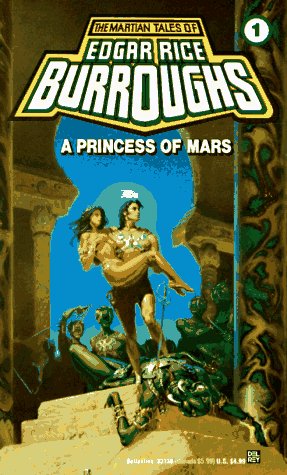
Tales From the Discount Bin: A Princess of Mars

I am now up to the 'S' section of my music library, which means I'll soon be done, and will be able to once again devote my time to blogging and writing in general.

Reading up on Edgar Rice Burroughs, author of the most recent book in my 'bargain bin' project, I couldn't help but feel a sort of kinship for the man. Born in 1875, Burroughs tried to enroll in West Point but wasn't accepted, enlisted in the army but received a medical discharge before too long. After that he took a few odd jobs, ending up at his father's firm in 1899, marrying in 1900, and quitting his job in 1904. He took a few odd, low-paying jobs, wandered the country, did some ranch work, and in 1911, as a pencil sharpener salesman(a job which I find it hard to imagine ANYONE doing) found himself with a lot of free time. It was during this free time that he began reading pulp magazines and novels, of which he later said:

"...if people were paid for writing rot such as I read in some of those magazines that I could write stories just as rotten. As a matter of fact, although I had never written a story, I knew absolutely that I could write stories just as entertaining and probably a whole lot more so than any I chanced to read in those magazines."

And so, at the ripe old age of 36, with no prior experience whatsoever, Edgar Rice Burroughs wrote the serialized story that would eventually become A Princess of Mars, the first book in his still-popular and influential series of books dealing with Mars. From there it was only a short time until Tarzan came out, becoming one of the most recognizable(and profitable) characters of the last century.

I don't mean to imply I'm a wildly talented and influential author, or even that I one day aspire to be, but I still find this man's life story inspiring and especially relatable to my life. It's been said, and I always assumed, that aimlessness and slacking off were traits specific to the later section of the 20th century, an affliction unseen in such abundance before Generation X. And here is proof positive that that is incorrect. Here is a man who spent his entire twenties wandering aimlessly from one short, low paying job to another, turning his back on his father's business even though he had a wife and children to provide for. A man in a job with a lot of free time, and a sudden, almost idle desire to begin writing. And he became as successful at it as anyone in his day. Moreso, in most cases. It gives me hope, as I near my thirties, with an ever-growing list of job titles behind me and no clear idea of what I want to do with my life. With a longtime girlfriend and a four year old daughter and still no driving ambition, only a desire to make a modest living doing things I enjoy and making my family life as happy as possible. It isn't too late for me to discover my purpose(for lack of a better word), and there's still plenty of time to make my way out of my 'wilderness years.'

Not having read too many(or, more truthfully, any) pulp fiction magazines from the early 1900s, I can't honestly say whether or not Burroughs succeeded in writing stories superior to the ones he had read, although I think history has proven him the victor. Certainly A Princess of Mars was enjoyable as all get-out, and to realize that this was Edgar Rice Burroughs' maiden voyage as a writer, his first attempt, is all the more impressive.

Featuring absolutely none of the techno-babble that stalls so many other sci-fi books, Burroughs instead focuses his book on one action set-piece after another. John Carter, a ridiculously virile man, a southern gentleman fresh out of the Civil War, hides in an empty cave from a tribe of hostile Indians, and is inexplicably transported to Mars, where he is 'captured' by the Tharks. Tharks are a race of green men larger than humans, with four arms and huge tusks. The Tharks are warriors by nature, almost a proto-Klingon; fierce and barbaric but with an honest and strict code of conduct. On Mars, John Carter finds he has almost super-strength(owing mainly to the low gravitational force), and when he strikes a Thark for rudeness, accidentally killing him, he finds himself made a lesser chieftain in this alien society. During his time with these Tharks, he witnesses a battle against a race more like his own in both appearance and temperament. The Tharks take one captive, a princess of this human-like race, and of course John Carter falls in love with her and they plan their escape back to her kingdom. The book is, I have to admit, a nifty piece of fantasy wish-fulfillment, both for the author(John Carter is clearly the type of man Burroughs would like himself to be) and the reader, with every obstacle overcome triumphantly, and every action as noble and self-sacrificing as could be.

Although Burroughs never gets bogged down in politics or technical minutiae(both of which murdered A Brand New World, my last purely sci-fi read), his vision of Mars is remarkably well thought out, even if we don't see everything. The society of the Tharks is believably constructed, and although it conveniently allows our hero some loopholes which allow the story to progress, it is always logical. They even have what is reputed to be the first example of a detailed alien language in sci-fi, although rudimentary and not very detailed. The weaponry and other assorted gadgetry is explained only as much as it needs to be in order for the story to make sense. There are a few questions raised that are never answered, most notably in my mind is exactly why and how John Carter was sent to Mars, although it's somewhat understandable why he came back. And what was up with that morbid tableau that greeted John when he returned to Earth in the very same cave? I'm assuming that these questions will be answered in future books, and the prospect of unfolding this mystery is especially tantalizing.

As you can probably tell, I enjoyed the hell out of this book. It was consistently fun and fast moving, although in that 'I'm getting paid by the word, lets use as many run-on sentences as possibly' way. And although the story progression isn't exactly complex, it has a sense of depths unseen that most of the books I've been reading in this project just don't have. I can't wait to read more, not just of this series but of this author.