Friday, November 23, 2007

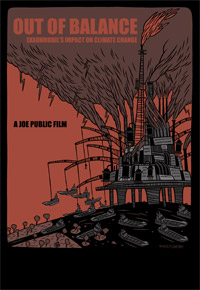
Spout #8: Out of Balance

This latest entry in my Spout Mavens reviews is probably the one I was looking forward to most, which makes the length it took me to view it a bit puzzling. Out of Balance plays into one of my pet obsessions; global warming and the corporations at the heart of the problem. Leaning more towards the left side of the political spectrum, environmental concerns and a distrust of large corporations is almost hard-wired into my thinking. And here the target is Exxon, the largest oil company, and, as the film argues, the largest CORPORATION in the entire world(I have no idea if that's true, and the film offers no quotable sources, but it sounds like it could be true). The only way this could be more up my alley was if the corporation being targeted was Wal-Mart.

Living in Alaska I may be quicker to distrust Exxon than most. The 1989 oil spill in Prince William Sound was a huge disaster that we're still reeling from today. It wasn't just the largest oil spill in history, but it was in an area where people made almost their entire living on the water, from tourism or fishing, and both were, essentially, ruined for years to come. I remember two trips to Homer to study the beaches, both during school field trips. One trip was in 1988, the other was in 1990, and the difference, even in an area not directly in the path of the oil spill, was noticeable. The year after the oil spill the beaches in Homer were not devastated, but they were a little more empty, with not quite so many fish, crabs or octopus, and the sand was noticeably looser, and you would sink in above your ankles where the year before you would stand comfortably on the hardpacked sand. To me the Exxon oil spill is not the firsthand disaster it was to the people who lived in the Prince William Sound area, but neither is it the empty headline of some faraway tragedy that it must have been for people living in, say Missouri. The continuing problems are increased by Exxon's refusal to pay the $5 billion in punitive damages they were court-ordered to pay, money that would help cover cleanup, health care for those with problems stemming from the spill, and the loss of income to many families who depended on fishing as a way of life. Just a couple weeks ago there were a new string of news stories detailing Exxon's continuing, and partially successful, attempts to get the Supreme Court to lower the amount they're required to pay. You don't need to try and convince me that Exxon is an immoral, harmful corporation.

Tom Jackson, the director and our guide through a list of Exxon's atrocities, seems like a well balanced, likable enough guy. That actually is important, because many of these anti-establishment style documentaries come off as reactionary, pretentious, and unlikable. Tom Jackson, however, puts himself right alongside the audience as he asks questions and learns the truth with us. He admits that global warming was something he didn't want to believe, in part, because he loves to just get in his car and drive. This everyman persona works slightly better than Michael Moore's attempts; his films may be more successful, both message-wise and monetarily, but he should stop trying to play the ignorant American constantly amazed by the things he puts in his movies.

The only real complaint to this film is it's brevity. At barely over an hour long, the film doesn't delve too deeply into specifics. There are plenty of talking heads, scientists, journalists and the like, but they focus more on the problem of global warming as a whole than Exxon's contributions. In fact, there's not really a lot here that the people watching this film wouldn't know already. Or maybe that's me, and people outside of Alaska aren't as aware of Exxon's misdeeds, but I couldn't help feeling that this film was preaching to the choir. It's unlikely that anyone not yet aware of global warming would pick this film up at their local video store, while anyone who would be interested in this sort of thing probably already knows this already. Still, Mr. Jackson is a decent guy, and the decision to film his own personal journey to find out why Exxon was so evil wasn't a bad one. The movie's heart is in the right place, and this is definitely a message that needs to be said, but there's not much here to recommend it over the other films of it's ilk.

Tuesday, November 20, 2007

The Convent

The Convent is an odd film, and certainly not for everyone, but I still find myself subjecting my friends to it whenever someone comes over who hasn't heard of the film, and I tend to enjoy it a little more each time I watch it. That may be due to the opening scene, which sets a high water mark that the remainder of the film cannot hope to sustain. It's a knockout of an opening that ranks among my favorite movie moments. This gives the rest of the film a sense of anticlimax, which is unfortunate because it's actually quite fun, although very low-rent and goofy.

Opening with a woman wearing black leather walking in slow motion into a convent, where she promptly chugs some whiskey, and proceeds to pull a baseball bat out of her duffel bag, attacking the nuns with abandon, all to the strains of a perfectly placed pop song from the sixties. This act goes unexplained for a bit as the film flashes forward several decades, to present day where the condemned convent has passed into urban legend, and Christine, the leather-clad woman from the opening, lives unseen in a spooky house after being released from a psychiatric ward. It's a bit suspect that a woman responsible for so many violent murders would ever be released, but if this bothers you, you may want to stop watching; logic isn't necessarily something you should expect from this movie.

The movie follows a group of college kids as they head out on an annual rite of passage to sneak past the local police and vandalize the convent, immortalizing their fraternity's logo. The "witty'' banter between these kids is anything but, and yet I still find myself chuckling at the atypical goth girl's perkiness and horndog Frijole's repeated claims of being able to seduce any woman in "fiiiiiiiiive minutes". Megahn Perry plays Mo, the entirely too-chipper goth girl, and is one of the highlights of the film. Staying behind at the convent when the local cops(played by Bill Mosely and a twitchy Coolio) bust the kids for trespassing, Mo runs afoul of a couple of poser devil worshipers, the hilariously effeminate Lords of Darkness. The Lords of Darkness are at the convent to, apparently, impress a couple of gullible women with a phony satanic ritual that unfortunately summons actual demons.

The effects in this movie are lower than low budget, amounting to basically glow in the dark makeup and blacklight. The most professional this gets is a bit of sped up camera work during the demonic transformations that looks like a cheaper version of the same effect used in Jacob's Ladder. Still, this isn't a complaint. You don't necessarily look for slick, polished film making in direct to video horror films, and the low rent effects fit perfectly with the quirky, cheesy charm of the film. And The Convent is self aware enough to know that this stuff is silly, and makes up for it with actual comedy, particularly when it comes to the scenes involving the Lords of Darkness and their inept bungling as they realize the bullshit they've been spewing is actually real.

There's a cooler-than-cool cameo towards the end of the movie that I won't spoil, although IMDB and the All Movie guide have no such qualms, so those of you without the patience to sit through a 90 minute movie can go find out who it is at any time. As I said, that opening scene may lead you to believe the movie your watching is better than it is, and may lead to some disappointment as you watch this the first time. But if you let your judgment go, and just settle back to enjoy a fun "bad" movie, I think you'll be pleasantly surprised.

Monday, November 12, 2007

Soundtrack to my Life

As I have mentioned more than a few times lately, I recently received a very massive iPod. So massive that I can put my entire collection on it, and still have room for a couple years worth of CD purchases(to be honest, I'm a bit ashamed that my entire collection fits so nicely on this one iPod). One of the great things about going disc by disc through my collection and importing them into a portable CD library is that I'm becoming reacquainted with some artists and albums that I haven't listened to in awhile. Some not even in this century. The usual question, and the one I've been asked by work friends who obviously don't know me well enough is 'why do you need all those CDs, if you don't listen to so many of them?' The obvious, logistical answer is that with so many albums in one collection, it's impossible to listen to them all regularly. But of course the real answer is probably the same one that would be given by anyone with a record collection in the triple(or quadruple) digits; these discs are important to me.


I know it isn't particularly enlightened, and we're all supposed to see material goods as nothing more than 'things', but if a house fire were to destroy my entire CD collection, DVD or book library, or even my collection of pop-culture memorabilia, I would be highly distraught. In the end these aren't family members, and so I wouldn't be devastated, but I am also more emotionally connected to my collection of 'things' than I think most people view as healthy. I can't yet explain it, as I've chosen not to closely analyze this compulsive collecting, but I think in the end I do agree with Rob from the novel High Fidelity; it's what a person likes that matters more than what a person is like. OK, a disclaimer; I don't follow that exactly, but I think the sentiment is a fairly close to how I view the world, good or bad.


People rarely show the outside world everything about themselves, and even the largest asshole you run into in the supermarket has hidden depths. The 'things' people buy can end up defining them in greater accuracy than a casual acquaintance could, if you know what to look for. And I think that's how I view my collection of CDs, books, movies and memorabilia. That after I'm gone, someone could sift through all of this stuff and know who I was, warts and all. They may not know that I have the admittedly lackluster Golden Earring album Cut on both Vinyl and CD because as a child my mom played that album during summer roadtrips across Alaska(this is also partly why I have so many Electric Light Orchestra albums, although the rest of the reason is because they rock!). There's no way someone randomly looking through my CDs would know that I own ABBA Gold because during a few months in London I would go to the club Trash every Monday with the Swedish woman I was staying with, and the final song every night was Dancing Queen. They played it ironically, I think, but I ended every night thinking 'this is the best song in the history of ever!' However this collection still traces the path of my life, my interests and my moods.


Everything I own has a story to go along with it, and a connection to my life that goes beyond what you might think. And although people probably won't get the whole story, my collection of 'meaningless things' forms as personal a roadmap of my life as any diary could be. If you know how to read it.

Tuesday, November 06, 2007

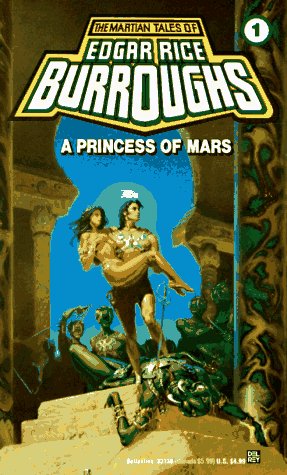
Tales From the Discount Bin: A Princess of Mars

I am now up to the 'S' section of my music library, which means I'll soon be done, and will be able to once again devote my time to blogging and writing in general.

Reading up on Edgar Rice Burroughs, author of the most recent book in my 'bargain bin' project, I couldn't help but feel a sort of kinship for the man. Born in 1875, Burroughs tried to enroll in West Point but wasn't accepted, enlisted in the army but received a medical discharge before too long. After that he took a few odd jobs, ending up at his father's firm in 1899, marrying in 1900, and quitting his job in 1904. He took a few odd, low-paying jobs, wandered the country, did some ranch work, and in 1911, as a pencil sharpener salesman(a job which I find it hard to imagine ANYONE doing) found himself with a lot of free time. It was during this free time that he began reading pulp magazines and novels, of which he later said:

"...if people were paid for writing rot such as I read in some of those magazines that I could write stories just as rotten. As a matter of fact, although I had never written a story, I knew absolutely that I could write stories just as entertaining and probably a whole lot more so than any I chanced to read in those magazines."

And so, at the ripe old age of 36, with no prior experience whatsoever, Edgar Rice Burroughs wrote the serialized story that would eventually become A Princess of Mars, the first book in his still-popular and influential series of books dealing with Mars. From there it was only a short time until Tarzan came out, becoming one of the most recognizable(and profitable) characters of the last century.

I don't mean to imply I'm a wildly talented and influential author, or even that I one day aspire to be, but I still find this man's life story inspiring and especially relatable to my life. It's been said, and I always assumed, that aimlessness and slacking off were traits specific to the later section of the 20th century, an affliction unseen in such abundance before Generation X. And here is proof positive that that is incorrect. Here is a man who spent his entire twenties wandering aimlessly from one short, low paying job to another, turning his back on his father's business even though he had a wife and children to provide for. A man in a job with a lot of free time, and a sudden, almost idle desire to begin writing. And he became as successful at it as anyone in his day. Moreso, in most cases. It gives me hope, as I near my thirties, with an ever-growing list of job titles behind me and no clear idea of what I want to do with my life. With a longtime girlfriend and a four year old daughter and still no driving ambition, only a desire to make a modest living doing things I enjoy and making my family life as happy as possible. It isn't too late for me to discover my purpose(for lack of a better word), and there's still plenty of time to make my way out of my 'wilderness years.'

Not having read too many(or, more truthfully, any) pulp fiction magazines from the early 1900s, I can't honestly say whether or not Burroughs succeeded in writing stories superior to the ones he had read, although I think history has proven him the victor. Certainly A Princess of Mars was enjoyable as all get-out, and to realize that this was Edgar Rice Burroughs' maiden voyage as a writer, his first attempt, is all the more impressive.

Featuring absolutely none of the techno-babble that stalls so many other sci-fi books, Burroughs instead focuses his book on one action set-piece after another. John Carter, a ridiculously virile man, a southern gentleman fresh out of the Civil War, hides in an empty cave from a tribe of hostile Indians, and is inexplicably transported to Mars, where he is 'captured' by the Tharks. Tharks are a race of green men larger than humans, with four arms and huge tusks. The Tharks are warriors by nature, almost a proto-Klingon; fierce and barbaric but with an honest and strict code of conduct. On Mars, John Carter finds he has almost super-strength(owing mainly to the low gravitational force), and when he strikes a Thark for rudeness, accidentally killing him, he finds himself made a lesser chieftain in this alien society. During his time with these Tharks, he witnesses a battle against a race more like his own in both appearance and temperament. The Tharks take one captive, a princess of this human-like race, and of course John Carter falls in love with her and they plan their escape back to her kingdom. The book is, I have to admit, a nifty piece of fantasy wish-fulfillment, both for the author(John Carter is clearly the type of man Burroughs would like himself to be) and the reader, with every obstacle overcome triumphantly, and every action as noble and self-sacrificing as could be.

Although Burroughs never gets bogged down in politics or technical minutiae(both of which murdered A Brand New World, my last purely sci-fi read), his vision of Mars is remarkably well thought out, even if we don't see everything. The society of the Tharks is believably constructed, and although it conveniently allows our hero some loopholes which allow the story to progress, it is always logical. They even have what is reputed to be the first example of a detailed alien language in sci-fi, although rudimentary and not very detailed. The weaponry and other assorted gadgetry is explained only as much as it needs to be in order for the story to make sense. There are a few questions raised that are never answered, most notably in my mind is exactly why and how John Carter was sent to Mars, although it's somewhat understandable why he came back. And what was up with that morbid tableau that greeted John when he returned to Earth in the very same cave? I'm assuming that these questions will be answered in future books, and the prospect of unfolding this mystery is especially tantalizing.

As you can probably tell, I enjoyed the hell out of this book. It was consistently fun and fast moving, although in that 'I'm getting paid by the word, lets use as many run-on sentences as possibly' way. And although the story progression isn't exactly complex, it has a sense of depths unseen that most of the books I've been reading in this project just don't have. I can't wait to read more, not just of this series but of this author.


Wednesday, October 31, 2007

Filling in the Blanks: The Wicker Man

Almost two weeks since my last post. Inexcusable. What have I been doing with my time? I'll tell you what; I got an early christmas gift from Amber. An iPod, a big ol' 160gig mammoth. Every moment of free time since then has almost completely been spent at my(kinda slow) computer importing my massive CD collection. As of this writing I have just begun the Ps. By the time I finish my main CD collection, and have moved on to soundtracks, rap, country & surf, and then move on to those CDs of Amber's that I want copies of, I think I'll have used up most of that space. With just a bit left over for MST3K episodes that I can watch while on the treadmill at the gym. Rest assured I've been stockpiling my posts, and although I haven't typed or posted any, I have several pages of notes. There should be a flurry of activity coming up, as soon as I'm done with my iPod project.

The Wicker Man is one of those almost inexcusable absences in my film-viewing career, made worse by the fact that I saw the remake first. This isn't the first time this has happened, in fact most classic movies that have remakes were seen this way, and normally I don't feel too bad about it, because I'm always sure to see the original shortly afterwards. But for some reason I've been slightly ashamed that I watched the Nicolas Cage remake before I watched the far, far superior original. Having seen the remake first, I was a tad surprised by the experience of watching the original. It turns out the remake, as inferior as it is, stays incredibly close to the original plot, so I was actually unsurprised by any of the plot twists. What was surprising was the context, which was completely different.

The original follows Sgt. Howie, a Scottish policeman as he investigates a missing child case in the private community of Summerisle. Although he was invited to the island(anonymously), he finds no help from the locals who treat him with fairly open derision, and deny the girl ever existed. The girl's mother(indicated by the letter Sgt. Howie received) claims to have no such daughter. On top of uncooperative villagers, the strictly Christian Sgt. Howie is vexed by the pagan lifestyle of the islanders, which includes plenty of casual sex, a complete disregard for all things church related, and a couple of folksy musical numbers. It's a credit to this film's inherent creepiness that that last part doesn't induce uncontrollable giggles.

There's not much I can add to the ever-growing library of dissections and reflections based around this movie, and I don't think I have much inclination to try anyway. The original Wicker Man served as a criticism of the Church and the draconian policies in effect in the UK at the time. Although now, several decades later, I have to admit I realized that intellectually more than I actually felt it. In fact I'm a bit surprised at how civil Sgt. Howie remains when confronted with so many things that go against his every belief. A friend commented on how the movie really makes you view the main character as an intruding asshole, stomping all over the island's religious practices, but my main question was why he didn't do it sooner, or freak out even more. My anti-church sentiments will automatically place my sympathies with those fighting against it, but in a fight this one sided I still felt sorry for Sgt. Howie. Remember: These people asked him to the island, mocked him, threw their beliefs in his face and tried to bait him throughout the film. I guess my problem here is that the pagan religion doesn't seem to be morally superior to the Christian religions. Although with the pagans there's plenty of naked Britt Ekland(ok, body double, whatever), so that does give it the edge.

The movie is creepy, however, and Christopher Lee is always awesome in everything he does, but rarely more so than in this film(although he doesn't have much screen time). And that's more than can be said about the recent remake, which, through one simple change, removes everything of value from the story. As I said, the remake is remarkably close in detail to the original, but it removes almost all of the sexual/pagan imagery and replaces it with some pretty serious misogynistic tendencies. Instead of pagans, the island is a matriarchy where the women run everything and the men are essentially animal labor. In case we don't get the symbolism, the island is famous for it's honey, and bees play an unfortunately major part in the films plot. To be fair, the original also had a case of on-the-nose symbolism with the pagan island famous for it's apples.

Much has already been made about the misogynism in the updated Wicker Man, in which literally every woman you see in the film is a controlling, murderous man-hating psycho-bitch. It's also been stated that the film would have been labeled misogynist even if the roles were reversed and the hero had been the lone female on an island full of men. That may be true, but it doesn't change the fact that this movie definitely has it's issues. There's no escaping the fact that The Wicker Man has nothing positive to say about women at all, and views them with nothing but contempt. Case in point; the montage near the end when Nicolas Cage finally cracks and begins randomly harassing and beating up the women he comes across.

There's a growing cult around this film, and I have to reluctantly admit I am a member. It's so bat-shit crazy, so mind-bogglingly silly that I have a good time whenever I watch it. There's that famous youtube clip which may go some of the way towards explaining my enjoyment of the film. There's also a pretty nifty rifftrax(downloadable film commentaries from Mike Nelson and a rotating cast of people, usually other MST3K members) available, and I'd heartily endorse following the links to both of those. Also, there's a pretty seriously awesome review over on the Onion AV Club, part of Nathan Rabin's My Year of Flops blog project, which dissects the appeal of this film far better than I could hope to.


Tuesday, October 23, 2007

Spout #7: Sun Dogs

When I first saw Sun Dogs on the list of movies available for review to Spout Mavens members, I skipped past it after reading only a few sentences. A movie about a Jamaican sled dog team? Cool Runnings gave me enough wacky Jamaican fish-out-of-water sports hijinks for one lifetime. Then I saw it was a documentary, and I put in a request. Then I started watching it and my interest waned. Then 10 minutes passed and I was hooked. Then I was bored. Then I was hooked again! It was a constant roller coaster of varying interest levels.

It's impossible to view Sun Dogs without thinking of Cool Runnings-the John Candy vehicle that had him training the first Jamaican bobsled team(based on a true story)- and in fact that's the intention of just about everyone involved in this film. The Jamaican sled dog idea was nothing more or less than a calculated ploy to bring money, tourism and attention to a country mired in widespread poverty and crime. This isn't an ignoble goal by any means; the main purpose of everyone involved is to show the world that Jamaicans are hardworking, strongwilled people, able to succeed at whatever they try. My problem, specifically in the beginning of the film, is that the documentary looks too much like a video postcard you might see on the travel channel, and I was worried that Sun Dogs would completely ignore the less attractive aspects of Jamaica. But, about 10-15 minutes in, the film begins to go down those more dangerous streets, and features a few talking head interviews that cover the crime rate in Kingston, the state of education, and the state of poverty. This seems to add a few new dimensions to the film, but in the end it isn't focused enough. The filmmakers try to cover so many topics, and then cram it into a few scant minutes during a documentary about sled dogs, that the documentary has no real depth.

For the most part the film follows the handful of people trying to pull together a sled dog team, train the dogs from scratch, and introduce this new sport in a country where most people don't even know what 'sledding' is. This is, literally, a ragtag team of dogs and people, which fits right in with the uplifting sports film these people are so desperate to make. All of the dogs are rescued from the J.S.P.C.A. and the filmmakers(and dogsled promoters) are eager to paint this as an allegory for Jamaica itself. These dogs are rescued from hard and brutal lives and given a shot to improve themselves and live happily ever after. And there lies my main complaint with this film; everyone is so eager to make this a brand, to market both the film and the country, that this documentary rarely feels real. I'm not saying that the events in this film never happened, or that it was all scripted, I'm just saying that for a documentary there's an awful lot of manipulation going on.

The previous documentary I reviewed here, Let The Church Say Amen, featured a group of people I would normally not enjoy spending time with, and despite the fact that I didn't enjoy spending time with the people in that film, I came away pleased with the movie overall. Mainly that was because every single thing in that film felt real, like the cameras just happened to capture these people and these events. In Sled Dogs it's obvious, painfully so, that some scenes and events have been staged because the filmmakers just needed the footage. A lot of these are minor, like characters meeting or having introductory conversations when it's clear they'd known each other previously.

It's hard for me to hate- or even dislike- this film, when the goal is so noble and the efforts of everyone involved are so heartfelt, but too much of this feels like a bad infomercial. Like the introductions of all the dogs where they do something wacky, the shot freezes as their name comes up and someone dubs in a cheesy 'woof woof' sound, to give them all personality. Something happens on the island near the end of the film that is a complete reversal of everything you would expect. The documentary seems eager to skip past this event, which I will not divulge here, but if anything more time should have been spent on it. It introduces the idea that perhaps the entire ills of a nation can't be solved by a winning sled dog team and a heart of gold attitude. It's also the one moment in the film that feels heartbreakingly real and unstaged. As it stands it's too little too late.

Sunday, October 21, 2007

For Love Not Lisa

I stopped in at a pawn shop the other night, something I do with some small amount of regularity. In fact it's the main reason I don't currently have an active membership at Blockbuster; the pawn shop down the street from me has an insanely huge collection of DVDs, and all of them for only a dollar more than the average rental price. Why rent them when I can buy them for almost the same price, and have a copy to keep if I like it? On this particular trip I was looking through the CD selection, which is something I don't often do. Most of the CDs are bargain bin, one hit wonders. Quite a few Reader's Digest compilations as well. I was pretty much looking through the CDs more out of boredom than the hope that I would find something worthwhile. For the most part I was correct, there were more than a few CDs by forgotten bands in the Boyz II Men mold. However something did catch my eye; a completely undecorated recordable CD, in a plain white sleeve with only the handwritten words 'Music From Lisa' on it. This was very tempting.

The homemade mix CD(or to a greater degree, the mixtape) holds a special allure to me. As soon as I got my first CD player I was making mixtapes for friends(despite having only 6 CDs to start with). A couple of years at the college station coincided with my entrance into the world of mix CDs, and while a disc doesn't have the same tactile sense, or indeed the same feel of love and labor, it has proven a boon to my habit of pouring my feelings onto a disc with another person's words. It seemed, when I first saw/read it, that High Fidelity had been written about me. Countless discs and tapes are floating around somewhere, and if they are ever collected they will serve as a perfect document of my attitude at any given moment of my life, and my feelings towards the women in my life. So this nondescript disc, with no indication at all what would be on it, was too much to ignore. Who was Lisa? What type of music did she feel expressed her feelings? Who had the music been intended for, and why had he been so callous as to toss out such an intimate expression of Lisa's emotions? Only one of my questions would be answered.

Lisa loves country music.

As I put the disc in my car stereo, after haggling the price down to 50 cents(it was tempting, but I don't think I would have paid the $3 asking price for a blank CD), Unknown Song #1 came out of the speakers. A song I recognized as 'country', although mainly because that's what this music is classified as these days. This isn't Johnny Cash or Hank Williams, this is music made by people who's musical heroes are Garth Brooks and Billy Ray Cyrus. Still, the song was pleasant, and the experience was striking enough that I instantly loved it. The following tracks were not nearly as enjoyable, but I was smitten by Lisa's opening shot, a melancholy song full of yearning for a far off, better place, and so I continued listening and let the flaws pass me by. In fact, a Morphine song about 4 tracks in threw me over the edge. However, another 10 songs of mediocre-to-shitty country songs began to grate on me, and I realized that Lisa and I were going through all the stages of a relationship, despite having never met.

First off, we 'met' in a striking manner. It may not have been epic, but it wasn't without it's romance. A spur of the moment decision, a lark, and something beautiful is born. At first it was amazing, with the romance and beauty blinding me to whatever flaws existed as we got to know each other. I was too amazed by all the new things I was discovering to realize we were doomed from the start. You see, we all grow up with sitcoms and romantic comedy films that lead us to believe in an unattainable idea of love. We forget that, outside of the fact that these are actors, these people don't spend every day together for extended periods of time. They have commercial breaks, and maybe an hour or two of actual interaction. So of course the relationship seems perfect; they never have time to go from 'getting to know you' to 'know you, hate your guts' or even 'know you, still love you, want some space', which is where the majority of real relationships end up. As I spent more time with Lisa, I began to lose interest.

Jello Biafra and Mojo Nixon showed up with a song off of Prairie Home Invasion around track 11 or so, and that was enough to brighten the outlook considerably. However, it was 'Are You Drinkin' with Me Jesus?' which was probably put on as a novelty song, meaning the deeper socio-political messages of that album could have been lost on Lisa. I'd already reached the point in our relationship where I was viewing things that I would normally see as endearing as obnoxious.

We were not going to last. Life is not like a sitcom. I took to skipping the songs after the first ten seconds or so, losing faith that I would find anything worthwhile. And then, on the last track(21), Rick Miller blasted out of my car stereo speakers and asked me to eat another Oatmeal Pie. A Southern Culture on the Skids track! Anyone with enough taste to end a CD with a SCOTS track, no matter how 'trivial', has to be a worthwhile human being. That Jello Biafra and Mojo Nixon song wasn't a fluke! Lisa did have great taste! All was forgiven, and I listened happily until pulling into my driveway and cutting off the final chords of Camel Walk.

Maybe life is like a sitcom sometimes.