Caught an episode of Ebert and Roeper this weekend, something I've gotten out of the habit of doing since Ebert took his medical leave. Roeper is annoying enough, but when he's paired with 'celebrity' guests and mediocre filmmakers, the sycophantic attitude and ill-defined criticisms are just too much to bear. So it's been awhile, and it took me a few moments to notice something was missing; the Thumbs.
Roger Ebert, left without speech after salivary cancer, owns the copyright to the use of the thumbs up/down gimmick, along with Siskel's widow. Disney and Ebert are in contract negotiations, and when the negotiations stalled, Disney yanked the Thumbs from the show, putting out a press release stating it was Ebert's decision. Ebert used his website(on which he's been reviewing movies again, thankfully) to state that he had allowed Disney the use of the Thumbs as a sign of good faith. I'm not sure what this means for the future of the show, although I can't imagine Disney firing Ebert from the show(Ebert does expect his voice to return as he heals).
Part of the reason I think his job is secure is the fact that Roeper just needs someone to slap him around every once in awhile. And on that matter, they may have finally found the perfect guest host, someone willing to loudly, jovially and vehemently disagree with Roeper, and openly mock is silly, silly opinons. Robert Wilonsky is a film critic I've never heard of before, although I've since read a few of his reviews online(there's a few available here). I can't honestly say whether or not I agree with his opinions, because I haven't seen any of the films he discussed, although I'd like to think he's woefully off the mark with his negative review of Across the Universe, a film I've been anticipating for awhile. I see he's been the gues for awhile, and he'll still be here next week, so I think I may start watching Ebert and Roeper again. Still, good critic or no, Wilonsky is the shot in the arm this show needs while it awaits the inevitable, glorious return of Ebert.
Tuesday, September 18, 2007


Saturday, September 15, 2007
Dead Silence: D.O.A.
 When I was a teenager, still in high school, and living with my mom, brother and sister, I found a doll in my room. A creepy little thing, about a foot tall, dressed in a parka made of real fur, and old. Not ancient, but definitely made before I was born, and in almost pristine condition. I found this doll, unexpectedly, on my bed one day after school. My siblings were not allowed in my room, but still I assumed it was one of theirs. My sister was the obvious choice, so I left it in her room. The next day the doll was back. My brother, much younger than I, was still at the age where playing with dolls(or stuffed animals, more likely), was not considered odd, so I put it in his room. I assumed the dolls return to my room was because my sister was saying 'its not mine!' But the next day the doll was back. Laying on the floor, staring up at my bedroom door. Now I assumed someone was fucking with me.
I began leaving the doll hidden in my siblings' closets, but it would always end up back in my room. One day, when I was home alone(my brother and sister still at daycare, and I was only recently home from school), I turned around to find the doll sitting on the floor behind me, when it had been absent moments before. I took this as a sign, and figured if the doll was going to keep coming back to me, I may as well accept it. The doll was allowed in my room, and was left undisturbed. Out of a sense of superstition I even afforded it some respect, and would always set it down rather than drop it or toss it, and it would usually reside on the couch in my bedroom, sitting up rather than laying askew.
One day, maybe 6 months to a year later, a friend was coming to stay the night and watch movies. Cleaning up, I put the doll on the couch in my room, against the armrest. When my friend arrived he took everything from the couch and piled it on the floor. Going over to the pile to sort it out, I noticed the doll was missing. "Hey, where'd you put that doll that was on the couch?" I asked. "What doll?" was his response. "Everything from the couch is in that pile." But the doll was gone, and I never saw it again.
Everything in that story is completely true, and I tell so that you will understand why I tend to give scary doll movies the benefit of a doubt, and I don't just assume they have to be silly. Yes, I always wonder why the characters in these films don't just kick the damned thing across the room, or stomp on it's head, but I'm also sympathetic to the idea that dolls can be creepy. Especially the ones that aim for a distorted human realism in their design. This story is also told so that you will believe me, utterly, when I say that Dead Silence is a complete and total piece of crap. In fact, if you got totally wasted one night and decided to make a horror movie with your sisters My Little Pony dolls, and left the lens cap on the camera, it would still have a shot at being a better, scarier film than Dead Silence.
Dead Silence falls into that no-mans-land of bad movies that are completely awful, but not quite horrible enough to be worth a campy good time. And the final kick in the shins is that it had promise, it had potential, it could have easily gone either way(scary or silly) and been a complete success. The beginning of this film got my hopes up, and I expected to at least enjoy myself when I saw the original Universal logo pop up, with some moody music beneath it. I still held out hope when the completely unnecessary title card(ala old silent films, natch) came up. But then the movie abandoned all attempts at fun and decided to go for a mood more familiar to the people who created the Saw franchise; unrelenting gloom and endless grey filters that have been popular in horror films aiming for class and respect ever since Seven. Donnie Wahlberg is almost amusing, with his world-weary detective who has a ridiculously over-zealous interest in our hero's life, and never goes anywhere without his electric razor(every scene he's in, almost, involve him shaving nonchalantly before beginning his questioning). He's like a slimy, unconvincing version of Columbo. Or at least that's what I imagine they were going for.
So, with humor no longer an option(or, as in Wahlberg's case, so inept that it can't be counted and is easily missed), the filmmakers opt for straight-up horror. And fail miserably. The central conceit is a intriguing, however, which only makes this missed opportunity all the more painful. When the evil doll-spirit is about to strike, all ambient sounds go away. Radios fade, the wind through the trees no longer whistles, and birds stop chirping. All you can hear are the sounds you make yourself, and if you scream, the spirit kills you, removing your tongue(In the realm of specific action inspired murders, this is pretty easy to avoid, and should result in a large amount of survivors). This setup almost reaches scary, before they end the scene with either a false scare or a gory murder. And on the subject of these murders, I'm still a little unclear as to what the actual story behind them is. It involves an old woman killed by the people of a small town(shades of Freddy Krueger), her 108 dolls, and a MacGuffin that is practically staring you in the face and shouting 'here I am, the obligatory twist ending!' from the first 15 minutes of the film on. Hint, for those who care; pay attention to character names.
Normally I don't tell people to stay away from a film, and in fact I've only ever done it once or twice in my life. Even if a movie is horrible, I still tend to find the experience worthwhile. But I doubt anyone out there is quite as forgiving. In my case, the viewing got this blog post, and I was 2 hours older at the end of the film. I have suffered so that you don't have to.
Wednesday, September 12, 2007
Marebito
 A few years back, when Asian horror was still a relatively new fixation of mine, and still relatively new in the eyes of most westerners, I caught my first glimpse of filmmaker Takashi Shimizu in the low budget horror film Ju-On. It was on a slightly grainy 'grey-market' VCD(I have appropriated the term grey-market from the All Movie Guide entry to this film, because it's a perfect way of describing those unofficial imports that pop up where international copyright laws get hazy), and it scared the bejesus out of me. Like no film had since I was a child, really, and certainly more so than Ringu. A slightly lackluster sequel followed, but it still had a few moments that elevated it to likable, and of course that utterly horrible remake(helmed by Shimizu himself, in all fairness). None of those things dampened my enjoyment of the original, but then came the official release. I bought the DVD as soon as it came out, and told all of my friends to buy it, because it was the scariest film I'd seen in ages. Watching the movie at home, I was completely unmoved, and secretly hoped none of my friends had followed my advice, because the film was decidedly not scary. What had happened was that the film was too clean, too sterile, and what had been terrifying in grainy low-definition became silly and cheap when displayed in a pristine digital format. Possibly, Shimizu-san was aware of this problem, and so filmed his followup to the Ju-On films, Marebito, in a mixture of slightly grainy digital, interspersed with ultra-grainy practical sources, such as a character's handheld video camera, or security-cam footage. And, I must admit, the tactic worked. For the first half of this film I was absolutely terrified, pushing back in my seat and tensing up for a huge scare that always seemed just around the corner.
Cult Japanese director Shinya Tsukamota(director of the infamous Tetsuo films) plays Masuoka, a freelance cameraman who takes whatever odd jobs he can get(documentary, TV news) and spends his free time watching and rewatching his footage. His obsession with filmed media extends to his personal life, and he has camera's set up around his apartment, seemingly not for security purposes. He also takes his camera with him everywhere, sometimes concealing it in a bag and filming his own public interactions, or walking everywhere with the camera in front of him, experiencing the world almost entirely through a viewfinder. Lately, Masuoka has been obsessed with a suicide he witnessed, and filmed, in a subway station. Constantly rewatching the footage, he yearns to see what the suicidal man saw, revisiting the scene of the incident, and embarking on a journey to what may or may not be the Underworld. He remarks at one point that "They didn't see something that terrified them. They saw something because they were terrified." It's statements like that that make it hard to imagine the film isn't speaking directly to(and about) us, the audience. Masuoka searches for terror with increasing veracity, desiring to learn what true terror can teach him, and ruminating on the unending search for new and more horrifying things. And in the end, isn't that exactly what brings us to movies like this?
As Masuoka ventures further and further beneath the streets of Tokyo, he meets the prerequisite oddballs and symbolically wraithlike strangers. Eventually the journey goes deeper than would logically be thought possible, until he finds himself in vast underground caverns reminiscent of a Jules Verne novel, with ruins straight out of Lovecraft. In fact, a lot of this movie seems like a fever dream inspired by turn of the(last) century fiction and occult beliefs, with references to the Dero's(short for Detrimental Robots, featured in Richard Shaver's sci-fi stories), Agartha and the Hollow Earth ideas popular in Lovecraft fiction, and Victorian-era occultist writer HP Blavatsky, all filtered through a modern day Japanese sense of terror and fear of technology. Eventually, in these vast underground caverns, full of natural light, Masuoka discovers a nude girl chained to the rock. She's unresponsive, and, it should be noted, attractive. It may be that last part that most informs Masuoka's decision to bring her back to his apartment. Although the relationship never becomes sexual, and he seems to be honestly interested in helping her recover from what he imagines was a harrowing ordeal.
After this point in the film, the focus on horror shifts from actual scares to terror at the depths that human depravity can reach. The film's frights are more akin to Henry Portrait of a Serial Killer, as Masuoka continually films the deeds he is driven to by the madness surrounding him, watching his adventures later with the same emotionless stare he wore when perpetrating the acts. There are a lot of ideas here, and many ways to interpret them. Masuoka's spiralling descent into madness becomes more frenzied, and the line between reality and fantasy begins to blur for both him, and the audience. This isn't a new technique in horror, but it's more clever in it's execution in Marebito. The implication is that when every aspect of your life can be filmed, then edited and re-edited, how do you keep track of what really happened? Events begin to take on different shades, they happen in a slightly different order, and people become characters that shift and change throughout the film. In this case the film is Masuoka's life, and the meta-message is that his madness spreads and draws the people around him into it. In this way it fits perfectly into the canon of Asian horror films dealing with technological anxieties. The camera distorts what it films, and reflects that back on society until it too becomes distorted. A sinister feedback loop that mirrors that politician's argument about how violence in media will bring about the end of the world.
As great as this film is, the end is a bit of a letdown. It fits, perfectly in fact, with the message of the film, but it still gets wrapped up in an unhealthy layer of Asian Horror Bullshit(henceforth to be known as AHB). AHB, basically is the ill-defined, pseudo-philosophical meandering that enters into almost every Asian horror film. Stuff that the filmmakers probably think is going to blow your mind, but is basically boring and nonsensical. It's not as prevalent here as in others, but the film still collapses under the weight of arty, philosophical time and reality warps. It's all consistent, as I said, but it seems a little... bare. The ending came and felt as if it didn't receive the same care the rest of the film did.
When the movie ended, I had no idea how much time had passed. The films running time is officially 92 minutes, but the reality warping effects of the camera spread outwards from the DVD, trapping you in a time-loop. All I knew at the end of the film was that there was daylight outside when I started, and it was pitch-black as the end credits rolled(nightfall comes quickly during Alaskan falls and winters). Had it been 45 minutes? Three hours? Though I didn't outright love the film, it cast a spell on me, and sucked me in to a degree most movies can't manage. If your looking for another frightfest along the lines of Ju-On, you may not really dig this film. But if your looking for something different in the increasingly stale J-Horror subgenre, this film is right up your alley.
Tales From The Discount Bin: In Which Our Host Explains His Inspirations
 First off, I use the word 'host' above because author would be too misleading a word. Authors create works that I write about here. I am merely an amateur writer. And now, my admission. This series in my blog is not entirely an original idea. I was inspired by AV Club writer Keith Phipps. He began a similar blog a few months ago when he bought a grab-box of 75 genre paperbacks for 30 bucks. As motivation to read them all, he began blogging about it on the AV Club's site. I've been enjoying that blog, and it's inspired me not only to write this, but to check out more books that I've been meaning to, but just never got around to. I love the pulp style, but until recently it's been mainly in the abstract sense. I was familiar with the fact that Dashiell Hammet, Robert Howard and Michael Moorcock were authors, and I even knew the basics of some of their more famous characters, but I had never actually read anything by them. And so, after reading a couple of Mr. Phipps' posts, and enjoying them, I picked up a few of the titles, and grabbed a couple of my own choices. I've justified my creative plagiarism by staying away from writing about books he's already covered. A rule I'm going to break today, because I find myself with a few things to say, and a desire to share this book with my friends.
As much as by Keith Phipps, this blog series was inspired by another writer; one Kilgore Trout. Of course, Kilgore Trout is an imaginary construct, but that doesn't mean his impact is not felt in this blog. Kilgore Trout is a character that appears in many of Kurt Vonnegut's novels, and is indeed most likely a surrogate for Vonnegut himself. He's a failed science fiction author, who is wildly prolific, but makes no money from it. His work appears mainly in the back of men's magazines, and by all accounts he's a fairly talentless writer. But where his strength lies is in his ideas, and Vonnegut seems to use him as an in-book outlet for all those ideas he wants to share, but probably can't stretch into a satisfying story. Where the point of Trout's story excerpts may be that he's a bad author, I always think to myself 'man, I would love to read that book'. And of course I'm always out of luck, though, because no such book exists. That isn't to say there aren't books like that, as I'm currently discovering, and today's entry is just the sort of thing I'm was looking for. Not having read much hard sci-fi(which I define as books that can't exist without the science, whereas most of what I read has the science as a hazy catalyst to the book's actual story), I was unfamiliar with Samuel R. Delany, though I gather he's fairly well known within the genre. Although I had never heard of him, his short, early novel The Ballad of Beta-2 turned out to be exactly the sort of thing I was looking for in bargain-bin paperbacks.
The Ballad of Beta-2 has no shortage of big ideas, and for the first half of this book my mind was officially blown. The basic plot concerns Joneny, a student of galactic anthropology, who is sent by his professor to study the art of the Star Folk, particularly the eponymous ballad. The Star Folk are humans who left earth towards the nearest habitable star system, in 12 city-ships, on a journey that would take at least 12 generations. While on their journey, humans on Earth discover faster than light travel, and by the time the ships arrive the system is already colonized. But, something happened during the voyage, something that no scientist has yet discovered, as the Star Folk are mainly given their own space and considered 'evolutionary dead ends' by prevailing wisdom. When the city-ships finally arrived at their destination, there were only 10 remaining, down from 12, and two of those were empty, intact but with gaping holes in their hulls. As I said, there seems to be no real desire by the human society in this book to determine what happened to these city-ships, or in fact to learn anything about them at all. A cursory examination was made when they first arrived, but finding the ships' inhabitants devolved to the point that they have no point of being integrated into human society, they are sent off in a perpetual orbit, in their own corner of the star system, and left there.
Joneny is at first reluctant to pursue this 'evolutionary dead end', and approaches this mystery as trivial. But of course it isn't. Reading through historical records he finds several blank areas, and is amazed that no one thought to study these people any further. Focusing on the Ballad of Beta-2(the Beta-2 was one of the empty city-ships), Joneny is at first unable to comprehend the meaning of the text, both due to the poetic symbolism, and the different way that language evolved in the two societies. As he reads and listens to ship logs, Joneny begins to piece together the meaning behind the ballad, which tells of the destruction that befell the fleet, and he discovers a secret that has been waiting out in those ships for over a hundred years.
The mind-bending finale suffers, though, for being a bit brief. In fact, the book itself suffers from brevity. Calling this a novel would be a bit too generous; at 115 pages, it's padded out by large font and a few blank pages, making it a long short story, or a short novella, but not a novel. With this shortness we get great ideas, but no real opportunity to flesh them out, which is a pity because they practically beg for expansion. On the flip side, Delany seems a little too preoccupied with the Science part of the Fiction, a curse that befalls most sci-fi authors at one point or another, and many are never able to overcome it. Although the science isn't described in technical detail, we're still given too many passages describing minute details and actions that amount to 'Joneny put on his suit and stepped outside'. I may not be the target audience here, though, and this may be a strength in the eyes of more hardcore genre fans. To the casual reader, however, it's a bit daunting.
There are a few other problems with this book, most notably, probably, is the never addressed question of why no one ever met the city-ships halfway to let them know about their nifty new hyper-drive technology, but the strengths are definitely... stronger. The mystery unfolds at a tantalizing, yet swift, pace, and the ideas are intriguing. The historical records lay out, in diary form, a fairly realistic sounding scenario in which eugenics(originally intended as a way to maintain genetic diversity during the long voyage) gives birth to religious mania, where anyone outside of the norm(being too tall, too thin, having the wrong hair color) is a crime punishable by death. The explanation for the ship's de-evolution is convincing, even if the book seems a little light on elucidation, sometimes. Still, this was enough to convince me to pick up another Samuel Delany novel on my last trip to the book store. Dhalgren is widely considered his masterpiece, and at near a thousand pages, it certainly offers him a chance to let his ideas expand and breath. Unfortunately, it could also give him the chance to fill hundreds of pages with off-putting technical jargon, so we'll see which way the coin falls.
[Small note; the cover pictured is not the cover I picked up, although I like this one much better. My scanner isn't hooked up today, and I just grabbed this one off of a google search]
Thursday, September 06, 2007
Four Eyed Monsters
 One of the hardest things to ignore on Spout.com, since the day I signed up, has been the constant discussion and advertisement of a film called Four Eyed Monsters. At first I was not very interested, the graphic accompanying all the advertisements, and the general tone I got, gave the impression that this would be a low-key, aggressively quirky, hipster-themed movie that would probably aggravate me. It wasn't that my interest mounted and the constant discussions about the movie pummeled me into wanting to watch it, I just found myself with an hour and a half to kill last night, and no desire to get up off the couch. So with the laptop on my chest, I surfed over to youtube, where the entire movie has been uploaded by the filmmakers, and decided to see what all the hubbub was about. It turns out my original impressions were completely correct, although I wasn't nearly as aggravated as I thought I would be.
From the opening, the film grabbed my attention with a quite simple, but still clever, manner of illustrating how human relationships have evolved, or devolved depending on your point of view. People's Myspace or Facebook profile photos are animated as the images tell the audience what they're looking for, or a little about them. The implication throughout most of the movie is that real, honest, face to face human interaction is quickly becoming a thing of the past. The world is full of lonely people stuck in their apartments, unable or unwilling to make the effort to meet people, and grasping around fruitlessly for some meaningful contact with the outside world.
Our hero is one of those people. Arin is a kid in his early 20s, he lives with a rarely seen but jovially scuzzy roommate and makes wedding videos for little or no money, although he dreams of a more creatively fulfilling job. He also spends his days fantasizing about every woman he meets, or fails to meet, more often then not. His nights are spent on social networking sites, throwing out a buckshot spray of emails, to everyone, hoping to get a response. These messages are pitifully inept, and would under normal circumstances be offputting to the exact type of woman best suited for him. He seems to want a sex object, but his hipster-emo style and complete social ineptitude would suggest that none of those women would give him the time of day. Which, of course, they don't. His inbox remains empty. Until he meets Susan, a young woman with the same artistic temperament, and an overwhelming boredom. Her reply to his slightly inappropriate email, which calls her hot, and requests more pics, is to give him the address of her place of employment, and tell him to just come in one night. This, to normal people, would not be a good idea, and the reasons why become apparent in the film. Arin goes to meet Susan, but his aforementioned social ineptitude makes him leave the restaurant, and hang around outside, following Susan home and filming her all the while. He then emails her a series of pictures of, including one of her sleeping, under the subject "stalking Susan". This behavior could only be found charming in a romantic comedy or by hipsters way too into performance art.
A romance is born, and then dies, and is born again, and then dies, and is... oh hell, you've heard this one before. And yet it plays out with a bit more intrigue, and enough twists to consider it inventive. In keeping with the theme of an uncommunicative society, the two romantic leads never speak directly, spending hours filling pages with notes passed back and forth, or video diaries mailed to each other. Did I mention this film was aggressively quirky? Is this pissing you off yet? Because reading back what I've written, I feel a flash of annoyance. These characters are not very likable. They come across as friendly people, but I've known too many people like this, who view everything as a piece of performance art, and are incapable of relaxing and being themselves, while constantly claiming to be 'true.'
I think it's telling that I keep referring to these people as 'kids', even though they're only a few years younger than me. I think I've grown past the age where I find selfishness and forced kookiness to be attractive qualities in a romantic partner. So as much as I enjoyed the final product, I found myself completely uncaring about what happens later, even though the film is far from the definitive end for these characters. Characters may be the wrong word, because by all accounts this movie is completely autobiographical, with the two leads playing themselves in a direct translation of what they went through. There are even video updates, new 'episodes' on foureyedmonsters.com, but I really am not interested. If Susan breaks up with Arin for his selfish controlling and insulting ways, well, good for her. If not, well, good for him; they are very much alike.
In the end, though, I did enjoy this movie. It was fun, sweet, and occassionally hilarious. Plus, I have respect for this DIY feature, which looks anything but, and has a nice visual style, melding various forms of media; Photo collage, stop motion, animation, and even the use of internet web-sites. It's a remarkably polished low budget film, and pretty well paced and acted(although, again, they are playing themselves). So I can't really fault the film, if it's autobiographical and I don't like the characters. Plus it's free, and short, so you could do worse than sit down with this for an hour and 11 minutes. Sounds like faint praise, I know, but it's hard to recommend this to people whose tolerance for asshole characters in a good movie may be lower than my own. Still, I would recommend this overall.
Monday, September 03, 2007
Tales From The Discount Bin #2: Judging a Book by it's Cover
In the mid 1960s, the spectre of World War II still loomed large. The event was a recent(comparatively) memory for many people, and many were still reeling from the horrors that had been brought to light at the end of that war. In 1961 old wounds were revisited with the high profile trial of Adolf Eichmann for war crimes, and lesser trials that continued throughout the early 60s. As the kids were waking up and moving to freedom, peace and love, many were stuck looking back at a time that seemed to have none of those things. Culturally it's a fascinating time, and the source of many great, incisive works that try to cut to the heart of the global emotions of the time. It is in this atmosphere that the book I review today was born, and it is just this goal that it attempts to realize. An admirable goal, anyone would agree. Still, in the quest for serious literary recognition, this was probably not the best idea:


First off, I have to express some slight disappointment with the Little People; it's actually, against all logic, a decent book. I was, I admit, half prepared for this, though not due to the dubious claim of "carefully laid on horror" from no other than the New York Times. John Christopher(one of the seven- Seven!- pseudonyms of British sci-fi author Samuel Youd) is the author the Tripod Trilogy, a series I enjoyed immensely when I was in Jr. High, and it was while I was looking for The Pool Of Fire in that series when I happened upon this book. And so, with that beloved series in mind, I had some inkling that The Little People might actually be halfway decent. But still... that cover... how could it be?

The book begins promisingly enough, with endless page after endless page of descriptions of place, and furniture. Loads of furniture description and long-winded British dialogue. Apparently "The calorific loss of the average male during sleep has been scientifically established as only a quarter of the loss when he is sitting in an armchair and reading a nice but unexciting book" is what passes for sweet, post-coitus pillow talk in England. Roughly translated, that sentence should read as 'good sex, me hungry!'
The dry British language and syntax in this book make for a daunting read in the beginning, and I found my eyes losing focus every time I picked up this book. I've slogged through some awful reads in my day, but this is the first and only time a book has literally put me to sleep. It took me three days to get past the first 30 pages. This of course led me to believe that my instincts were correct, and this book would be suitably horrible. And then, on the 4th day, I finished the book. You get used to the writing style, around page 30, and Christopher turns out to be a witty and intelligent author, with astute observations and characterizations. At least more so than a book with this title and cover would imply.
The basic story revolves around Bridget, an Englishwoman who inherits a decrepit Irish castle from her cousin Seamus. She decides to open it up as a Bed and Breakfast, mainly as a way to ensure she gets a higher value when she eventually sells it. During it's inaugural days of being open, strange things begin to happen to and around the characters. Based on that cover, I can imagine some fairly upset customers feeling cheated. Instead of homicidal garden gnomes with whips, we get a book more concerned with the inner lives of it's main characters. For the first three quarters of this book, Christopher sets up these characters' lives in a series of introspective moments. As the houseguests wander around the castle they think back over their lives in a distinct tone of melancholy. All the while, there are a few odd goings on in the background; some items go missing from the kitchen, one of the guests sees a small shape outside the castle one night that appears "feminine", and a mysterious diary, entirely in German, is found. Everything escalates when a tiny footprint is found by a hole in the castle wall, and the inhabitants of the castle begin a whimsical and only half serious search for the Little People of Irish legend. They search the castle tower(finding intricate and well furnished doll houses), and the basement. Setting a watch one night, to see if any little people will come out for food, they capture a woman no more than a foot tall, and begin a slow, strange dialogue with her, eventually coaxing out her cohorts.
The little people are revealed just over halfway through the novel, and with the diary translated by Stefan, a German ex-soldier, we're given the story of where they came from. It involves Nazi scientists experimenting on the pituitary gland in an effort to increase the human life span, and creating seven(and yes, that's noticed by the characters) miniature humans. After the war ended, the little people remained in the castle, locked in the tower as a secret known only to Bridget's cousin Seamus, who used them as, quite literally, his own playthings. Seamus was God to the Little People, a role he seemed to enjoy a bit too much, spending his hours locked with them in the tower, giving them meaningless orders and forcing them to punish each other with whips for his amusement. It's probably this aspect that the cover artist was referencing when he put whips in all of the Little People's hands, for they never actually carry whips in the book.
If it weren't for the explicit cover, I may have been unsure of the destination this book was heading in. It could, for most of it, be leading into a more idyllic adult fantasy realm. As the characters' search for the Little People continues, first starting as an amusement, and then turning into something more serious, the book has a mild sense of wonder. This wonder works on the characters as well, and they seem to be taking the first, tentative steps toward self-recovery as their quest continues. Mat, the drunken Irishman, finds temporary relief from the Whiskey bottle, the argumentative American couple appear to be rediscovering their respect for one another, Stefan seems to be making some personal headway with his guilt and subtle resentment towards his Jewish wife, and Bridget finds she quite enjoys running a bed and breakfast. But, as the cover so blatantly lets us know, this isn't going to last.
In the end, the book is somewhat of a shaggy dog story, with the Little People serving as a catalyst for a more personal journey for the various characters in this story. But, though the Little People aren't as homicidal as the cover suggests, they are indeed malevolent. I wont spoil exactly how they begin to turn on their hosts, in the off-chance that anyone will actually pick this up, but it's not as violent as the cover implies. Still no less horrific. In this one night, one chapter, of horror, the various hopes, fears and concerns of the characters are warped, twisted and perverted as the sadism of the Little People finally becomes clear. After the night is over, it would be untrue to call this a happy ending for any of the survivors, as the small glimpses of brightness in their future seem to have been extinguished by this one event. Mat and Cherry(daughter of the American couple) become engaged, but this happiness seems to belong to another book. Bridget's final reflections, suddenly without a fiance and unwilling to continue on in her cousin's home, paint the tone of this novel better than I probably can:
The abandonment of cousin Seamus' legacy was no hardship, and what else had she lost? Nothing material. Merely the feeling that one could trust oneself to another human being, at any time, under any circumstances. That was not important, surely. One could get along much better without it.
So, again, that cover. It's horribly misleading, and disguises an actually enjoyable read. On the other hand, I wouldn't have read this book without it. I don't suppose it'll change much about the way I pick books, because it fulfilled my reasons for starting this project. The idea that out there, hidden in the exploitative covers and silly titles, are great works of art that have been forgotten, or buried beneath unskilled writing. So I think I'll continue buying books for their covers. Here's hoping the next one isn't quite this good.
Saturday, September 01, 2007
Spout #4: 13 Tzameti
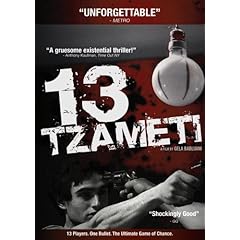 I was really looking forward to this week's movie for Spout Mavens, 13 Tzameti. I had seen a flurry of reviews(many positive), and the DVD case was packed to the gills with glowing blurbs from some very respectable sources. The director had won Best First Feature at the Venice Film Festival, and the film won the Grand Jury Prize at Sundance, so obviously people liked this film. The description on the back painted the film as a thoughtful, if gritty, meditation on poverty and the temptations of violence. And then I opened the DVD case and was greeted by an ad for a 'real time version' of the game of Russian Roulette that forms the center of this film, which asked 'do you dare play?' So now I didn't know what to think as I began the movie.
Luckily I find uncertainty to be the best state of mind for watching a new movie, and I found myself being drawn in as the movie unfolded. And I do mean that the movie unfolded, like a road map, piece by piece becoming larger and clearer and more informative. The film begins with Sebastian, a 22 year old immigrant in France, and his brother as they work as handymen on a seaside house. We get glimpses of the owners of the house; an affluent-seeming junkie and his girlfriend. There is no effort on the part of the director to explain this scenario, letting the actions speak for themselves, giving a much more realistic feel to this film than many others. How many people speak in exposition that clearly delineates what they are talking about? None, most people have their own shorthand when they get together with friends, and although it isn't really obtuse, it never includes the backstory and explanation that most movie dialogue has. And what eavesdropper is lucky enough to hear every conversation from the beginning, so everything is laid out for him? Again, none, and it is in this way that Sebastian makes the unfortunate choice of stealing an envelope from the seaside house shortly after his employers death. All he, or the audience, knows is that this envelope holds a train ticket to Paris and a pre-paid hotel room, and the promise of a big payout. This is so tempting to him not out of selfish greed(or, not entirely anyway), but out of a need to support his family, who share a tiny apartment. Had he been in a more typical movie, one where eavesdroppers get all the pertinent information, he probably would not have decided to go to Paris.
But, of course, he does go. There would be no film if he hadn't, and now the movie really begins to unfold. In Paris Sebastian receives a phone call with more instructions, which lead to even more instructions, which in turn leads to a secluded house in the middle of a dark, imposing forest, and a very dangerous game run by very dangerous men with very large gambling addictions. This first section of the film, with Sebastian moving from place to place with no idea what is going to happen at the next stop, sets up a good deal of tension. It's twisty and a maybe a little fun to figure out the rules and follow along, but there's a fatalistic dread eating at the edges. Once he makes that first, almost innocent blind step(although lets not fool ourselves, Sebastian is well aware that whatever he's going after is illegal), Sebastian is pulled along on a trip he has no control over, towards an unknown destination.
The tension builds towards that inevitable game in the forest, and although most reviews, and the case for this DVD, seem happy to give spoilers, the details of this game are revealed in a way so integral to the films effectiveness that I would advise you to skip over any part of a review that goes into too deep a description. The tension built in the first half of the film begins to pay off here, while ratcheting up the intensity at the same time. With every round of the game the tension builds, releases for a moment, and then builds again, reaching greater heights each time. Some of this may become a tad bit repetitive, and have a slight numbing effect, but the craftwork is still to be admired, as it unravels with an almost clockwork precision. Sebastian's reaction to this 'game' is at first shocked refusal, but he finds himself unable to leave, stuck by his own bad decisions. As the game continues, and the stakes are raised, he finds himself becoming emotionally numbed even as his internal horror rises. At the end, it's impossible for the viewer to tell if he's laughing or crying as he raises the gun.
So obviously I enjoyed this one. My main complaint with the film itself would be the ending, which seems a little too tidy. It robs the character, and the audience, of the opportunity to reflect and deal with the aftermath of the 'game'. I suppose it fits with the feel of the film, which is spare and concise to the point of feeling like a short film. An extra 15 minutes or so of reflection and aftermath would have made the ending feel a bit bloated. Still, it is a bit of an obvious ending, and a slight disappointment.
Now on to that online game. I went to the site advertised, but the game took a long time to load and then asked me to download a bunch of attachments, so I never went forward with it. But I did look around the site, which is far too tasteless for this film. You can look at the leaderboards to see who's killed the most and survived the most games, read discussion threads full of bloodthirsty trash-talk, or even look at the 'Best Shots', which is a list of famous suicides and Russian roulette losers. I found nothing to indicate whether the filmmakers were involved with this, or if it was a site put up as a marketing tool by clueless studio executives, but it shows no understanding of the film itself, and is as crass as can be. The marketing for this movie, even down to the DVD case, seems to be selling this film as an exploitation piece, capitalizing on the central figure of the infamous game. So maybe I'm the one who's clueless. Perhaps this is merely a bit of modern snuff torture porn, wrapped up in classy french clothes that has fooled me into thinking it's art. Whatever the outcome, it's an interesting ride, and an effective film that I may actually be buying one day, to see it without the screener warnings and maybe check out some of the special features. And that, actually, might be the highest recommendation I can give this film.
Subscribe to:
Posts (Atom)