Friday, June 05, 2015

Summer of Darkness: Stranger on the Third Floor

Stranger on the Third floor is a highly influential film, cited by many as the first true noir film, codifying many of the elements of the genre. Expressionistic lighting, low camera angles, flashbacks, a dream sequence, a wrong man desperate to clear his name. The movie looks great, and from the visually distorted world of German Expressionism. Stranger on the Third Floor has a lot of things going for it, and deserves to be seen and appreciated as the important film that it is. It also, sorry to say, was not really for me.

The film is fairly brief, just over an hour long, but the entire first half hour had me twiddling my thumbs and wondering what all of it's fans were seeing in it. Peter Lorre shows up and provides the film a dose of his special Peter Lorre creepiness, but for the most of the first 37 minutes we're following a couple cookie-cutter characters in not-entirely-realistic dialogue and actions. John McGuire plays reporter Mike Ward, who happens one night to become the only witness to a murder, and suddenly finds professional success with this scoop. His testimony puts a man(played by Elisha Cook Jr.) in prison, and Mike is happy enough to have done his civic duty and reap the rewards of it. His girlfriend, Jane(Margaret Tallichet) is not so cavalier about his part in sending a man to the electric chair, especially since what he witnessed is not entirely damning.

That's not bad, or free from drama, as story setups go. But I couldn't really get onto the film's wavelength. I just wasn't amused by Mike and Jane's chemistry, which I found lacking. The movie also didn't seem to fully engage in it's anti-death penalty argument. All of that changed, however, at about 37 minutes in, when Mike finds himself in his apartment worrying that his next door neighbor might have just been killed, and worrying about how he might be held responsible if he calls the police. There are a couple of flashbacks as his voiceover memories drift to times when he's explicitly described how he wanted to kill the neighbor, and they are hilariously on the nose. Like Family Guy cutaway gags only relevant to the plot. But then the drugs appear to kick in, as Mike experiences a fever dream nightmare that seems to be the entire point of the film.

The long and slanted shadows of film noir grow and become nightmarish reaching tendrils in this dream, which has him imagining his own arrest and sentencing for his neighbors death in something that would look right at home in a Terry Gilliam film. Particularly the courtroom daydreams of Johnny Depp in Fear and Loathing in Las Vegas. This extended sequence sends Mike on the run, but his much more sensible girlfriend persuades him to take what he knows to the police, when it appears the murder of his neighbor might be related to the murder he helped send a man to prison for. But his instincts prove to be correct, and he's quickly arrested for the murder himself, leading Jane to search for the killer(who we already have reason to believe is Peter Lorre).

From the dream sequence on Stranger on the Third Floor finds an energy and tension that had been entirely missing up to that point. Maybe it's just that I couldn't dig John McGuire as the lead, or maybe I just really enjoyed Peter Lorre's performance, crazy hillbilly teeth and all. Most likely a little from column A, a little from Column B. Lorre's performance as the quietly, unassumingly insane man is the second highlight of this film. He speaks in a small voice, and shows childlike compassion until he suddenly snaps into a blind rage, and he performs both poles excellently.

Stranger on the Third Floor ends with a ridiculous gag that had me rolling my eyes while also thinking it was a pretty fun choice. It's nicely anti-death penalty, but that subject was handled much more impactfully seven years later in Time Without Pity. In the end the film is a flimsy framework holding up some amazing objects. The elements of this film would be diluted, yes, but also employed to more conventionally pleasing uses in the decades to come.

Summer of Darkness: Journey Into Fear

Journey Into Fear bears the heavy fingerprints of Orson Welles, who cowrote, produced, acted in, and designed the film, but did not direct. Some reviewers will bring up the idea that Orson Welles may have ghost-directed this film, taking the reins from credited director Norman Foster. In fact, Welles' IMDb page lists him as an uncredited director on the project. I'm willing to take Orson at his word, though, when he says that everything was directed by his friend Norman. Apparently, the aspect he takes the most credit for is the pre-credits sequence involving the film's assassin gearing up while his phonograph skips.

Leaving aside the question of the film's authorship for the moment, Journey Into Fear is an unassuming, taut, incredibly entertaining spy film with noir elements. The type of film Hitchcock is famous for, though on a slightly smaller scale. There are no heartstopping chases through national monuments, no sustained sequences of suspense. The film is, outside of a few scenes, primarily a stagebound affair, taking place in a series of cramped hallways and quarters on a boat travelling Batumi. Joseph Cotten plays the requisite everyman-thrust-into-the-sinister-spotlight as an engineer for an American munitions company that nazis would like to see killed, not because he's important, but because his death would slow down the arming of Turkish naval vessels.

The films title refers to Cotten's personal journey from disbelieving prey to, in the finale, fed up predator, as Cotten at first runs from the nazis who have captured him, and then attempts to turn the tables and goes after the monstrous nazi assassin who has been dogging him the entire film. Journey Into Fear is narrated by Cotten, in the form of a letter he's written to his wife in case he is killed. This sets us up to assume a fatal end for our hero, which turns out to be a bit of misdirection. This movie isn't meant to be a downer. It isn't meant to inspire thoughts of the dark soul of man. It's meant, quite simply, to be an entertaining yarn, simply yet professionally told.

Summer of Darkness Extra Credit: Scarlet Street

For those who aren't aware yet, I'm taking part in TCM's Summer of Darkness, which is a programming event for June and July, coinciding with an online course on the history and techniques of film noir. It just started this week, which should explain to you why I've been posting so many reviews under the Summer of Darkness heading. As far as suggested movie viewings go, I'm going to be moving at my own pace, due to both the fact that I no longer subscribe to a cable provider, and I've seen several of the movies multiple times. Right now I'm jumping around the schedule quite a bit, rewatching a film or two, and tracking down whatever films on the list I can get my hands on. Throughout the months the course instructor has chosen a few public domain films not airing on TCM that are easy to find online. I plan on watching those, and as I find time, covering a couple of other films that aren't mentioned in the course. Consider these personal tangents I'm embarking on in order to spice things up a bit, or broaden my own personal appreciation of the subject. 

The first public domain film is Fritz Lang's film Scarlet Street, which is available on Hulu or Netflix or, due it's public domain status, on youtube(linked below). If you haven't seen it yet, I highly recommend watching it before reading below the link. I couldn't find a satisfying way to discuss this film without going into detail about the plot, and specifically the finale. So yes, spoilers lie ahead. I believe the film will still have an impact if you read this first, but I understand many people like the go in clean. I know I do. Also, if you somehow came here by mistake and don't feel interested in my ramblings, feel free to click along the trail, but still, watch this movie. 


Scarlet Street opens with a '25th anniversary of employment' party for the whimsically named Christopher Cross(Edward G. Robinson). The beginning passages set Cross up as the ultimate sap; he's been working the same unglamorous job as a cashier for 25 years, he's middle aged and all of his friends seem to be substantially older than he is, he lives with a wife who emasculates him at every turn, and he even wears a comically floppy apron as he does the dishes. The only brightspot in his life seems to be his painting, a hobby which he only allows himself to indulge in on Sundays, as he locks himself in his bathroom to paint still lifes away from the disapproving glare of his wife. He may harbor small daydreams of seeing his work in a gallery one day, but seems content to simply show them to the odd coworker.

That changes one night when he sees his boss climbing into a car with a beautiful younger woman, and his daydreams begin to drift towards romance, and away from his loveless marriage and pathetic routine. On his way home on that same night, Cross comes across a woman being beaten by a man we will later learn is her boyfriend. Cross successfully fends him off with his umbrella, and is immediately smitten with the girl, Katharine, played by Joan Bennett. Cross sees his opportunity, and jumps at it. He begins a courtship of the woman, playacting at the type of affair a wealthier, more confident man might have. He steals money(first from his wife, later from work) in order to rent Katharine an apartment where they can be alone together. He thinks it's love, she just wants a place to lounge around and entertain her hoodlum boyfriend.

But does he really think it's love? I'm not entirely convinced. Robinson never seems all that passionate in the role, which drew some unfavorable notices from critics of the day. But to me he seems to be going through what he imagines a midlife crisis should be. He seems to not really care about sex, which is good because Katharine withholds sex with a variety of flimsy excuses. Cross doesn't seem incredibly interested in Katharine as anything other than a symbol to grasp on to. An imagined ideal of a more lively, romantic, adventurous life. He continues to steal, to lie, to hide part of his life seemingly not out of real desire, but the almost mechanical hope that this will all eventually get to a point where he feels fulfilled. The larger irony here is that what we see of his life before meeting Katharine seems to imply a sense of satisfaction. He's well respected at work, gets along with his coworkers, and even seems satisfied to simply paint on lazy Sunday afternoons.

To say Cross never reaches a point of satisfaction would be a gross understatement. He begins storing his paintings at Katharine's apartment, and Katharine's boyfriend, assuming Cross to be a famous artist, attempts to sell some of them. He quickly learns that no one in the art world has ever heard of Christopher Cross, and hatches a plan to sign Katharine's name to all of the paintings and pass them off as hers. Katharine quickly becomes a success, and word, of course, reaches back to Cross. Instead of feeling anger, however, he's overjoyed. He doesn't care that the paintings have someone else's name on them. He's simply happy to learn that people enjoy his work, and so he helps her by continuing to provide paintings for her to sign off on.

The ending, when it comes, contains so many reversals of fortunes that I wasn't quite sure where it would land. I've got a lot of plot points to get across in this paragraph, so strap in. Cross learns that his wife's former husband, presumed dead, had actually faked his death to skip out on some gambling debts. He threatens to return to his wife unless Cross pays him, but it's clearly a hollow threat. The man doesn't really want to return, and Cross realizes this, plotting to get them back together anyway. Thus, having cleared up the problem of his being married, he feels emboldened to propose to Katharine, but she spits his proposal back in his face. She laughs at him, mocks him, reveals she was only stringing him along for his money. In the heat of the moment Cross stabs her to death with an icepick and flees the apartment. At work the next day, when his boss calls him into his office where two officers are waiting, Cross assumes he's being arrested for murder. But no, it turns out the thefts from his employer were discovered. His employer, respecting and pitying Cross, decides not to press charges, instead simply firing him. And finally, in a montage of Brechtian deus ex machina, Katharine's boyfriend is arrested, tried, sentenced, and executed for her murder. Christopher Cross seems to be in the clear.

But, as the film's coda shows, he's not. He's lost his job, his wife, his home, and even his painting, as he can't reveal to anyone that he was truly the artist behind the suddenly popular works. He tries to kill himself, but is rescued at the last moment. He tries to turn himself in to the police, but they don't believe him. At the end of the film, five years have passed and Cross is homeless, sleeping on park benches. He walks slowly past a gallery where one of his paintings has just sold for thousands of dollars, and continues on down the street. Eventually the crowd leaves him, fades from existence, and he's left alone, trudging slowly through the snow and slush.

I know I bring it up often in these reviews, but the film's treatment of women was a bit suspect. Or rather, it would have been egregious had the film not treated its male characters with the same amount of pitying contempt. All of the women are either nagging shrews or moneygrubbing, self hating whores. But the major male characters don't get off any better. Katharine's boyfriend is an abusive oily creep. Christopher Cross is a sympathetic figure in the early parts of this movie, but as the film goes on we see that his misfortunes are all only attributable to himself. I spent some time after viewing the movie contemplating what it was saying about crime and punishment. Who were the heroes? Who were the victims? The film had a preponderance of victims; no one had a happy end. They all fell prey to their own desire for things they thought they wanted at the expense of those things they needed.

Wednesday, June 03, 2015

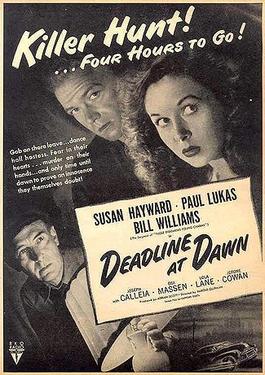
Summer of Darkness: Deadline at Dawn(1946)

I think the effects of watching so much film noir are becoming apparent. Not that I find my energy or enthusiasm flagging; quite the opposite. I've looked over my letterboxd grades for these films and found that I'm rating them all pretty much the same, and have been uniformly enthusiastic in my reactions. I'm not used to this. I like movies, and I think that, as critical as I generally am, I'm also more forgiving when it comes to final judgments. I try to find things to recommend more often than I try to find things to nitpick, even in the worst films. And yet this was bizarre. Unheard of, really. I was enthusiastically enjoying every movie I was watching. Something was wrong. I was becoming blind to the faults that must be there. And so, with some encouragement from my pal Rik, I decided to take a brief break from the shadowy world of film noir. Not really a break, more of a breather. I'd watch a film or two, non-noir, of questionable quality just to reset my critical receptors.

But before that break, I watched Deadline at Dawn, a surprisingly light hearted noir from 1946, about a newly enlisted sailor who takes the fall for a woman's murder, and tries to prove his innocence in time to catch the bus that will be taking him to basic training. We as the audience know immediately he is innocent, because we see the woman alive after he has already left her, and we have a more likely suspect in her ex-husband, to whom she owed a large sum of money. But the sailor was blackout drunk, and sobers up on the street with the dead woman's money in his pocket, so he can't be entirely sure he didn't kill her. Taking pity on the boy is a taxi dancer played by the radiant Susan Hayward, and a helpful immigrant cab driver played by Paul Lukas. Together they follow meager clues and try to find someone, anyone, who could have killed the woman.

Part of my problem with watching so many films in a row of this nature is that, although I enjoyed Deadline At Dawn quite a bit, I find myself with not much more to say about it outside of plot description. The mystery itself never feels very important, even when the murdered woman's brother, a gangster played by Joseph Calleia, comes into the plot with a touch of menace. The heroes fat never really seems in jeopardy, because even though this is a noir it never feels like that type of movie. This is a movie where very early on you realize there will be a happy ending. Maybe not as happy as you might think, because there is a touch of sadness in it, but this is a movie where the bad guys are punished and the good guys live happily ever after with the love of their lives, whom they just met a few hours ago.

The saving grace of this film is the chemistry between the two leads. Bill Williams is perfect for this part, playing a young kid who's lack of guile does not equate to a lack of intelligence. He comes off squeaky clean and genuine without seeming like an obnoxious caricature of early WWII American exceptionalism. Susan Hayward is believably aloof, and slowly warms to the kid through the course of the movie. She's smart, capable, and warmly witty. Together it's a winning combination, and helps to elevate what might otherwise have been forgettably mediocre.

Tuesday, June 02, 2015

Summer of Darkness: Murder, My Sweet(1944)


I've seen Murder, My Sweet three times now, and while I really enjoy it and find it an engaging and entertaining film, I've never truly understood it's labyrinthine plot. It's a movie that loves to keep the audience, and most of it's characters, in the dark, and reveals it's secrets piece by piece so that if you aren't paying attention it's easy to miss how they fit together. Or maybe I'm just dense, and get too focused on Dick Powell's wonderfully sardonic turn as Phillip Marlowe, and the amazing noir lighting, and that fantastic drugged up daydream in the middle of the movie. I am completely willing to admit that maybe I'm just not smart enough to have pieced everything together on the first, or second, viewings. So this time I took notes. I don't know if I've caught everything, and at least one relationship was unclear to me, but it mostly makes sense now.

That confusion could be a disadvantage in the film if the rest of Murder, My Sweet weren't so expertly constructed. In fact, the movie takes it's byzantine plot machinations, it's tenuous explanation of character motives and it's vague descriptions of unseen actions and turns it into a running theme. Marlowe himself is introduced in the very first scene wearing a blindfold(the result, we'll learn, of being temporarily blinded by a muzzle flash), while surrounded by surly men barking questions at him. From the very outset he's hampered in his grasp and understanding of his own environment. At every step of the way Marlowe is able to tell when he's being lied to, but isn't able to figure out why, or what the truth is, until the very end. At one point his ignorance is used in service of the discovery of a clue, when a cop inadvertently lets slip the name of a person of interest, and Marlowe takes his own ignorance of the man's identity as proof of his importance. "There are lots of people in this town, but I've never heard of Jules Amthor," is his reply. One of the very first things Mr. Amthor says upon meeting Marlowe is 'there are some things you don't understand,' which is basically the movie's mission statement.

There's a drug induced, extended hallucination midway through the movie, which is one of the best examples of it's kind. Marlowe is utterly helpless for this segment, chased through doorways to nowhere by a phantom doctor, where his vision(and ours) is obscured by spiderwebs, and all means of support dissolve before he can grasp them. At this point his two-fisted tough guy language turns into jumbled beat poetry, as he attempts to threaten people through a narcotic fog. The thing is, it still packs a punch, and only a fool would disregard the danger presented by a man who shouts the following, even without the gun he held in his face.

I had a nightmare! A lot of crazy things! I slept. I woke up and the room was full of smoke. I was a sick man. Instead of pink snakes I got smoke! Well, here I am. All cured. What were you saying? ...Speak up, Dr. Jekyll! I'm in a wild mood tonight. I wanna go dancing in the foam. I hear the banshees calling. I haven't shot a man in nearly a week.


What can be said for certain about the plot? The movie starts with a girl. Or rather, with a man looking for a girl. Mike Mazurki plays Moose Malone, recently out of prison and looking or his girlfriend who went missing during the 8 years he was away. Mazurki plays Moose as a dangerous, temperamental, but fundamentally childlike thug. He's violent, and angry, but is somehow lovably dimwitted, his naivety and mental simplicity making him come across as an underworld variation on Lennie from Of Mice and Men. I've always found great sympathy for his character in this film, because he may be murderous and he may be someone to avoid, but he's also entirely too trusting and full of a great depth of love for his lost girlfriend. Marlowe is the PI Moose finds in the yellow pages to track down his missing girl. Helen is the socialite housewife who hires Marlowe to track down a stolen piece of jewelry, or maybe she's being blackmailed by her psychiatrist, or maybe something even worse. Trying to parse through the plot details on an initial viewing is likely to lead to a headache, and it might be best to just let the film's punchy dialogue and shadow filled scenes wash over you. It should suffice to say, however, that no one in the film is exactly who they first claim to be, and the movie ends in a series of betrayals and reversals that stack up so quickly it's liable to induce whiplash.


Monday, June 01, 2015

Summer of Darkness: Raw Deal(1948)

Dennis O'Keefe plays Joe Sullivan, a convict serving time in the State Penitentiary for a crime he didn't commit, though he's willing to take the fall for his gangster friend, because to him there is still honor among thieves. Marsha Hunt plays Ann, a social worker who sat through Joe's trial and has visited him in jail, urging him to begin working on his parole and straighten himself out while in prison. Claire Trevor plays Pat, Joe's girlfriend who helps him break out of prison and plans to escape with him to South America. Raymond Burr, never slimier, plays Rick, the friend that Joe thinks is helping him flee the country, but is actually setting him up to be killed by the police so he'll never be able to testify against him. Things don't go the way Rick hopes and plans, however, and Joe, with the help of Pat, is able to outsmart and avoid every obstacle that keeps popping up. The plans never work out perfectly, but they show an amazing talent for improvisation while on the run from the law. Along the way, they kidnap social worker Ann and evade roadblocks by stealing a car, and having the theft victim arrested by the police when he chases after them.

Noir films frequently place the hero between two women of polar opposites, the Good Girl and the Femme Fatale. The femme fatale who is poison for our hero, but he just can't keep himself away, and the good girl, who only wants what's best for our hero but is usually ignored for the more exciting options on the other side of the tracks Rarely are those two diametric poles more pronounced than in Raw Deal, which posits the two female leads as two sides of Joe's conscience. An angel and demon on his shoulder, each trying to steer him down a different path. Superficially those labels would fit here, as Ann wants Joe to go straight and lead a steady life, and Pat wants Joe to flee the police and live a life of adventure with her. But below that surface, the labels begin to blur. Pat honestly loves Joe, and is merely trying to make him happy in their escape attempts, and Ann herself begins to sympathize more and more with Joe's position. By the end of the movie Ann will have gunned a man down and Pat will sacrifice her one shot at happiness in order to save Ann's life. And Joe? What happens to him? About what usually happens to the anti-heroes of films like this.

Raw Deal is as fatalist as noir films get. Each character in the film plots and schemes in their own way, and tries to grasp what they perceive as happiness. Several characters act in a manner counter to their immediate desires in order to achieve their greater goal of happiness, only to have those acts amount to, as the man said, a hill of beans. Joe desperately wants revenge when he discovers Rick has been trying to kill him, but at Pat's urging pushes that desire aside in order to go off and live with her. Ann wants Joe to turn himself in, and attempts to call the cops herself, but gives up later and decides to let Joe decide his own fate. Pat wants nothing more in the film(not money, not material goods, nothing) than to live and be loved by Joe, but she lets him run to Ann's rescue because she wants him to be happy. The only character in Raw Deal with unwavering conviction is the villain of the piece, Rick, who can't see how his own plans to secure happiness end up leading him towards despair.

Summer of Darkness: Woman on the Run(1950)

The woman in question is Eleanor Johnson(Ann Sheridan), husband of Frank Johnson(Ross Elliott), and while the title may imply this woman is running from something, she's actually running towards someone; her husband. Walking the dog one night, Frank witnesses a murder, and is shot at himself before the killer hops back into his car and races away. When the cops arrive, Frank learns that the victim was a witness in a federal case involving organized crime, and now he's stepped into that position, as his identification of the murderer will somehow still allow the prosecution to go forward. Not wanting to be put in the spotlight, and possibly become a murder victim himself, Frank seizes an opportunity to run for it and go into hiding.

To be honest I had a few problems with this opening. The look and staging of it was all great, but the logic felt a little forced, the characters a tad too dull and aggressive. After witnessing a murder and calling the cops, Frank responds to the officers questions about the killer's description with a confrontational 'say, what's the deal here?' The dialogue felt a bit too punchy, too self consciously 'noir.' Luckily, we don't have to wait too long for Ann Sheridan to appear, because the film takes a big turn for the better once she arrives.

As the cops question Eleanor about her runaway husband, they discover a few oddities. She has no pictures of him, knows nothing of his friends, if he has any, doesn't seem the least bit interested in his activities outside of the house, and is completely dumbfounded to learn he has a serious heart condition that he's been taking medication for(she had assumed the pills were vitamins). Clearly things have not been happy in their home for awhile, and Eleanor is as much convinced that Frank has gone into hiding to escape their marriage as to escape a gangland execution. But still she won't help the police, and makes her own attempts to track down her husband, with the help of a friendly reporter who offers payment for an interview before Frank disappears for good.

Woman on the Run is, like most film noir, an allegory, but unusually it's an allegory for marriage, and how people so close can become surly strangers without even noticing it. Eleanor's journey to find her husband before the police or assassins do becomes a journey into her husband's secret life, or at least a life that was secret to her. She discovers his medical condition, his friends, the stories he's never shared with her, and the fact that he is still very much in love with her. It's powerful stuff, undercut, however, by the fact that Eleanor does not get a similar treatment. We never get to see her point of view, the slights that she has experienced in the marriage. We see only that she's misunderstood her secretive but loving and devoted husband, and that places the onus of this once-failing relationship almost entirely on her shoulders.

Still, the film isn't intentionally misogynistic, and by placing a strong capable woman at the center of the film it's actually pretty progressive. It's unfair to judge this film by our modern standards, and should only be judged against the measure of it's own time. In that regard, this film is quite enjoyable. Take in everything I've said so far, and then add in some great San Francisco scene work, a story with a compelling forward momentum, and an honestly exciting, literal rollercoaster ride of an ending, and the resulting film emerges as a hidden gem of the postwar noir movement.